Caulerpa taxifolia: The Biology and Impact of the Invasive 'Killer Alga'
Caulerpa taxifolia is a species of green seaweed that has gained international notoriety as a highly successful invasive species. While native to the tropical waters of the Pacific Ocean, the Indian Ocean, and the Caribbean Sea, certain strains have spread far beyond their natural habitats, causing significant ecological shifts in the Mediterranean Sea, Australia, and the United States.
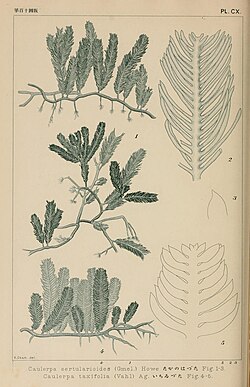
The species name taxifolia refers to its unique appearance; its leaf-like fronds closely resemble those of the yew tree (Taxus). Beyond its aesthetic qualities, this alga is biologically remarkable, holding the distinction of being identified as the largest known single-celled organism.
Key Facts
- Classification: A green seaweed (Chlorophyta) within the genus Caulerpa.
- Biological Marvel: It is a single cell with many nuclei, making it one of the largest single-celled organisms known.
- Invasive Status: Listed by the IUCN as one of the 100 World's Worst Invasive Alien Species.
- Toxicity: Produces toxins like caulerpenyne, which can affect marine organisms.
- Resilience: Can survive out of water for up to 10 days in moist conditions and can reproduce from fragments as small as 1 cm.
Biological Characteristics and Toxicity
Physically, C. taxifolia is light green in color. It grows via stolons—stems that creep along the sea floor—from which upright, sparsely-branched fronds rise to heights of approximately 20–60 cm (8–24 in). Unlike many other organisms, it consists of a single cell containing multiple nuclei.
Chemical Defenses
Members of the Caulerpa genus synthesize a mixture of toxins known as caulerpicin, which is believed to give the plant a peppery taste. Specifically, C. taxifolia produces caulerpenyne. Research has shown that extracts from this alga can negatively affect P-glycoprotein-ATPase in the sea sponge G. cydonium.
The Aquarium Connection and Global Spread
The global spread of C. taxifolia is closely linked to the aquarium trade. Since the early 1970s, the species has been cultivated in Western Europe for its aesthetic appeal and its ability to control unwanted plant growth in tanks. A specific cold-resistant clone was observed at the Wilhelma Zoo in Stuttgart and was further developed through exposure to ultraviolet light and chemicals. This strain was subsequently distributed to various aquaria, including the Oceanographic Museum of Monaco.
While the aquarium strain is morphologically identical to wild populations, studies have noted differences in reproductive behavior. For instance, a 2008 study in Australia found a population near Caloundra that exhibited markedly reduced sexual reproduction, consisting primarily of male plants during certain episodes.
Ecological Impact and Regional Presence
The impact of C. taxifolia varies significantly depending on the region and the local ecosystem.
The Mediterranean Sea
The presence of the alga in the Mediterranean was first reported in 1984 near Monaco. Although marine biologist Alexandre Meinesz attempted to warn authorities in 1989, the spread continued, and by 1999, scientists concluded that elimination was no longer possible. While some studies suggested that fish diversity and biomass in Caulerpa meadows remained equal to or greater than in seagrass beds, the alga's ability to thrive in polluted waters makes it a formidable invader.
Australia and California
In Australia, research has indicated that C. taxifolia can negatively affect native bivalve molluscs and that its detritus (decaying organic matter) can reduce species richness and abundance in soft sediment communities. In California, the species was discovered near San Diego in 2000. Following intensive efforts using chlorine bleach, the strain was declared eradicated from the Agua Hedionda Lagoon in 2006. However, strict laws remain in place to prevent its reintroduction.
| Region | Status/Impact | Key Findings |
|---|---|---|
| Mediterranean | Established Invasive | Likely introduced via aquarium; difficult to eliminate. |
| Australia | Invasive | Impacts native bivalves and sediment species richness. |
| California | Eradicated (Local) | Eradicated in Agua Hedionda Lagoon; strict possession laws apply. |
| Native Range | Natural Habitat | Tropical Pacific, Indian, and Caribbean waters. |
Control and Management
Managing C. taxifolia is challenging due to its rapid growth and ability to regenerate from tiny fragments. Known control methods include:
- Mechanical removal: Physically extracting the algae from the sea floor.
- Chemical treatment: Using chlorine or salt to kill the plant.
- Biological control: Researchers investigated the sea slug Elysia subornata as a natural predator, but found it unsuitable for the Mediterranean due to cold winter temperatures and low population density.
Additionally, the alga can pose practical problems for humans by becoming entangled in boat propellers and fishing gear.
Frequently Asked Questions
Is Caulerpa taxifolia toxic to humans?
The source material focuses on the toxin caulerpenyne and its effects on marine organisms like sea sponges; it does not specify toxicity levels for humans.
How does the alga spread so quickly?
The species is highly resilient; even a fragment as small as 1 cm can produce a viable new plant, and it can survive out of water for up to 10 days if kept moist.
Can it grow in polluted water?
Yes, C. taxifolia is noted for its ability to thrive in heavily polluted waters, which may have contributed to its spread in the Mediterranean.
What makes it a "single-celled" organism?
Despite its large size and complex structure, it consists of a single cell that contains many nuclei, a condition known as being a coenocyte.
Is it illegal to own this seaweed?
In certain regions, such as California, it is illegal to possess, sell, transport, or release Caulerpa taxifolia due to its status as a noxious weed.