Catholicity and Denominational Interpretations of the Universal Church
In the context of Christian theology, the term catholic (derived from the Greek word for "universal") is often used in two distinct ways: as a proper noun referring to the Roman Catholic Church, and as a descriptive term referring to the universal body of all Christian believers. This distinction leads to a wide variety of interpretations across different denominations, many of which base their claims to "catholicity" on apostolic succession—the belief that their church leadership is derived from an unbroken line of ordinations tracing back to the original Apostles.
Generally, Christian groups can be categorized into five groups based on their view of this succession: those in full communion with the Bishop of Rome; those claiming unbroken succession from the early church independently; those who see themselves as a constituent part of the universal church through succession; those who claim spiritual rather than institutional descent; and those who have restored succession after a historical break.
Key Facts
- The Catholic Church consists of the Latin Church and 23 Eastern Catholic Churches, all in communion with the Holy See.
- Apostolic Succession is the primary theological mechanism used by many denominations to claim legitimacy and catholicity.
- Eastern and Oriental Orthodox churches claim to be the original "One, Holy, Catholic, and Apostolic Church."
- Anglicanism describes itself as both "Catholic and Reformed," blending episcopal governance with Reformation theology.
- Reformed traditions often interpret "catholic" as an invisible, universal union of the elect under Christ.
The Catholic Church and the Holy See
The Catholic Church, frequently called the Roman Catholic Church, is the world's largest Christian denomination, comprising approximately 1.27 billion members. It defines Catholicism as being in full communion with the Bishop of Rome. This body is not a single monolithic entity but a communion of 24 particular churches (or rites), including the Latin Church and 23 Eastern Catholic Churches. While these particular churches are of equal dignity, they all acknowledge the primacy of jurisdiction of the Pope.
The Church's doctrine of infallibility is rooted in the belief that the authority granted by Jesus to Peter has been passed to his successors. Consequently, the Catholic Church recognizes the valid episcopates of the Eastern Orthodox Church but views Protestant denominations as "ecclesial communities" rather than churches in the proper sense, as it believes they lack valid episcopal orders capable of celebrating the Eucharist.
Some scholars, such as Richard McBrien, argue that "Catholic" and "Roman Catholic" are not synonymous. He suggests that "Roman" specifically refers to the diocese of Rome, whereas "Catholic" encompasses the wider communion, including non-Latin traditions like the Coptic, Armenian, and Maronite churches.
Orthodox Interpretations of Catholicity
Eastern Orthodox Church
The Eastern Orthodox Church asserts that it is the true One, Holy, Catholic, and Apostolic Church. It adheres to the model of the pentarchy (the five ancient patriarchal sees) and views the Roman See as schismatic due to theological innovations, such as the Filioque clause, introduced after the Great Schism of 1054.
Oriental Orthodoxy and the Church of the East
Similarly, Oriental Orthodox churches (including the Coptic, Syriac, and Armenian churches) maintain that their communion constitutes the universal church based on ancient traditions of apostolicity. The Assyrian Church of the East and the Ancient Church of the East also use the term "catholic" in their official names to denote traditional catholicity, though they are not in communion with the Roman Catholic Church.
Protestant Perspectives on the Universal Church
Lutheranism
Lutheranism, as outlined in the Augsburg Confession (1530), teaches that the faith confessed by Martin Luther is the true catholic faith. Some Lutheran bodies, such as the Church of Sweden, maintained an unbroken line of apostolic succession after the Reformation. In the 20th century, the High Church movement further emphasized "Evangelical Catholicity" to restore these traditions.
Anglicanism
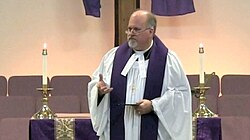
Anglicanism is often described as "Catholic and Reformed." This tradition maintains a historical episcopate and episcopal governance. Within Anglicanism, the Anglo-Catholic movement (influenced by the 19th-century Oxford Movement) emphasizes Catholic elements such as the Seven Sacraments, Marian devotion, and the use of incense and bells during the Eucharist (or Mass).
Methodism and Reformed Traditions
Methodists often view themselves as standing centrally within the Catholic tradition, with some theologians arguing that John Wesley's adherence to the Eastern Fathers makes Methodism deeply catholic. In contrast, Reformed Christianity (including Presbyterians and Baptists) typically views the "catholic church" as an invisible church consisting of the total number of the elect gathered under Christ, rather than a visible institutional hierarchy.
Independent Catholicism
Various groups, such as the Old Catholics and the Polish National Catholic Church, identify as "Catholic" but reject the absolute authority of the Pope. They often view the Bishop of Rome as primus inter pares (first among equals) and advocate for conciliarism—the idea that a church council holds supreme authority over the pope.
| Group | Basis of Catholicity | Relationship to Rome |
|---|---|---|
| Roman Catholic | Full communion with the Pope | Central Authority |
| Eastern Orthodox | Unbroken succession / Pentarchy | Schismatic / Independent |
| Anglican | "Catholic and Reformed" / Episcopacy | Independent / Ecumenical |
| Reformed | Invisible union of the elect | Independent |
| Independent Catholic | Theology/Practice without Papal authority | Reject Papal Primacy |
Frequently Asked Questions
What is the difference between "Catholic" and "catholic"?
When capitalized, "Catholic" usually refers to the Roman Catholic Church. When written with a lower-case "c," it often refers to the universal or worldwide body of Christian believers, as mentioned in the Nicene Creed.
What is apostolic succession?
Apostolic succession is the belief that the spiritual authority and office of the bishops have been passed down in an unbroken chain of ordinations from the original twelve Apostles to modern-day clergy.
Do all Catholics follow the Latin Rite?
No. The Catholic Church includes the Latin Church and 23 Eastern Catholic Churches. Many of these Eastern churches use the Byzantine Rite or other non-Latin traditions while remaining in full communion with the Pope.
How do Reformed churches view the "catholic church"?
Reformed traditions generally view the catholic church as an "invisible" entity, meaning it is the spiritual collection of all true believers across time and space, rather than a single visible organization.
Why do some Lutheran churches claim to be catholic?
Some Lutheran churches believe their confessions are a return to the true, original faith of the early church and, in some cases, have maintained the historical line of apostolic succession through their bishops.