Cassava: The Resilient Root Crop Powering Global Food Security
Cassava (Manihot esculenta), also known as yuca or manioc, is a woody shrub belonging to the Euphorbiaceae family. Renowned for its ability to thrive in poor soils and withstand drought, this perennial crop serves as a primary source of carbohydrates for millions of people across Africa, Asia, and Latin America. Its storage roots are prized for their high starch content, making it a cornerstone of global food security.
From its origins in the Americas to its current status as a global staple, cassava has evolved into a versatile resource used for human consumption, animal feed, and industrial applications.
Key Facts
- Scientific Name: Manihot esculenta Crantz.
- Primary Use: High-starch storage roots used for food, flour, and biofuel.
- Top Producer: Nigeria is the world's leading producer of cassava.
- Toxicity: Contains cyanogenic glycosides (such as linamarin) that require processing to remove.
- Nutritional Profile: Rich in carbohydrates and Vitamin C, but low in protein and fat.
Production and Global Distribution
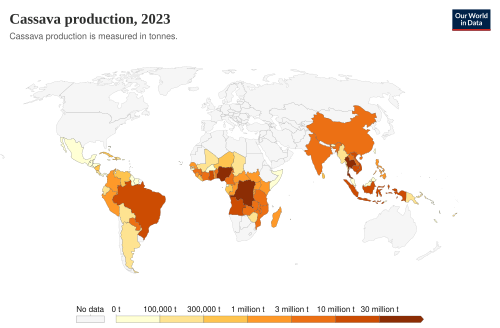
Cassava is cultivated extensively in tropical and subtropical regions. Its resilience makes it an ideal crop for areas where other staples might fail. In 2022, global production reached approximately 330 million tonnes.
| Country | Production (Millions of Tonnes) |
|---|---|
| Nigeria | 60.8 |
| Democratic Republic of the Congo | 48.8 |
| Thailand | 34.1 |
| Ghana | 25.6 |
| Cambodia | 17.7 |
| Brazil | 17.6 |
| World Total | 330 |
The crop's distribution is a result of the Columbian Exchange, which spread the plant from its native South American home to other tropical regions worldwide.
Cultivation, Pests, and Diseases
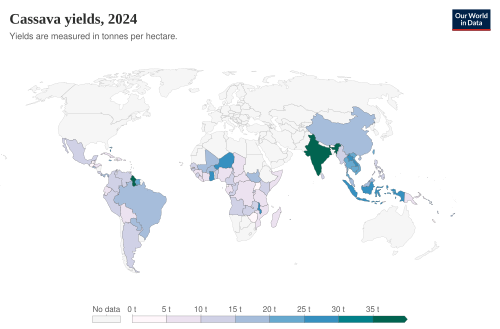
Cassava is grown from stakes (stem cuttings) and is harvested for its tuberous roots. While hardy, the plant is susceptible to various biological threats that can significantly impact yields.
Biological Threats
- Viruses: Cassava Mosaic Disease and Brown Streak Disease are major concerns, particularly in Africa.
- Bacteria: Bacterial blight can affect plant health and productivity.
- Fungi and Oomycetes: Various fungal infections, including rust (Uromyces manihotis) and super-elongation disease, can damage the crop.
- Insects and Nematodes: Grasshoppers often act as secondary pests, while root-knot nematodes (Meloidogyne spp.) can hinder root formation.
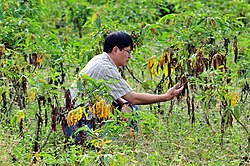
![Grasshoppers, here on cassava in Nigeria, are secondary pests of cassava.[42]](/images/8a/bb/8abbd6ee79ab72c122bb91505205aaefda8c95b6bd6d23dc275eaf99c8f2f04b.jpg)
Toxicity and Safe Preparation
A critical aspect of cassava consumption is the management of its natural toxicity. Raw cassava contains cyanogenic glycosides, most notably linamarin. When these compounds are broken down, they release hydrogen cyanide, which is poisonous to humans and animals.
To make cassava safe for consumption, "bitter" varieties must undergo rigorous processing. This typically involves peeling, grating, soaking in water, and boiling or fermenting to reduce the cyanide content. Tools like the sebucan or tipiti (traditional filters) are often used to squeeze out the toxic liquids.
![Raw cassava is dangerous to eat as it contains linamarin (illustrated) and other cyanogenic glycosides, which are broken down to release poisonous hydrogen cyanide.[76]](/images/fe/0e/fe0e15dca6611a3f24f00abe98ee49eadb300f22f7c7d2cbbc7ebf2efb417a15.webp)
Nutritional Value and Versatile Uses
Cassava is primarily an energy-dense food. While it provides significant calories, it is relatively low in protein and fats, often requiring supplementation with other food sources for a balanced diet.
Nutritional Profile (per 100g)
- Energy: 160 kcal (670 kJ)
- Carbohydrates: 38.1 g
- Protein: 1.4 g
- Fat: 0.3 g
- Vitamin C: 23% of Daily Value (DV)
- Potassium: 9% of DV
Diverse Applications
Beyond direct food consumption (such as noodles, bread, and cakes), cassava is used in several industrial ways:
- Starch Production: Processed into tapioca or laundry starch.
- Animal Feed: Dried roots are used to feed pigs and chickens.
- Biofuel: The high starch content makes it a viable feedstock for ethanol production.
Frequently Asked Questions
Is raw cassava poisonous?
Yes, raw cassava contains cyanogenic glycosides like linamarin, which release poisonous hydrogen cyanide when broken down. It must be properly processed—peeled, soaked, and cooked—to be safe for consumption.
What is the difference between sweet and bitter cassava?
Bitter cassava contains higher concentrations of cyanogenic glycosides and requires extensive processing (soaking and fermenting), whereas sweet cassava has lower levels of these toxins and can often be prepared more simply.
Which country produces the most cassava?
Nigeria is the world's leading producer, contributing 60.8 million tonnes as of 2022.
Can cassava be used for more than just food?
Yes, cassava is widely used to produce industrial starch for laundry and textiles, animal feed for livestock, and as a raw material for biofuel production.
What are the main diseases affecting cassava?
The most significant threats include the Cassava Mosaic Virus, Brown Streak Disease, bacterial blight, and various fungal infections like rust and super-elongation disease.