Cartagena de Indias: The Fortified Jewel of Colombia's Caribbean Coast
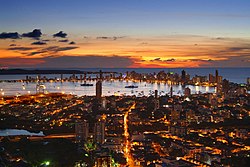
Perched on the Caribbean coast of Colombia, Cartagena de Indias is a city where colonial grandeur meets tropical vibrancy. Known for its imposing fortifications and colorful streets, this port city serves as a living museum of the Spanish Empire's influence in the New World. From its origins as a series of indigenous settlements to its status as a UNESCO World Heritage Site, Cartagena remains one of South America's most significant cultural and economic hubs.
The city's unique identity is defined by its relationship with the sea, acting as a gateway for trade, a target for pirates, and today, a premier destination for global travelers.
Key Facts
![Painting of 1893 of Plaza de los Coches.[58]](/images/c7/5d/c75d1e78e1b1ea86bfdcede000522ff8a07c113a9b80e8c683596be8f8fffbcd.jpg)
- Founded: June 1, 1533, by Pedro de Heredia.
- UNESCO Status: Designated as a World Heritage Site in 1984.
- Population: Approximately 914,552 in the district (2020).
- Key Landmark: The historic center is protected by 11 kilometers of defensive walls.
- Economy: Heavily driven by tourism and a diverse array of industrial ports.
- Climate: Tropical, with an average temperature of 30°C (86°F).
A Journey Through History
Pre-Columbian Roots
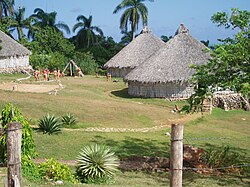
Long before the arrival of Europeans, the Bay of Cartagena was inhabited by the Mocana villages of the Carib people. These settlements were strategically spread across the region, including Kalamarí in the present-day downtown area, Carex on Tierrabomba island, and Bahaire on what was then the peninsula of Isla Barú. Other notable tribes included the Cospique on the eastern coast and the Yurbaco in the suburban Turbaco area.
The Colonial and Viceregal Eras
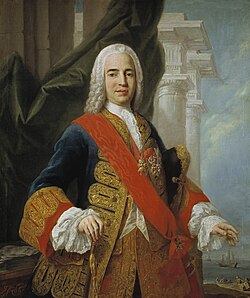
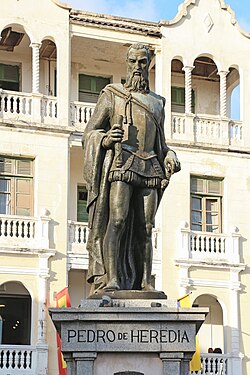
The city was officially founded on June 1, 1533, by Pedro de Heredia and named after Cartagena, Spain. Due to its strategic location, it became a vital port for the Spanish Crown, but this wealth attracted constant threats from pirates and rival empires.
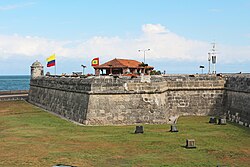
To counter these threats, the Spanish constructed a massive system of defenses between 1614 and 1796. These included 11 kilometers of walls and various coastal fortifications, earning the city a reputation for being impregnable.
Military Conflicts and Resilience
Cartagena's history is marked by dramatic sieges. In 1697, French privateers led by Bernard Desjean, Baron de Pointis, successfully raided the city, looting roughly 2,000,000 livres. However, the city saw a legendary victory in 1741 during the Siege of Cartagena de Indias. A Spanish force of 2,800 men, commanded by Blas de Lezo, defeated a British fleet of 23,600 soldiers under Admiral Edward Vernon. This victory was a turning point in the War of Jenkins' Ear, ensuring Spanish economic dominance in the Caribbean until the Seven Years' War.

![Siege of Cartagena de Indias of 1741, where Spanish Empire forces of 2,800 men, commanded by Blas de Lezo, defeated the British fleet and armies of 23,600 soldiers under Admiral Edward Vernon. The failed siege was decisive for the victory of the War of Jenkins' Ear, and allowed the Spanish Crown to maintain economic dominance in the Caribbean until the Seven Years' War.[39]](/images/16/f8/16f8f065ecfd09a1b2791f8fbb9027fa3e11e876102bd861338d54373e436b03.jpg)
Architectural and Cultural Landmarks
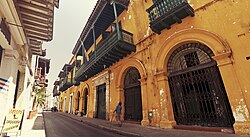
The Walled City and Religious Sites
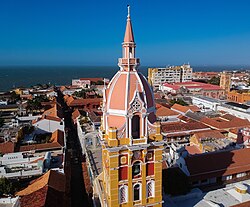
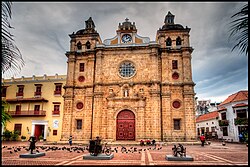
The historic center is a treasure trove of Baroque and colonial architecture. Notable structures include the Cathedral of Santa Catalina de Alejandría (built 1577–1612) and the Convento de Santo Domingo (built 1565–1630), the city's oldest church.
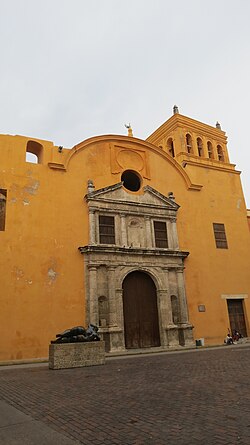
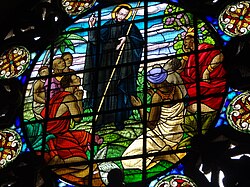
The city also honors Saint Peter Claver, a Spanish Jesuit priest who dedicated his life to the dignity of enslaved Africans. His legacy is preserved in the Iglesia de San Pedro Claver and the dedicated Sanctuary of Saint Peter Claver.
Fortifications and Civic Spaces
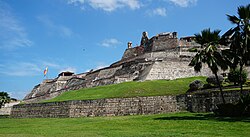
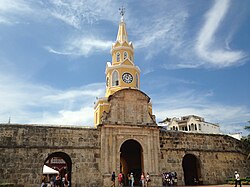
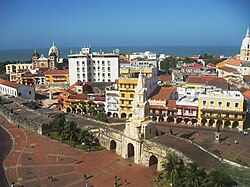
Beyond the walls lies the Castle of San Felipe de Barajas, one of the most formidable Spanish forts in the Americas. Within the city, the Puerta del Reloj (Clock Tower), built between 1704 and 1738, stands as a masterpiece of the Hispanic American School of Fortification.
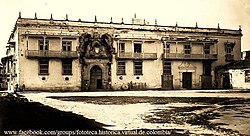
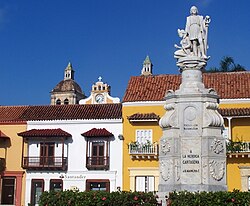
The city's social history is further reflected in the Palace of the Inquisition and the colonial charm of the Plaza de los Coches and Plaza de la Aduana.
Geography, Climate, and Demographics
Urban Layout and Neighborhoods
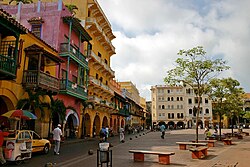
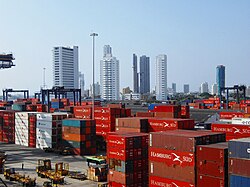
Cartagena is divided into several distinct areas. The Downtown and San Diego districts preserve the colonial atmosphere, while Getsemaní is known for its cultural vibrancy. In contrast, Bocagrande represents the modern face of the city with its high-rise skyline.
Climate and Environment
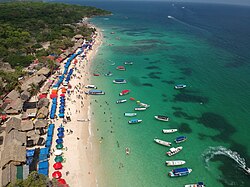
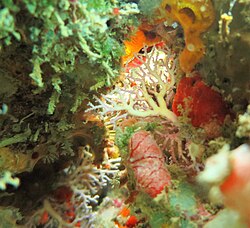
The city experiences a hot, humid tropical climate. While the first few months of the year are relatively dry, precipitation peaks between September and November. The surrounding environment includes the beautiful Playa Blanca on Isla Barú and the endangered Varadero Coral Reef in Cartagena Bay.
Population and Ethnicity
As of the 2005 census, the city's ethnic composition is diverse, reflecting its history as a port of the slave trade and colonial migration. The population consists of 63.2% Whites and Mestizos, 36.1% Black, mulatto, or Afro-descendant, and smaller percentages of Palenquero, Indigenous, ROM, and Raizal peoples.
Economy and Infrastructure
Tourism is a primary economic driver, but Cartagena is also a critical industrial hub. The city hosts numerous specialized ports, including the Container Terminal of Cartagena and private terminals for companies like REFICAR, SABMiller, and Dow Chemical.
Education is anchored by the University of Cartagena, which has occupied the 16th-century Convent of San Agustín since 1828.
![The Convent of San Agustín at background, convent built in 16th-century, and since 1828 is occupied by the University of Cartagena. Currently, of the original structure of this convent remains only the cloister, the arches and the supporting walls. The tower is of Italian Revival style and as the large interior garden and courtyard.[citation needed]](/images/c7/c4/c7c4dab4ce4e26b515d0f6e6da429943b0df4a253aa426ce6f15b24ee7a3b1ff.jpg)
Summary of City Profile
| Category | Details |
|---|---|
| Foundation | June 1, 1533 |
| Founder | Pedro de Heredia |
| UNESCO Designation | 1984 (Cultural) |
| District Area | 83.2 km² |
| GDP (PPP 2023) | $17.1 billion |
| Average Temp | 30°C (86°F) |
Frequently Asked Questions
Who founded Cartagena de Indias?
The city was founded on June 1, 1533, by the Spanish explorer Pedro de Heredia.
Why is Cartagena known as an "impregnable" city?
It earned this reputation due to its extensive defensive system, including 11 kilometers of walls and strategic fortifications like the Castle of San Felipe de Barajas, which protected it from pirate attacks and foreign invasions.
What is the significance of the 1741 siege?
In 1741, a small Spanish force led by Blas de Lezo defeated a much larger British army and fleet. This victory was decisive in the War of Jenkins' Ear and allowed Spain to maintain economic control of the Caribbean for several more decades.
Which UNESCO site is located here?
The "Port, Fortresses and Group of Monuments, Cartagena" was designated as a UNESCO World Heritage Site in 1984 based on its cultural and architectural significance.
What are the main neighborhoods of Cartagena?
The city is composed of the historic Downtown and San Diego areas, the cultural neighborhood of Getsemaní, and the modern high-rise district of Bocagrande.