The Vital Role of Carrion in the Natural World
In the cycle of life, death is not merely an end, but a transition. When an animal dies, its remains become carrion—the decaying flesh of dead animals. While the term often evokes images of decay and unpleasant odors, carrion is a fundamental component of Earth's ecosystems. It serves as a critical energy source that fuels a vast network of specialized organisms, helping to recycle essential nutrients like nitrogen and carbon back into the environment.
Carrion can originate from various sources, including natural causes like disease or malnutrition, predation, or human-related incidents such as livestock loss and vehicle collisions. From the smallest microbes to the largest predators, a diverse array of life forms relies on these remains to survive.
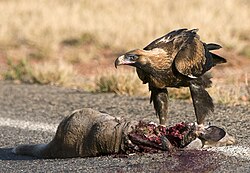
Key Facts
- Necrophagy is the scientific term for the act of eating carrion.
- Carrion feeders play a vital role in nutrient recycling within ecosystems.
- Decaying flesh produces cadaverine and putrescine, which cause a distinct foul odor.
- Certain plants and fungi, known as carrion flowers, mimic the scent of decay to attract pollinators.
- Humans are highly sensitive to botulinum toxin, which can be found in certain types of carrion.
The Science of Decay and Scavenging
The process of decomposition begins the moment an animal dies. As the body breaks down, it attracts insects and encourages the growth of bacteria. This biological activity produces specific chemical compounds, namely cadaverine and putrescine, which emit the characteristic foul odor associated with rotting meat.
Animals that consume carrion are known as necrophages or carrion feeders. While the term scavenger is frequently used to describe these animals, it is a broader classification that also includes organisms that consume refuse or dead plant material.
The Ecosystem of Decomposers
Carrion supports a complex food web. Invertebrates, such as blow-fly maggots, flesh-fly maggots, and various beetles, are often the first to arrive. These organisms, alongside microbial decomposers, work to break down organic matter, ensuring that carbon and nitrogen are returned to the soil.
![Duck carrion (e.g. Anas crecca carrion) can harbor Clostridium botulinum and Pasteurella multocida.[17]](/images/1b/7e/1b7ed93f9572ac8a52e715ebde6c1c67ef788cc95b4506d323e40b38614ac566.jpg)
Who Eats Carrion?
The consumers of carrion span almost every biological class, from microscopic bacteria to massive mammals.
Invertebrate Consumers
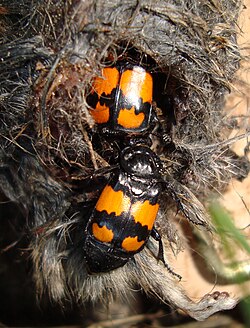
Hundreds of invertebrate species rely on carrion. In terrestrial environments, this includes certain ant species (such as red imported fire ants), "vulture bees" (*Trigona crassipes*), and various beetles like the burying beetle (*Nicrophorus vespilloides*). Flies, including bone skippers and blow flies, also play a major role in the decomposition process.
Vertebrate Consumers
Vertebrates occupy various niches in the scavenging community:
- Birds: Vultures (both New and Old World), red-tailed hawks, and carrion crows.
- Mammals: Spotted hyenas, coyotes, Tasmanian devils, Virginia opossums, and wild boars.
- Reptiles and Amphibians: Komododo dragons, brown tree snakes, and even certain larvae like the midwife toad.
- Fish: Black hagfish and abyssal grenadiers.
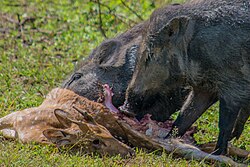
While many animals eat carrion opportunistically—meaning they eat it when available—only a few species, such as the various types of vultures, rely on it as their primary means of survival.
Health Risks and Disease Transmission
While scavenging is a natural process, carrion can be a reservoir for dangerous pathogens. Contact with decaying remains can transmit various infectious agents to other animals and humans.
Pathogens Found in Carrion
Carrion may harbor a variety of biological threats, including:
- Viruses: Such as rabies and West Nile virus.
- Bacteria: Including Bacillus anthracis (anthrax), Listeria monocytogenes, and Yersinia pestis (plague).
- Bacterial Toxins: Most notably the botulinum toxin produced by Clostridium botulinum.
- Helminths: Parasitic worms such as Trichinella species.
| Group | Examples | Primary Role |
|---|---|---|
| Invertebrates | Burying beetles, blow flies, vulture bees | Rapid decomposition and nutrient breakdown |
| Birds | Cinereous vultures, carrion crows | Specialized scavenging and carcass cleaning |
| Mammals | Hyenas, wild boars, coyotes | Opportunistic scavenging and omnivory |
| Fungi/Plants | Stinkhorn mushrooms, carrion flowers | Scent mimicry to attract insects |
Human Interaction with Carrion
Throughout history, humans have interacted with carrion in various ways. While modern humans generally avoid it due to the risk of disease, documented instances show that people have consumed carcasses from predator kills, beached marine mammals, or dead livestock.
Humans are particularly vulnerable to botulism, a severe illness caused by the botulinum toxin. Unlike many scavengers, the human body is extremely sensitive to this toxin. Consequently, some hunter-gatherer communities that utilize carrion have developed precautionary traditions, such as prioritizing quick access to a carcass, disemboweling the animal, and thoroughly cooking or sun-drying the meat.
Cultural and Literary Perspectives
The concept of carrion appears frequently in human culture:
- Religious Law: In Islam, certain types of animals killed by violence or predation are considered carrion and are forbidden. Similarly, the laws of Ulla in the Talmud prohibit human consumption of carrion.
- Literature: Authors like William Shakespeare and Daniel Defoe have used the term "carrion" to evoke themes of decay, filth, or unusable food.
Nature's Mimics: Carrion Flowers and Fungi
Not all organisms eat carrion; some simply pretend to. Certain plants, known as carrion flowers, and fungi, such as stinkhorn mushrooms, have evolved to emit scents that mimic decomposing flesh. This evolutionary strategy attracts specific insects that assist in the plant or fungus's reproduction through pollination or spore dispersal.
Frequently Asked Questions
What is the difference between a scavenger and a necrophage?
A necrophage is an organism that specifically eats dead animal flesh. A scavenger is a broader term that includes animals eating carrion, but also encompasses those that consume refuse or dead plant matter.
Why does rotting meat smell so bad?
The foul odor is caused by the presence of bacteria and the release of specific chemical compounds called cadaverine and putrescine during the decomposition process.
Can eating carrion make humans sick?
Yes. Carrion can harbor many dangerous pathogens, including viruses, bacteria, and toxins. Humans are especially susceptible to botulism, which can be found in carcasses colonized by Clostridium botulinum.
Do all animals that eat carrion rely on it to survive?
No. Most animals that eat carrion, such as wild boars or hyenas, do so opportunistically. Only a few specialized groups, such as New World and Old World vultures, are known to rely on carrion as their primary source of survival.
How do plants use the scent of carrion?
Some plants, called carrion flowers, evolve to smell like decaying meat to attract insects. These insects then aid in the plant's reproduction by acting as pollinators.