Carrion Flowers: The Fascinating World of Mimetic Plants
In the natural world, beauty is often associated with sweet fragrances and vibrant colors. However, a unique group of plants known as carrion flowers—also referred to as "stinking flowers"—takes a completely different approach to survival. Instead of attracting bees or butterflies with nectar, these plants use mimesis, a biological strategy where they mimic the appearance and scent of a decaying corpse to attract scavengers.
By emitting odors reminiscent of rotting flesh, these plants target specific pollinators, primarily scavenging flies and beetles. To complete the illusion, many carrion flowers feature deep red, purple, or brown coloration, specialized hair-like structures called setae, and complex, orifice-like architectures that can even temporarily trap insects to ensure successful pollen transfer.
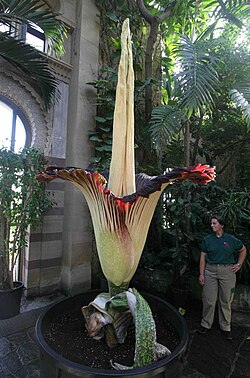
Key Facts
- Primary Strategy: Mimicry of decaying organic matter through scent and color.
- Common Pollinators: Blowflies, house flies, flesh flies, and various beetles.
- Chemical Components: Scents are produced by compounds like dimethyl sulfides, amines (putrescine and cadaverine), and trimethylamine.
- Visual Cues: Often display dull, pale, or translucent patches to attract fly species.
Notable Genera of Carrion Flowers
Amorphophallus: The Giants of Stink
Many species within the genus Amorphophallus (family Araceae) are famous for their odor. The most iconic is the Titan arum (Amorphophallus titanum), which boasts the world's largest unbranched inflorescence. An inflorescence is a complex flower structure; in the Titan arum, it consists of a central stalk called a spadix—containing tiny male and female flowers—surrounded by a large, petal-like structure known as a spathe.
To enhance its reach, the Titan arum can actually heat up its spadix, helping to broadcast its powerful scent to attract carrion-eating beetles and flesh flies (family Sarcophagidae). This remarkable plant was first scientifically described in Sumatra in 1878.
Rafflesia: The Parasitic Marvel
The genus Rafflesia (family Rafflesiaceae) produces some of the most extraordinary blooms on Earth. The species R. arnoldii holds the record for the world's largest single bloom, capable of reaching 90 centimeters (3 feet) in diameter and weighing up to 7 kilograms (15 lb). Found in the primary rainforests of Borneo and Sumatra, this plant is a complete parasite on the Tetrastigma vine.
Because it is parasitic, Rafflesia lacks visible leaves, roots, or stems, and it does not perform photosynthesis. Instead, it relies entirely on its host plant for water and essential nutrients.
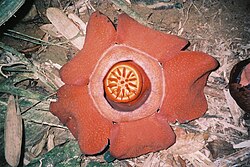
Stapelia: Succulent Mimics
Unlike the giants of the rainforest, plants in the genus Stapelia are small, spineless, cactus-like succulents. Most are native to South Africa. Their flowers are characterized by varying degrees of hairiness and colors that mimic rotting meat to attract scavenging flies. While many are grown as common potted plants, some species, such as Stapelia gigantea, can produce massive flowers up to 30 cm (12 in) in diameter.
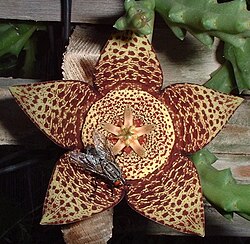
Bulbophyllum: The Scent of Orchids
The orchid genus Bulbophyllum is known for producing an incredible range of overpowering odors. Depending on the species, the scent might resemble sap, urine, blood, dung, or even carrion. Some species, such as Bulbophyllum beccarii, B. fletcherianum, and B. phalaenopsis, are so pungent they have been compared to the smell of a herd of dead elephants, making it difficult to even enter a greenhouse when they are in bloom.
The Science of the Scent and Pollination
Chemical Composition
Identifying the exact source of these scents is challenging because the chemical compounds exist in extremely low concentrations (between 5 to 10 parts per billion). However, biochemical analysis has revealed several key contributors:
- Dimethyl sulfides: Such as dimethyl disulfide and dimethyl trisulfide.
- Amines: Including putrescine and cadaverine.
- Other compounds: Methyl thioacetate (smelling of garlic or cheese), isovaleric acid (smelling of sweat), and trimethylamine, which provides a "rotten fish" scent as the flower nears the end of its life.
The Pollination Mechanism
For pollination to succeed, the plant must establish a relationship of attraction and reward. Carrion flowers use visual cues—such as funnel-shaped architectures or translucent patches—and olfactory cues to draw in pollinators like blowflies (Calliphoridae) and house flies (Muscidae). Once the insect arrives, its body mechanically picks up pollen, which is then dispersed when the insect visits another flower. In some instances, the flower architecture acts as a trap, holding the insect temporarily to ensure the pollen transfer is complete.
Summary of Major Carrion Flower Groups
| Genus | Family | Key Characteristic |
|---|---|---|
| Amorphophallus | Araceae | Large inflorescence with a heated spadix. |
| Rafflesia | Rafflesiaceae | Parasitic; world's largest single bloom. |
| Stapelia | Apocynaceae | Succulent, hairy, cactus-like appearance. |
| Bulbophyllum | Orchidaceae | Orchids with diverse, pungent odors. |
| Smilax | Smilacaceae | Herbaceous vines found in North America. |
Frequently Asked Questions
Why do these flowers smell like rotting meat?
The scent is a form of mimicry designed to attract specific pollinators, such as flies and beetles, that are naturally drawn to decaying organic matter for feeding or egg-laying.
Do all carrion flowers have the same smell?
No. While many smell like carrion, the scents can vary widely, including smells resembling urine, blood, dung, sweat, or even garlic and cheese.
Are carrion flowers dangerous to humans?
The odors can be extremely overpowering and unpleasant, particularly in enclosed spaces like greenhouses, but the plants themselves are not inherently dangerous.
How do these plants ensure they get pollinated?
They use a combination of visual mimicry (colors and shapes) and chemical mimicry (scent). Some species even use complex flower shapes to temporarily trap insects, ensuring they are covered in pollen before being released.
Is the Titan arum a single flower?
No. The Titan arum produces an inflorescence, which is a cluster of many small male and female flowers arranged on a central stalk called a spadix.