Capitol Power Plant Emissions and Air Quality Trends
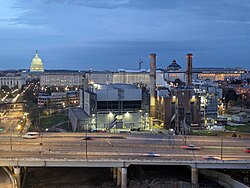
Air quality in urban centers is often dictated by a few major point sources of pollution. In the District of Columbia, the Capitol Power Plant (CPP) historically played a significant role in the city's emissions profile. Despite being roughly 1/100 the size of a typical 500 MW power plant, its impact on local air quality was disproportionately high before the transition to cleaner energy sources.
To understand the scale of this impact, it is necessary to examine the nature of particulate matter and the regulatory standards designed to protect public health.
Understanding Particulate Matter (PM)
Particle pollution, known as particulate matter (PM), is a complex mixture of liquid droplets and extremely small particles suspended in the air. It is one of six criteria pollutants regulated by the Environmental Protection Agency (EPA), alongside lead, mercury, sulfur dioxide, nitrogen oxide, and ozone.
PM is categorized by the size of the particles:
- PM2.5: Fine particles with a diameter of 2.5 micrometers or smaller. These are the most closely associated with human health effects because they can reach the deepest regions of the lungs.
- PM10: Inhalable coarse particles that are larger than 2.5 micrometers but smaller than 10 micrometers.
Exposure to these pollutants is linked to severe health issues, including aggravated asthma and premature death in individuals with heart or lung disease. Additionally, particle pollution is the primary cause of visibility impairment in national parks and major cities.
Historical Emissions in the District of Columbia
In 2002, the Capitol Power Plant was a dominant source of local pollution. While other facilities like the Pepco Benning Road and Buzzard Point generating stations contributed significantly to sulfur dioxide (SO2) and nitrogen oxide (NOx) levels, the CPP was the primary driver of fine particulate matter.
Specifically, the CPP produced 65% of all PM2.5 emitted by fixed sources in the District of Columbia in 2002, excluding mobile sources such as cars, trucks, and trains.
| Facility | PM2.5 (Tons) | NOx (Tons) | SO2 (Tons) | PM10 (Tons) |
|---|---|---|---|---|
| Capitol Power Plant | 83 | 129 | 483 | 84 |
| Pepco Benning Road Station 15/16 | 15 | 253 | 1467 | 67 |
| Pepco Buzzard Point Station | 5 | 340 | 390 | 5 |
| GSA Central Heating Plant | 12 | 66 | 8 | 12 |
| 10 Miscellaneous Sources | 12 | 529 | 320 | 14 |
| TOTAL | 127 | 1,317 | 2,468 | 182 |
The Transition to Natural Gas and Pollution Reduction
The environmental profile of the Capitol Power Plant changed drastically following its transition to natural gas. This shift, combined with the closure of other large power plants in the District, led to a significant decline in harmful emissions.
Between 2007 and 2011, there was a marked decrease in sulfur dioxide and particulate matter. For example, SO2 emissions dropped from 460.95 tons in 2007 to 48.04 tons by 2011. Similarly, PM emissions fell from 114.08 tons in 2007 to 19.09 tons in 2011. Carbon dioxide equivalent (CO2e) emissions also saw a reduction, falling from 118,851 tons in 2007 to 78,862 tons in 2011.
Key Facts
- In 2002, the Capitol Power Plant accounted for 65% of all fixed-source PM2.5 emissions in the District of Columbia.
- PM2.5 refers to fine particles 2.5 micrometers or smaller, which can penetrate deep into the lungs.
- The transition to natural gas significantly reduced SO2, NOx, and PM emissions at the CPP.
- The EPA tightened the 24-hour fine particle standard in 2006 from 65 to 35 micrograms per cubic meter.
- The annual fine particle standard remains at 15 micrograms per cubic meter.
Frequently Asked Questions
What is the difference between PM2.5 and PM10?
PM2.5 consists of fine particles 2.5 micrometers in diameter or smaller, while PM10 consists of inhalable coarse particles between 2.5 and 10 micrometers in diameter.
Why is PM2.5 considered more dangerous than PM10?
Because of their smaller size, PM2.5 particles can travel deeper into the lungs, leading to more significant health problems, including heart and lung disease.
How did the Capitol Power Plant reduce its emissions?
The plant achieved significant pollution reductions by transitioning its energy source to natural gas.
What are the current EPA standards for fine particles?
The EPA maintains an annual fine particle standard of 15 micrograms per cubic meter and a 24-hour standard of 35 micrograms per cubic meter.
Why was the annual PM10 standard revoked?
The EPA revoked the annual PM10 standard due to a lack of evidence linking long-term exposure to coarse particle pollution to specific health problems.