Capillary Action: The Science of Liquid Flow in Narrow Spaces
Capillary action—also known as capillarity, wicking, or capillary rise—is a fascinating physical process where a liquid flows through a narrow space without the help of external forces, such as gravity. This phenomenon is why a paper towel absorbs a spill, how plants draw water from the soil, and why a paintbrush can hold a bead of paint between its bristles.
At its core, capillary action is driven by intermolecular forces. It occurs when the surface tension (caused by cohesion within the liquid) and the adhesive forces (the attraction between the liquid and the surrounding solid surface) combine to propel the liquid forward. When the diameter of a tube or pore is sufficiently small, these forces overcome gravity, pulling the liquid upward or outward.
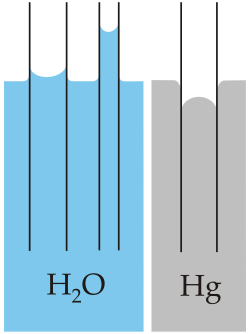
Key Facts
- Driving Forces: It is caused by the interaction between cohesion (liquid-liquid attraction) and adhesion (liquid-solid attraction).
- Tube Diameter: The narrower the tube or space, the higher the liquid will rise.
- Material Impact: Porous materials like paper, plaster, and clay bricks are highly susceptible to capillary action.
- Biological Role: It is essential for water transport in plants and certain animal species.
The Physics of Capillary Rise
The behavior of a liquid in a capillary tube is governed by the relationship between the liquid's properties and the geometry of the container. A key concept here is the meniscus, the curved upper surface of a liquid in a tube. The shape of this curve depends on whether the liquid is attracted to the walls (forming a concave meniscus, like water in glass) or repelled by them (forming a convex meniscus, like mercury in glass).
Jurin's Law and Liquid Height
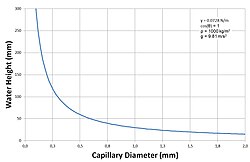
The height to which a liquid will rise is described by Jurin's law. For water in a glass tube under standard laboratory conditions (20 °C), the height is inversely proportional to the radius of the tube. For example:
- In a tube with a 2 m radius, the rise is a negligible 0.007 mm.
- In a tube with a 2 cm radius, the water rises 0.7 mm.
- In a narrow tube with a 0.2 mm radius, the water can rise as much as 70 mm.
Real-World Examples and Applications
Construction and Porous Materials
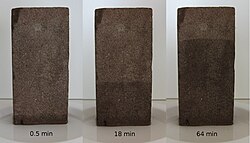
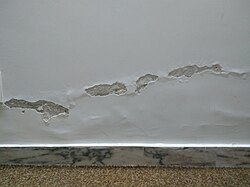
In building construction, capillary action can lead to rising damp, where groundwater is drawn up through porous masonry. Different materials exhibit different levels of sorptivity (the rate at which a material absorbs water).
| Material | Sorptivity (mm·min1/2) |
|---|---|
| Gypsum plaster | 3.50 |
| Clay brick | 1.16 |
| Mortar | 0.70 |
| Aerated concrete | 0.50 |
| Concrete brick | 0.20 |
Biological Adaptations
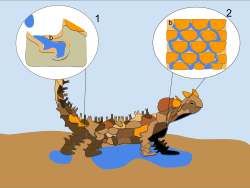
Nature utilizes capillary action for survival. In plants, it helps transport water from roots to leaves. An extraordinary example is the thorny devil lizard, which uses a network of microstructures between its scales to channel moisture from the environment directly to its mouth for ingestion.
Scientific History
While early observations of capillary action can be found in the manuscripts of Leonardo da Vinci, a quantitative mathematical treatment didn't emerge until 1805. Thomas Young and Pierre-Simon Laplace independently derived the Young–Laplace equation to describe the pressure difference across the liquid interface.
Later contributions include Carl Friedrich Gauss, who determined the boundary conditions at the liquid-solid interface in 1830, and Sir William Thomson (Lord Kelvin), who in 1871 established the Kelvin equation regarding the effect of the meniscus on vapor pressure.
Frequently Asked Questions
What is the difference between cohesion and adhesion?
Cohesion refers to the attraction between molecules of the same substance (e.g., water molecule to water molecule), while adhesion refers to the attraction between molecules of different substances (e.g., water molecule to a glass wall).
Why does water rise higher in thinner tubes?
In a thinner tube, a larger proportion of the liquid's volume is in contact with the tube walls relative to the total weight of the liquid column. This allows the adhesive forces to lift the liquid higher against the pull of gravity.
Does capillary action happen in space?
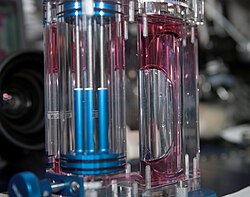
Yes. Because capillary action does not rely on gravity to move the liquid, it remains a functional process in microgravity environments, as investigated in experiments aboard the International Space Station.
Can all liquids exhibit capillary action?
Most liquids do, but the direction varies. Polar liquids like water typically rise in polar tubes (like glass), whereas non-polar liquids or those with high cohesion relative to adhesion (like mercury) may actually be depressed in a capillary tube.