Water: The Chemical Properties and Molecular Dynamics of H2O
Water is the most abundant substance on Earth's surface and the third most abundant molecule in the universe, following molecular hydrogen (H2) and carbon monoxide (CO). While it appears simple, the molecule known scientifically as oxidane possesses unique chemical and physical properties that make it essential for life and a primary driver of Earth's climate system.
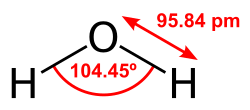
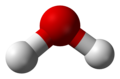
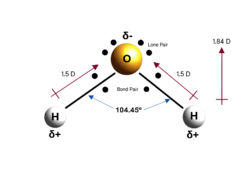
At its most basic level, water consists of two hydrogen atoms covalently bonded to one oxygen atom. This arrangement creates a bent molecular geometry, where the H–O–H angle is approximately 104.48°. This specific angle is caused by the repulsion of two lone pairs of electrons on the oxygen atom, which push the O–H bonds closer together than they would be in a standard tetrahedral arrangement.
Key Facts
- Chemical Formula: H2O
- Molar Mass: 18.015 g·mol
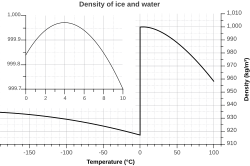
- Maximum Density: Occurs at approximately 3.983 °C
- Melting Point: 0.00 °C (at standard pressure)
- Boiling Point: 99.98 °C (at standard pressure)
- Dipole Moment: 1.8546 D, making it a highly polar molecule
- Global Distribution: 97.39% of Earth's water volume is found in the oceans
Molecular Structure and Polarity

The polarity of water is one of its most defining characteristics. Because oxygen is more electronegative than hydrogen, the electrons in the O–H bonds are pulled closer to the oxygen atom. This creates a dipole moment, meaning the molecule has a partial negative charge near the oxygen and partial positive charges near the hydrogens.
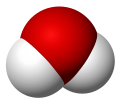
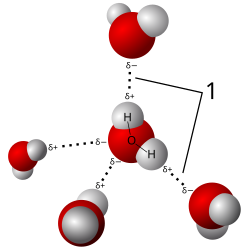
This polarity allows water molecules to form hydrogen bonds—weak attractions between the positive hydrogen of one molecule and the negative oxygen of another. These bonds are responsible for water's high cohesion and its ability to act as a universal solvent.
Physical Properties and Thermal Dynamics
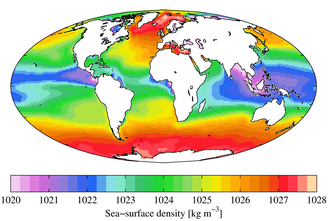
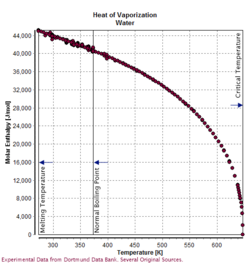
Water exhibits an unusually high specific heat capacity (4184 J/(kg·K) at 20 °C), meaning it requires a significant amount of energy to raise its temperature. Combined with a high heat of vaporization, these properties allow the oceans to buffer global temperature fluctuations, moderating the Earth's climate.
Density Anomalies
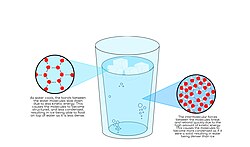
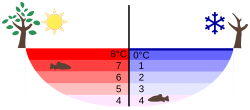
Unlike most substances, water reaches its maximum density at approximately 4 °C rather than at its freezing point. As water cools toward 0 °C, it forms a low-density, open lattice structure. This is why ice is less dense than liquid water and floats, a phenomenon that prevents lakes from freezing solid from the bottom up.
Phase Transitions and the Triple Point
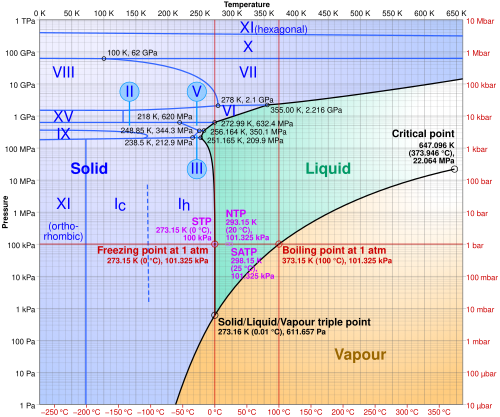
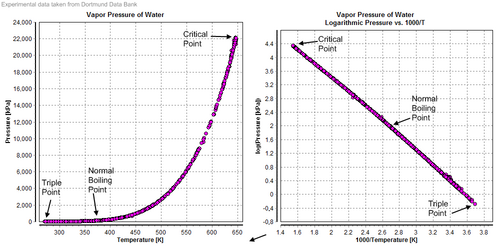
Water can exist as a solid, liquid, or gas depending on temperature and pressure. The triple point is the unique condition (611.657 Pa at 273.16 K) where all three phases coexist in stable equilibrium.
Surface Phenomena and Fluid Dynamics
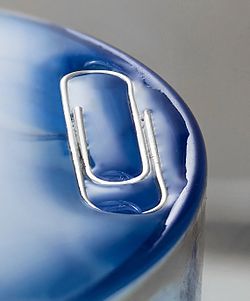
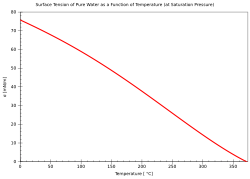
The strong cohesive forces between water molecules result in high surface tension. This allows water to resist external force and enables small insects or objects to stay atop the surface without sinking.

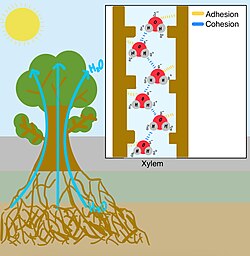
Surface tension, combined with adhesion (the attraction between water and other surfaces), enables capillary action. This is the process by which water moves upward through narrow tubes, such as the xylem in plants, defying gravity to transport nutrients.

Chemical Reactivity and Quantum Behavior
Water is amphoteric, meaning it can act as both an acid and a base. It undergoes self-ionization, where two water molecules react to form hydronium (H3O+) and hydroxide (OH-) ions. In redox reactions, water can react with active metals; for example, reacting with sodium (Na) to produce hydrogen gas and sodium hydroxide.
Recent scientific research has also highlighted quantum tunneling in water. This occurs when hydrogen bonds are broken or regenerated through quantum mechanical processes rather than classical thermal activation, particularly observed in water hexamers.
Summary of Water Properties
| Property | Value | Condition |
|---|---|---|
| Density (Liquid) | 0.999 974 95 g/mL | At 3.983 °C |
| Density (Solid) | 0.9167 g/mL | At 0 °C |
| Vapor Pressure | 3.1690 kPa | At 25 °C |
| Refractive Index | 1.3330 | At 20 °C |
| pKa / pKb | 13.995 | Standard |
| Thermal Conductivity | 0.6065 W/(m·K) | Standard |
Frequently Asked Questions

![Some hydrogen-bonding contacts in FeSO4.7H2O. This metal aquo complex crystallizes with one molecule of "lattice" water, which interacts with the sulfate and with the [Fe(H2O)6]2+ centers.](/images/cd/aa/cdaa39badfce71f5d5fee2728713a0289fb7950f7f16f0ff3f2ea004b11c1e60.png)
Why does ice float on water?
Ice floats because it forms a crystalline lattice structure via hydrogen bonding that is more open and less dense than the molecular packing of liquid water.
What is the "triple point" of water?
The triple point is the specific temperature (0.01 °C) and pressure (611.657 Pa) at which water exists simultaneously as a solid, liquid, and gas in equilibrium.
How does water contribute to climate regulation?
Due to its very high specific heat capacity, water can absorb and store vast amounts of heat energy with minimal changes in its own temperature, buffering the Earth against extreme temperature swings.
What causes the "bent" shape of the water molecule?
The bent shape is caused by two lone pairs of electrons on the oxygen atom. These lone pairs occupy more space and repel the O–H bonds, pushing them closer together to an angle of 104.48°.
What is the difference between cohesion and adhesion in water?
Cohesion is the attraction between water molecules themselves (creating surface tension), while adhesion is the attraction between water molecules and different substances (enabling capillary action).