Frost Heaving: The Science of Soil Expansion and Ice Lens Formation
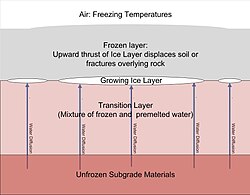
When temperatures drop, the ground beneath our feet can undergo a dramatic transformation. Frost heaving is the process of upward swelling in soil caused by the growth of ice as it moves toward the surface from a freezing front. This phenomenon is not merely a result of water expanding as it freezes; rather, it is a complex geological process driven by the migration of water through soil pores.
As the freezing boundary penetrates the earth, it creates a demand for water. If the soil allows it, water travels upward via capillary action—the ability of a liquid to flow in narrow spaces without the assistance of external forces like gravity. This continuous supply of water feeds the growth of ice, which can eventually lift layers of soil by as much as 1 foot (0.30 metres) or more.
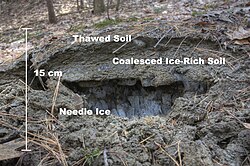
Key Facts
- Frost heaving is caused by the growth of ice lenses, not just the expansion of existing water.
- Frost-susceptible soils, such as silt and loam, are essential for the process to occur.
- The process can damage infrastructure, including roads, building foundations, and ice rinks.
- Needle ice is a specific type of frost heave occurring at the start of the freezing season.
- Unique landforms like palsas and lithalsas are created by these freezing processes.
The Mechanics of Ice Lens Development
The primary driver of soil displacement is the formation of ice lenses. These are lens-shaped areas of ice that grow within the soil. As the freezing front moves downward, it consumes water that has migrated from a lower groundwater source or water table. The weight of the overlying soil often constrains this growth, forcing the ice to expand laterally into these distinct lens shapes.
Historical Scientific Breakthroughs
For centuries, the cause of frost heaving was misunderstood. In 1694, Urban Hjärne noted the phenomenon of "earth casting," where large chunks of sod were tossed upward by the freezing ground. However, it wasn't until 1930 that Stephen Taber, head of the Department of Geology at the University of South Carolina, disproved the long-held hypothesis that heaving was caused solely by the 9% volume expansion of water as it turns to ice.
Taber demonstrated that the vertical displacement of soil is significantly greater than what molar volume expansion alone could achieve. By showing that even liquids like benzene—which contracts when it freezes—could produce frost heave, he proved that the migration of liquid water toward the freeze line was the dominant mechanism.
Micro-scale Processes and Thermal Regelation
At a microscopic level, the process is even more intricate. Due to the Gibbs–Thomson effect, water in very fine soil pores can remain liquid even at temperatures well below the standard freezing point. This allows water to continue percolating toward the growing ice lens.
Furthermore, a phenomenon known as thermal regelation occurs at the particle scale. As ice surrounds fine soil particles, a thin film of unfrozen water exists between the ice and the soil. Because water has lower thermodynamic free energy in bulk ice than in a supercooled liquid state, water continuously flows from the warmer side of a particle to the colder side, causing the particle to migrate downward toward the warmer soil. This process effectively purifies the ice lenses by repelling fine soil particles.
Frost-Susceptible vs. Non-Frost-Susceptible Soils
Not all ground is prone to heaving. For frost heaving to occur, the soil must be frost-susceptible. This means the soil must have a pore structure that facilitates capillary flow—large enough to allow water to move, but small enough to maintain capillary continuity.
- Frost-Susceptible: Silty and loamy soils are prime candidates due to their fine particle size.
- Non-Frost-Susceptible: Dense clays may be too compact to allow water flow (low hydraulic conductivity), while clean sands and gravels have pores that are too large to support capillary action.
| Soil Type | Pore Structure | Capillary Action | Frost Susceptibility |
|---|---|---|---|
| Silt/Loam | Fine/Intermediate | High | High |
| Dense Clay | Very Small | Low (Low Conductivity) | Low |
| Sand/Gravel | Large/Open | Low (Broken Continuity) | Low |
Natural Landforms and Environmental Impact
Frost heaving shapes the landscape in diverse ways, creating unique geological structures. In organic-rich soils like peat, these heaved mounds are known as palsas. In mineral-rich soils, they are called lithalsas. These can be found in various climates, including alpine regions like Mount Kenya.
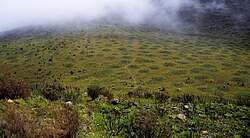
In Arctic permafrost regions, long-term ground heaving can create massive structures called pingos, which can reach heights of 60 metres. Other formations include cryogenic earth hummocks, known variously as thúfur in Greenland or pounus in Fennoscandia. Interestingly, similar polygonal frost-heave patterns have even been observed on Mars.
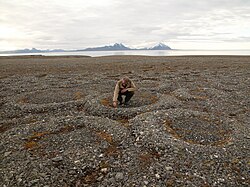
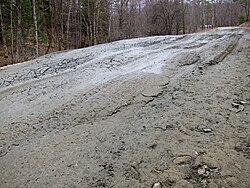
In human environments, differential frost heaving is a major cause of infrastructure damage. It can crack road surfaces, leading to springtime potholes, and compromise building foundations. This is particularly a concern for refrigerated buildings and ice rinks, where sub-freezing temperatures can extend deep into the soil.
Frequently Asked Questions
What is the difference between frost heave and needle ice?
Needle ice is a form of frost heaving that occurs at the very beginning of the freezing season. It happens before the freezing front has penetrated deeply into the soil and before there is enough soil overburden (weight) to create a traditional heave.
How do engineers prevent frost heave in buildings?
To protect foundations, engineers may use non-frost-susceptible soil beneath the structure, install insulation to prevent the freezing front from reaching the soil, or use heating systems to keep the subsurface soil above freezing temperatures.
Can frost heaving happen near the equator?
Yes. While common in polar regions, frost heaving can occur in alpine areas near the equator, such as the palsas found on Mount Kenya.
Why do roads develop potholes in the spring?
Differential frost heaving can crack road surfaces. When the ground thaws in the spring, the weakened structure and the presence of water contribute to the formation of potholes.
What are the main requirements for frost heaving to occur?
Three conditions must be met: frost-susceptible soil, a continuous supply of water (a water table) below the freezing line, and freezing temperatures that penetrate the soil.