Canids: The Evolutionary History and Biology of the Dog Family
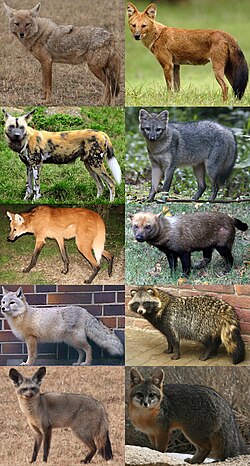
From the tiny, desert-dwelling fennec fox to the formidable gray wolf, the family Canidae represents one of the most successful lineages of carnivores on Earth. These animals, ranging from small foxes to large wolves, have occupied diverse ecological niches across nearly every continent, adapting to environments as varied as frozen tundras, dense forests, and arid deserts.
To understand the modern canid, one must look back millions of years to the Late Eocene epoch, when the first members of this family appeared in North America. Since then, they have undergone significant evolutionary shifts, diversifying into various subfamilies and eventually forming the complex web of species we recognize today.
Key Facts
- Origin: First appeared in North America during the Late Eocene (approximately 37.8 million years ago).
- Diversity: Includes various subfamilies such as Hesperocyoninae, Borophaginae, and the only surviving subfamily, Caninae.
- Size Range: Varies from the 0.6 kg fennec fox to the 79 kg gray wolf.
- Distribution: Native to all continents except Australasia and Antarctica.
- Domestication: The domestic dog was the first species domesticated by humans.
Evolutionary Lineage and Taxonomy
The evolutionary journey of canids is rooted in the Carnivoramorpha, a group that emerged roughly 45–42 million years ago (Mya) and split into the cat-like Feliformia and the dog-like Caniformia. The Canidae family itself emerged during the Late Eocene in North America, later migrating to Eurasia during the Late Miocene and to South America by the Late Pliocene.
During the Eocene epoch, the family branched into three distinct subfamilies:
- Hesperocyoninae: Existed from approximately 39.74 to 15 Mya.
- Borophaginae: Emerged around 34–32 Mya.
- Caninae: Emerged around 34–30 Mya and remains the only surviving subfamily today.
Over time, many canid lineages showed an increase in body mass. However, some species developed specialized hypercarnivorous diets—diets consisting primarily of meat—which ultimately made them more susceptible to extinction when environmental conditions changed.
Physical Characteristics and Adaptations
Size and Habitat
Canids are remarkably adaptable. They inhabit mountains, grasslands, deserts, and forests. While most are terrestrial, a few species, such as the gray fox, the island fox, and the raccoon dog, are capable of climbing trees.
Dentition and Bite Force
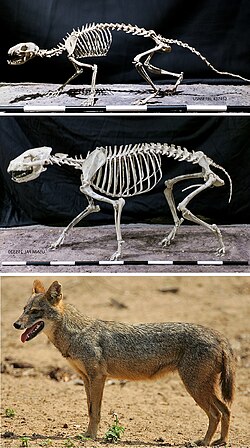
The dental structure of most canids is highly specialized for predation. A typical adult canid possesses 42 teeth, following a dental formula of 3.1.4.2 / 3.1.4.3. Their strong molar teeth are often used to crack bone to access marrow. Interestingly, the bite force at the canine teeth varies significantly among species. Research indicates that the extinct dire wolf possessed the greatest adjusted bite force among placental mammals, followed by modern hypercarnivores like the African wild dog, gray wolf, dhole, and dingo.
| Species | Relative Bite Force Value |
|---|---|
| African Wild Dog | 142 |
| Gray Wolf | 136 |
| Dhole | 112 |
| Dingo | 108 |
Reproduction and Life History
Canid reproduction is closely tied to environmental cues, particularly the length of the day (photoperiod). For many species, the breeding season is seasonal; when moved across the equator, these cycles shift by six months to match the local light patterns. In captivity, artificial lighting can sometimes disrupt these natural rhythms, causing domestic dogs to enter oestrus (the period of sexual receptivity) more frequently.
The reproductive cycle involves several hormonal stages:
- Proestral period: Characterized by increased estradiol, making the female attractive to males.
- Estral phase: A period of receptivity driven by rising progesterone.
- Dioestrous phase: A lengthy period during which pregnancy occurs.
Gestation periods vary by size: small and medium canids typically gestate for 50 to 60 days, while larger species average 60 to 65 days. It is also noted that canids may experience pseudo-pregnancy if they ovulate but do not conceive.
The Relationship Between Canids and Humans
The bond between humans and canids is one of the oldest in history. The domestic dog was the very first species to be domesticated. Archaeological evidence suggests that dogs lived alongside human hunter-gatherers, with undisputed remains found in burials dating back 14,700 years, though some disputed evidence points as far back as 36,000 years.

Frequently Asked Questions
Which canid subfamily is still alive today?
Only the Caninae subfamily is currently extant; the Hesperocyoninae and Borophaginae subfamilies are extinct.
How large can canids grow?
Canids exhibit extreme size variation. The fennec fox can be as small as 24 cm long and weigh only 0.6 kg, whereas the gray wolf can reach lengths of 160 cm and weigh up to 79 kg.
Are all canids strictly meat-eaters?
While some species are specialized hypercarnivores, many canids have strong molar teeth that allow them to process various foods, including cracking bones for marrow.
Where did the first canids originate?
The Canidae family first appeared in North America during the Late Eocene epoch, approximately 37.8 million years ago.
Can canids climb trees?
Most canids are terrestrial, but a few specific species, including the gray fox, the island fox, and the raccoon dog, are known to habitually climb trees.