Canadian National Railway: A Legacy of North American Transport
The Canadian National Railway Company (CN) stands as a titan of North American logistics, operating a vast network that bridges the Atlantic and Pacific coasts. Founded on June 6, 1919, CN has evolved from a government-led Crown Corporation into one of the most efficient public transport companies in the world, facilitating the movement of goods and passengers across Canada and the United States.
With a massive infrastructure spanning approximately 20,000 miles (32,000 km), CN utilizes a 1,435 mm standard gauge track system to maintain seamless connectivity across borders. Headquartered in Montreal, Quebec, the company continues to be a driving force in the global transport industry.
Key Facts
- Founded: June 6, 1919
- Headquarters: Montreal, Quebec, Canada
- Network Length: 20,000 miles (32,000 km)
- 2024 Revenue: CA$ 17.05 billion
- 2024 Net Income: CA$ 1.17 billion
- Workforce: 24,671 employees (2024)
- Track Gauge: 1,435 mm (Standard Gauge)
The Evolution of CN
Founding and Early Growth
CN was established in 1919, emerging from the consolidation of several predecessors, most notably the Canadian Northern Railway. A pivotal moment in its early expansion occurred in November 1919 with the acquisition of the Grand Trunk Railway System, which was fully implemented by May 1920. For much of its early history, CN operated as a Crown Corporation, reporting to the Minister of Railways and Canals until 1936, and subsequently to the Minister of Transport.

Privatization and Modern Expansion
The transition from a government entity to a public company marked a new era of efficiency and growth. Following its privatization, CN aggressively expanded its footprint through strategic acquisitions. This growth included the integration of several U.S. railroads, such as the Wisconsin Central Railroad, the Illinois Central Railroad, and the Elgin, Joliet and Eastern Railway.
More recently, CN has continued to refine its network, acquiring the Iowa Northern Railway and the TransX Group of Companies to bolster its intermodal and short-line capabilities.
Diversified Operations and Subsidiaries
Beyond the Tracks
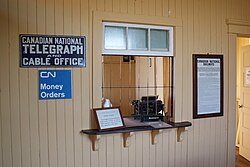
Historically, CN's reach extended far beyond rail. The company managed a diverse portfolio of non-rail subsidiaries, including CN Hotels, CNR Radio, and the CN Telegraph system, which provided critical communication infrastructure across the Canadian wilderness.
Maritime Ventures: Canadian National Steamships
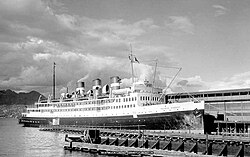
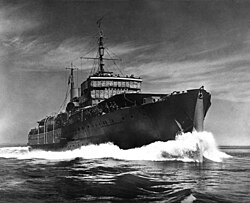
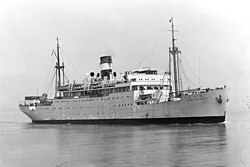
The Canadian National Steamship Company operated a significant fleet to complement its rail services. On the West Coast, CN operated ships such as the Prince Robert, Prince David, and Prince Henry. Some of these vessels, like the Prince David, served as armed merchant cruisers during World War II.

Technical Infrastructure and Assets
Locomotive Technology
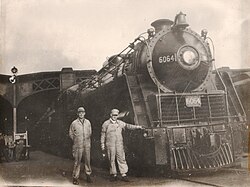
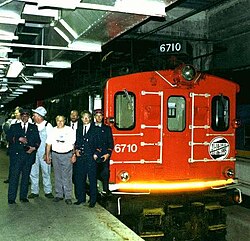
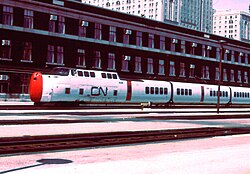
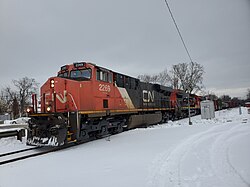
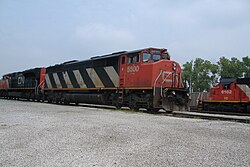
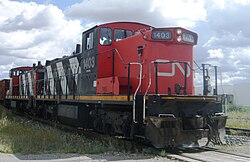
CN has utilized a wide array of motive power over the last century. This progression began with coal-fired steam engines and transitioned through electric locomotives (used from 1918 to 1995) and the innovative TurboTrain. Today, the fleet is dominated by powerful diesel-electric locomotives, including models from EMD and GE, such as the ES44DC.

Logistics Hubs and Terminals
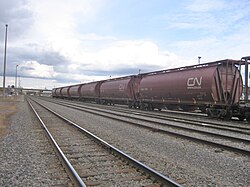
To manage the flow of freight, CN operates several hump yards—specialized classification yards that use gravity to sort rail cars. Major hubs include the MacMillan Yard in Vaughan, Ontario, and the Symington Yard in Winnipeg, Manitoba. Additionally, the company maintains a network of intermodal terminals in key cities like Chicago, Detroit, Halifax, and New Orleans to facilitate the transfer of containers between rail, ship, and truck.
![Properties of the CN in the United States serve, in many instances, as routes for Amtrak. Pictured is the Amtrak station in Hammond, Louisiana, refurbished with a modern passenger platform. This segment of the CN was built in 1854 to form part of the New Orleans, Jackson and Great Northern railway, which later became part of Illinois Central.[citation needed]](/images/42/8d/428de98751cb9267063652fd67b5f7d52f219e5673d9bcecf0504102a48ce56c.jpg)
CN Operational Summary
| Category | Details |
|---|---|
| Reporting Mark | CN |
| Stock Tickers | TSX: CNR, NYSE: CNI |
| Total Assets (2024) | CA$ 57.07 billion |
| Total Equity (2024) | CA$ 21.05 billion |
| Primary Gauge | 1,435 mm (Standard) |
| Key Leadership | Shauneen Bruder (Chair), Tracy Robinson (President & CEO) |
Frequently Asked Questions
When was the Canadian National Railway founded?
The Canadian National Railway Company was founded on June 6, 1919.
What is the current size of the CN rail network?
CN operates a network spanning approximately 20,000 miles (32,000 km) across Canada and the United States.
Did CN ever operate ships?
Yes, through the Canadian National Steamship Company, CN operated various vessels on both the East and West Coasts, including the Prince series of ships.
What are hump yards and where are they located?
Hump yards are classification yards used to sort rail cars via gravity. Major CN hump yards include MacMillan Yard (Vaughan), Symington Yard (Winnipeg), Kirk Yard (Gary, Indiana), and Harrison Yard (Memphis, Tennessee).
Is CN a government-owned company?
No. While it began as a Crown Corporation under the Canadian government, it has since been privatized and is now a public company traded on the TSX and NYSE.