Caloosahatchee: A Legacy of Cold War Naval Replenishment
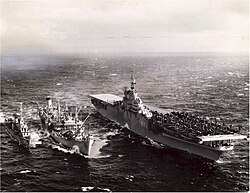
The Caloosahatchee served as a vital artery for the United States Navy during the Cold War, ensuring that combat fleets remained mobile and lethal through the art of at-sea replenishment. By transporting oil and fueling ships while underway, the Caloosahatchee allowed the Navy to project power across vast distances without the need for frequent port visits.
In her early years, the vessel operated primarily off the East Coast of the United States and conducted a voyage to Iceland from Norfolk, Virginia. However, her primary legacy began on August 14, 1947, when she embarked on her first tour with the United States Sixth Fleet in the Mediterranean. This deployment established a pattern that would define her service, as she returned to the Mediterranean nearly every year until 1960.
Key Facts
- Primary Role: Provided critical fuel and oil replenishment to increase the mobility and efficiency of the U.S. Sixth Fleet.
- Jumboization: Underwent a major structural expansion between 1966 and 1968, increasing cargo capacity by over one-third.
- Operational Peak: Set a ship record in 1980 with over 170 replenishments completed.
- Global Reach: Operated across the Mediterranean, North Atlantic, Baltic Sea, Caribbean, and even crossed the Arctic Circle.
- Final Major Milestone: Recorded 191 underway replenishments during her final Mediterranean deployment in 1988.
Operational History and NATO Contributions
The Caloosahatchee was more than just a fuel carrier; she was a key participant in international diplomacy and military readiness. From September 16 to October 20, 1953, she took part in NATO Operation Mariner off Greenock, Scotland. She also supported the next generation of naval leadership, providing summer training for midshipmen during cruises to Le Havre, France (1954) and Copenhagen, Denmark (1956).
Throughout the late 1950s, the oiler maintained a constant presence in European waters, visiting ports in England, Scotland, France, and Portugal. To maintain peak readiness, the crew participated in large-scale Atlantic Fleet exercises, including Operation Springboard in the Caribbean, which continued through 1960.
The Jumboization Process
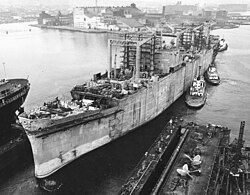
Between 1966 and 1968, the Caloosahatchee underwent a transformative process known as jumboization. This engineering feat involved cutting the ship in half and inserting a newly built 400-foot (122 m) midsection between the original bow and stern, replacing the previous 310-foot section.
This modification significantly increased the vessel's liquid cargo capacity by more than one-third, bringing her configuration in line with modern replenishment oilers. Following this upgrade, she was recommissioned on September 27, 1969, and assigned to Service Squadron 2 (SERVRON 2) in Newport, Rhode Island.
Later Service and Global Deployments
In September 1970, the Caloosahatchee supported the naval blockade off the coast of Lebanon during the Black September conflict in Jordan, a struggle between the Palestine Liberation Organisation (PLO) and the Jordanian Armed Forces.
The 1970s were marked by both intense activity and significant mechanical challenges. In 1974, while entering the Bethlehem shipyard for an overhaul, the ship struck a dockside chock, bending the starboard shaft. After seven months of repairs and the installation of new twin screws, she transitioned to Service Squadron 4 in February 1975, homeported in Norfolk, Virginia.
Her 1975 deployment was particularly grueling. After transiting the Arctic Circle and operating off the coast of Norway, she entered the Mediterranean, where she was involved in a collision with the USS Inchon and USS Hermitage. The accident resulted in a gash to the port side and the loss of the port anchor, requiring extensive repairs in Genoa and Naples, Italy.
Final Years and Records
The ship's later years were characterized by high-tempo operations. In 1977, a steering casualty aboard the USS Rich (DD-820) led to a collision with the Caloosahatchee off Puerto Rico; the USS Rich was subsequently deemed a total loss and scrapped. Despite such incidents, the Caloosahatchee continued to excel in her primary mission.
Following a major overhaul in Brooklyn in 1978, she returned to the North Atlantic and Baltic Sea in 1979, replenishing 116 ships. Her productivity peaked in 1980 with over 170 replenishments. Her service concluded with a final Mediterranean deployment in 1988, where she recorded 191 underway replenishments, and participation in exercise UNITAS XXX in 1989.
| Period/Year | Key Event/Location | Significance |
|---|---|---|
| 1947–1960 | Mediterranean / Sixth Fleet | Annual deployments for fleet fueling |
| 1953 | Operation Mariner | NATO exercise off Scotland |
| 1966–1968 | Jumboization | Capacity increased by over 1/3 |
| 1970 | Lebanon Coast | Black September naval blockade |
| 1980 | Global Operations | Record 170+ replenishments |
| 1988 | Mediterranean | Final deployment (191 replenishments) |
Frequently Asked Questions
What is "jumboization" in the context of the Caloosahatchee?
Jumboization was a structural modification where the ship's original 310-foot midsection was replaced with a new 400-foot section, significantly increasing its liquid cargo capacity.
Which naval fleets did the Caloosahatchee support?
The ship primarily supported the United States Sixth Fleet in the Mediterranean and the United States Second Fleet during operations in Northern Europe and the North Atlantic.
What was the ship's record for underway replenishments?
The Caloosahatchee set a ship record in 1980 by completing over 170 replenishments, later recording 191 replenishments during her final Mediterranean deployment in 1988.
What major international conflicts or exercises did the ship participate in?
The vessel participated in NATO Operation Mariner, the naval blockade during the Black September conflict in Jordan, and exercise UNITAS XXX.
What happened during the collision with the USS Rich?
In 1977, off the coast of Puerto Rico, a steering casualty on the USS Rich led to a collision with the Caloosahatchee. The USS Rich was damaged beyond economical repair and was eventually scrapped.