C-390 Millennium: Embraer's Versatile Multi-Mission Tactical Airlifter
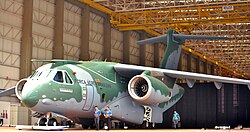
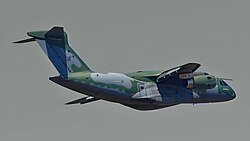
The C-390 Millennium is a sophisticated military transport and aerial refueling aircraft developed by the Brazilian aerospace giant Embraer. Designed to meet the rigorous demands of modern tactical airlift, the aircraft blends the speed of a jet with the rugged capabilities of a traditional cargo plane, providing a flexible solution for logistics, search and rescue (SAR), and strategic refueling.
Since its first flight in 2015, the C-390 has transitioned from a national project for the Brazilian Air Force into a globally recognized platform, securing contracts across Europe and the Middle East.
Key Facts

- Manufacturer: Embraer (Brazil).
- Primary Roles: Military transport, aerial refueling, SAR, and firefighting.
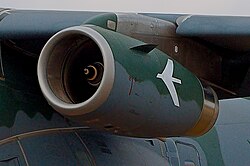
- Powerplant: Two IAE V2500-E5 turbofan engines.
- Maximum Payload: 26,000 kg (57,320 lb).
- Maximum Speed: 988 km/h (Mach 0.93).
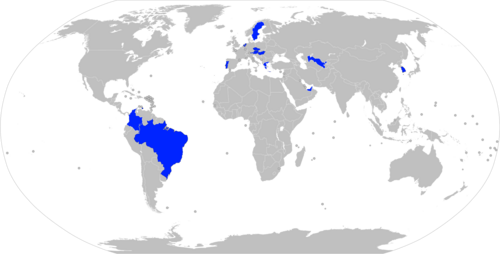
- Global Reach: In service with Brazil, Portugal, Hungary, and the Czech Republic.
Development and Evolution
The journey of the C-390 began with studies for a C-130-sized tactical airlifter, leading to the official program launch and the first prototype's maiden flight on February 3, 2015. The aircraft was designed to provide a high-performance alternative to turboprop transports, utilizing jet engines to reduce transit times and increase operational efficiency.
The first production aircraft was delivered to the Brazilian Air Force on September 4, 2019. Shortly thereafter, during the Dubai Airshow in November 2019, Embraer rebranded the aircraft as the C-390 Millennium for the international market to highlight its versatility and modern design.
Design and Technical Specifications
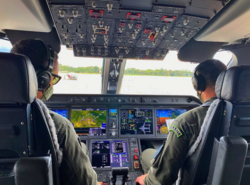
The C-390 is engineered for versatility. Its spacious cargo hold allows for the transport of heavy equipment, while its advanced avionics ensure precision in complex environments. The aircraft utilizes the Rockwell Collins Pro Line Fusion avionics suite and features a glass cockpit for enhanced situational awareness.
To support diverse missions, the aircraft is equipped with several specialized systems:
- CCDP (Continuously Computed Drop Point): An automated system for accurate cargo drops.
- CDS and LVAD: Container Delivery System and Low Velocity Airdrop Delivery for logistics.
- Self-Defense: Includes RWR (Radar Warning Receiver), chaff and flare dispensers, and DIRCM (Directional Infrared Countermeasures).
- Emergency Power: An Emergency Electric Power Generator System (EEPGS), also known as a Ram Air Turbine (RAT).
Technical Summary
| Characteristic | Specification |
|---|---|
| Crew | 3 (2 Pilots, 1 Loadmaster) |
| Length / Wingspan | 35.2 m / 35.05 m |
| Max Takeoff Weight (MTOW) | 86,999 kg |
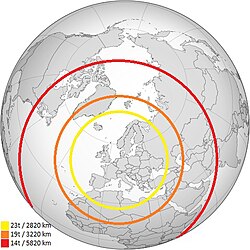
| Useful Lift | 26,000 kg |
| Cargo Hold Dimensions | 18.5 m (L) x 3.0 m (H) x 3.4 m (W) |
| Cruise Speed | 870 km/h (Mach 0.8) |
| Ferry Range | 6,240 km to 8,460 km (with aux tanks) |
Variants and Operational Roles
The aircraft is produced in two primary configurations to serve different strategic needs:
- C-390: The standard model optimized for transport, search and rescue (SAR), and aerial firefighting operations.
- KC-390: The aerial refueling variant, specifically developed for the Brazilian Air Force to extend the range of other aircraft in flight.
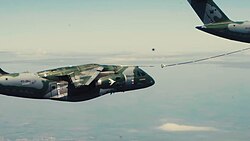
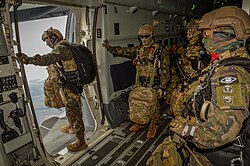
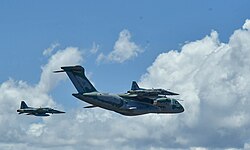
Operationally, the C-390 has proven its worth in diverse scenarios. This includes the transport of Special Forces during free-jump training and critical humanitarian missions, such as Operation Repatriation in March 2022, which brought Brazilian and foreign nationals back from Ukraine.
Global Adoption and Market Reach
While the Brazilian Air Force remains the primary user, the C-390 has seen significant international success. The Portuguese Air Force operates the aircraft for various missions, and Hungary has integrated the platform into its fleet.
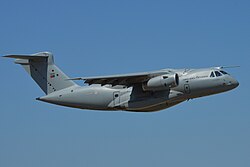
The Czech Air Force signed a contract on October 25, 2024, for two aircraft to meet its medium-lift transport and refueling requirements, with deliveries beginning in June 2026. Other nations have expressed interest or entered negotiations, including the Netherlands, Austria, Sweden, South Korea, and the United Arab Emirates.
Frequently Asked Questions
What is the difference between the C-390 and the KC-390?
The C-390 is the standard transport version used for cargo, SAR, and firefighting. The KC-390 is the specialized variant equipped with aerial refueling capabilities.
What is the maximum payload the C-390 can carry?
The C-390 has a useful lift capacity of 26,000 kg (57,320 lb).
Which engines power the C-390 Millennium?
The aircraft is powered by two IAE V2500-E5 turbofan engines, each providing 139.4 kN of thrust.
How does the C-390 handle cargo drops?
It uses a Continuously Computed Drop Point (CCDP) system for automated accuracy, alongside a Container Delivery System (CDS) and Low Velocity Airdrop Delivery (LVAD).
Which countries currently operate the C-390?
Current operators include the Brazilian Air Force, the Portuguese Air Force, the Hungarian Air Force, and the Czech Air Force.