Aerial Refueling Systems: The Mechanics of In-Flight Fueling
Aerial refueling is a critical capability in modern aviation, allowing military aircraft to extend their range, increase payload capacity, and remain airborne for extended durations. By transferring fuel from a tanker aircraft to a receiver mid-flight, air forces can conduct long-range strategic missions that would otherwise be impossible. This process relies on two primary mechanical systems: the flying boom and the probe-and-drogue.
The Flying Boom System
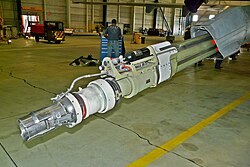
The flying boom is a rigid, telescoping tube equipped with movable flight control surfaces. A boom operator on the tanker aircraft manually extends and steers the boom into a receptacle located on the receiving aircraft. Because boom-equipped tankers typically feature a single boom, they can only refuel one aircraft at a time.
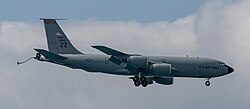
This system was developed in the late 1940s at the request of General Curtis LeMay of the Strategic Air Command (SAC), who sought higher fuel transfer rates than flexible hoses could provide. The B-29 was the first aircraft to use the boom, followed by the KC-97 Stratofreighter. However, the piston-engined KC-97 posed a challenge: its slow cruise speed of 230 mph (370 km/h) forced newer jet aircraft to slow down to dangerous levels, sometimes approaching their stall speed, to mate with the boom. This led to the development of jet-powered tankers, most notably the Boeing KC-135 Stratotanker.
How the Boom Operates
The boom is attached to the rear of the tanker via a gimbal, allowing it to move in coordination with the receiver. It uses a nozzle with a flexible ball joint and a poppet valve to prevent fuel leakage until a secure connection is made. Once mated, toggles in the receiver's receptacle lock the nozzle in place.
The term "flying" refers to the small airfoils (often in a V-tail configuration) that create aerodynamic forces to steer the boom. These are controlled hydraulically by the boom operator. To ensure safety, the receiver pilot must stay within the air refueling envelope—the safe zone of travel. Deviating from this envelope can cause structural damage or mid-air collisions, as seen in the 1966 Palomares B-52 crash.
Operator Perspectives and Global Use
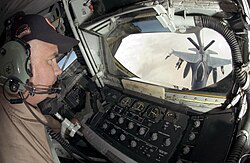
The role of the operator has evolved over time. In the KC-97 and KC-135, the operator lies prone to see through a tail window. In the KC-10, the operator is seated. The modern KC-46 utilizes 3D screens and cameras, allowing two operators to manage the process from the front of the aircraft.
The flying boom is primarily used by the US Air Force, as well as air forces in Australia (KC-30A), the Netherlands (KDC-10), Israel, Japan (KC-767), Turkey (KC-135Rs), and Iran. The system is prized for its high flow rates, reaching up to 1,000 US gallons (3,800 L) or 6,500 pounds (2,900 kg) per minute on the KC-135.
Probe-and-Drogue Refueling
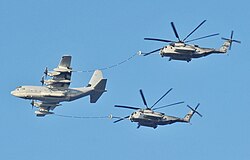
The probe-and-drogue method utilizes a flexible hose trailing from the tanker. At the end of the hose is a drogue (or basket)—a shuttlecock-shaped fitting that stabilizes the hose and acts as a funnel. The receiver aircraft is equipped with a probe, a rigid arm (often retractable to reduce drag) that the pilot must fly directly into the drogue.
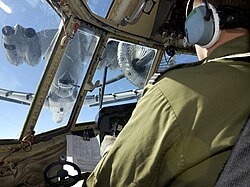
Developed in the UK by Flight Refuelling Limited in the late 1940s and 1950s, most of these systems follow a NATO standard. This allows interoperability between different nations' tankers and receivers. To prevent structural damage during turbulence or poor maneuvers, the system uses shear rivets; if excessive load is applied, the fuel valve breaks off (a "broken probe") rather than damaging the aircraft's airframe.
The Buddy Store Concept
A buddy store (or buddy pod) is an external hose-and-drogue unit mounted on a fighter or bomber's hardpoint. This allows a non-tanker aircraft to act as a "buddy tanker," extending the range of other strike aircraft. This is particularly useful for carrier air wings, allowing aircraft to take off with heavier weapon loads and less fuel, topping up once airborne.
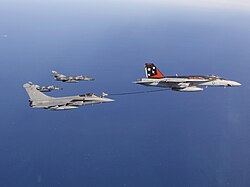
Refueling via buddy store requires a precise closure rate of approximately two knots. Too little speed results in an incomplete connection; too much speed can cause the hose to oscillate violently and sever the probe tip. The receiver typically approaches from behind and below the drogue to avoid the "bow wave" of air that can push the lightweight basket away.
Hybrid and Specialized Systems
Boom Drogue Adapter Units
Some tankers, like the USAF KC-135 and French KC-135FR, can be converted to probe-and-drogue using an adapter. This replaces the boom nozzle with a hose and a steel basket. Naval aviators call this the "iron maiden" because the rigid steel basket is unforgiving; if contacted off-center, it can pivot and strike the receiver's fuselage.
Multi-System Tankers
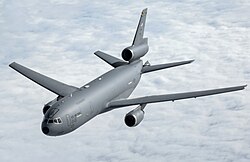
To maximize versatility, some aircraft employ multiple systems. The KC-10 features both a centerline flying boom and a separate hose-and-drogue system. Other tankers use under-wing pods, such as the Multi-point Refueling System (MPRS) on the KC-135 or Wing Air Refueling Pods (WARPs) on the KC-10 and A330 MRTT, allowing them to refuel multiple aircraft simultaneously.
Historical Methods
- Wing-to-Wing: Used by some Soviet Tu-4 and Tu-16Z aircraft, where a hose was released from the wingtip and caught by a lock under the receiver's wingtip.
- Simple Grappling: An early pioneering method where the receiver aircraft grappled a trailing hose mid-air and reeled it in, as seen during the 1929 Question Mark endurance flight.
Key Facts
- Flying Boom: Rigid, operator-controlled system; high fuel flow; refuels one aircraft at a time.
- Probe-and-Drogue: Flexible hose system; receiver-pilot controlled; allows for multi-point refueling of several aircraft.
- Buddy Tanking: Use of external pods to allow fighter aircraft to refuel other fighters.
- NATO Standard: Ensures probe-and-drogue compatibility across different allied nations.
- Air Refueling Envelope: The critical safety zone the receiver must maintain to avoid collisions or equipment damage.
| Feature | Flying Boom | Probe-and-Drogue |
|---|---|---|
| Control | Tanker Boom Operator | Receiver Pilot |
| Mechanism | Rigid Telescoping Tube | Flexible Hose & Basket |
| Fuel Flow Rate | Very High (up to 1,000 gal/min) | Moderate |
| Capacity | One aircraft at a time | Can be multi-point (multiple aircraft) |
| Primary Users | USAF, Australia, Japan, etc. | US Navy, USMC, European Militaries |
Frequently Asked Questions
What is the difference between a boom and a drogue?
A boom is a rigid, telescoping pipe steered by an operator on the tanker into a receptacle on the receiver. A drogue is a flexible hose with a basket-shaped end that the receiver pilot must manually fly their probe into.
Why is the "iron maiden" adapter dangerous?
Unlike standard canvas drogues that guide the probe into the center, the "iron maiden" is made of steel. If the probe hits it off-center, the basket can pivot and slap the receiver aircraft's fuselage, causing structural damage.
What happens if a probe-and-drogue connection is too forceful?
Excessive closure speed can trigger a strong transverse oscillation in the hose, which may sever the tip of the receiver's probe.
How does buddy tanking help carrier-based aircraft?
It allows aircraft to take off with a heavier weapon load and less fuel, as they can be "topped up" in the air by another fighter equipped with a buddy store pod.
What is the air refueling envelope?
It is the specific area of space behind the tanker where the boom can safely connect and move. If a pilot leaves this envelope, they risk damaging the boom or causing a mid-air collision.