Bürgerliches Gesetzbuch (BGB): The Foundation of German Civil Law
The Bürgerliches Gesetzbuch, commonly abbreviated as the BGB, is the comprehensive civil code of Germany. It codifies the majority of private law that applies generally across the nation. Developed starting in 1881 and taking effect on January 1, 1900, the BGB was a groundbreaking project that sought to unify a fragmented legal landscape into a single, systematic body of law.
Beyond Germany's borders, the BGB has served as a vital template for civil law jurisdictions worldwide, including Japan, Korea, Thailand, Brazil, Greece, Estonia, Latvia, and Ukraine. It also significantly influenced the civil codes of Italy, Portugal, Switzerland, and the Netherlands.
Key Facts
- Effective Date: January 1, 1900.
- Purpose: To systematize and unify private law across the German Empire.
- Structure: Divided into five main "books" based on a modified pandectist structure.
- Core Doctrine: Utilizes the Abstraktionsprinzip (abstraction principle) for the transfer of property title.
- Global Impact: Influenced legal systems in Asia, Europe, and South America.
The History and Evolution of the BGB
The German Empire and Unification
The drive for a unified German civil code was sparked by the 1804 Napoleonic Code in France. While early efforts faced opposition from the Historical School of Law, the unification of German states into the German Empire in 1871 provided the necessary political framework. A critical turning point occurred in 1873 with the Lex Miquel-Lasker, a constitutional amendment that transferred legislative authority over civil law from individual states to the Empire (Reich).
After an initial draft in 1888 was rejected, a second committee—consisting of jurists and representatives of various ideological and financial interests—developed a revised version. This version was passed by the Reichstag in 1896.
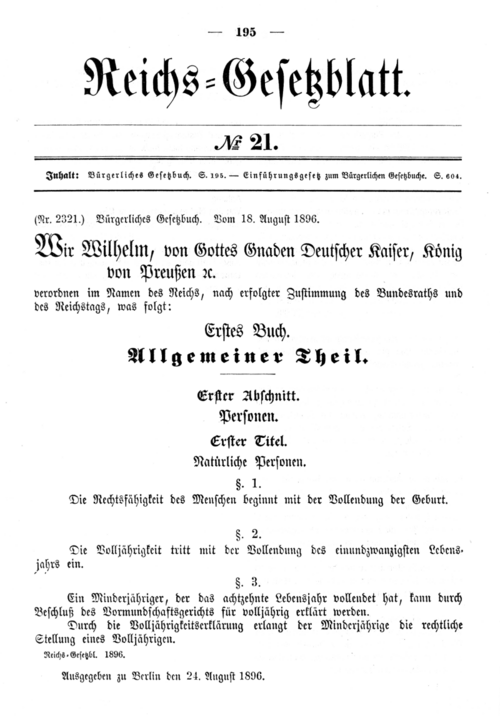
The BGB Under Nazi Germany
During the Nazi era, there were attempts to replace the BGB with a Volksgesetzbuch ("People's Code") to better align the law with Nazi ideology. However, this new code was never completed. Instead, the regime utilized the BGB's flexible general principles to achieve their goals. Specifically, the doctrine of good faith (§ 242 BGB) and the contra bonos mores doctrine (§ 138 BGB)—which allows transactions to be voided if they are against public policy or morals—were re-interpreted by judges and lawyers to serve nationalist ideology.
Post-War Era and Reunification
Following World War II, the BGB continued to operate in both West and East Germany. However, East Germany gradually replaced BGB regulations with socialist laws, culminating in a new civil code (Zivilgesetzbuch) in 1976. Upon German reunification in 1990, the BGB was restored as the sole codification for the entire country.
In recent decades, the BGB has evolved through numerous amendments, most notably the 2002 reform of the Law of Obligations. Additionally, the code is now interpreted in light of European Union (EU) law. For instance, the European Court of Justice (ECJ) ruled in Pia Messner v Firma Stefan Krüger that certain BGB provisions regarding consumer withdrawal and compensation were precluded by EU law.
Structure of the Code
The BGB employs a modified pandectist structure derived from Roman law. Unlike some other codes, it begins with a general section that applies to all subsequent parts. The code is organized into five books:
| Book | Sections | Focus Areas |
|---|---|---|
| General Part (allgemeiner Teil) | 1–240 | Legal capacity, personality rights, contract formation, and limitation periods. |
| Law of Obligations (Schuldrecht) | 241–853 | Contractual obligations, torts, and unjust enrichment. |
| Property Law (Sachenrecht) | 854–1296 | Possession, ownership, and transfer of property rights. |
| Family Law (Familienrecht) | 1297–1921 | Marriage, guardianship, and marital property. |
| Inheritance Law (Erbrecht) | 1922–2385 | Wills, estates, and succession contracts. |
The Doctrine of Abstract Title Transfer
A defining and technical feature of the BGB is the abstract transfer of title. This system separates the agreement to transfer property from the actual transfer itself.
The Separation Principle (Trennungsprinzip)
The BGB distinguishes between obligationary agreements (which create the obligation to transfer) and real agreements (which actually transfer the property). For example, signing a sales contract does not automatically transfer ownership; it merely gives the buyer the right to demand the transfer. Ownership only passes upon delivery or conveyancing (traditio).
The Abstraction Principle (Abstraktionsprinzip)
Going a step further, the Abstraktionsprinzip dictates that the transfer of title is independent of the validity of the underlying contract (the causa). If a sales contract is found to be invalid, the transfer of title remains valid if the delivery was performed correctly. The original owner may then seek the return of the property through unjust enrichment laws, but the title remains with the transferee until it is formally transferred back.
This system provides high legal security for complex transactions. A primary example is retention of title: a seller can maintain legal ownership of a product while the buyer possesses it, only transferring the title once the final installment of the purchase price is paid.
Frequently Asked Questions
What is the BGB?
The BGB (Bürgerliches Gesetzbuch) is the civil code of Germany, serving as the primary legal framework for private law, including contracts, property, family, and inheritance.
How does the BGB differ from the French Civil Code?
Unlike the French Code civil, the BGB uses a pandectist structure with a general part that applies to all other sections. It also employs the abstraction principle for property transfer, whereas French law generally allows an obligationary agreement to suffice for the transfer of title.
What is the "abstraction principle" in German law?
The abstraction principle (Abstraktionsprinzip) means that the legal transfer of property is separate from the validity of the contract that motivated the transfer. Even if the underlying contract is void, the transfer of title remains valid.
Does the BGB still apply today?
Yes, the BGB remains the centerpiece of the German legal system, though it is frequently amended and must be interpreted in accordance with European Union law.
What is "bee law" in the BGB?
Found in the property law section (§§ 961–964), "bee law" (Bienenrecht) allows beekeepers to maintain ownership of a swarm of bees after they leave the hive, as bees are otherwise considered unowned property (ferae naturae) once they fly away.