General State Laws for the Prussian States (ALR)
The General State Laws for the Prussian States (German: Allgemeines Landrecht für die Preußischen Staaten, or ALR) represent one of the most ambitious legal undertakings of the 18th century. Promulgated in 1792 and fully codified by 1794, this massive legal framework sought to unify the laws of Prussia under a single, comprehensive system.
Developed under the direction of Frederick II (Frederick the Great) and codified by legal scholars Carl Gottlieb Svarez and Ernst Ferdinand Klein, the ALR was designed to replace a fragmented legal landscape with a clear, accessible code that minimized judicial manipulation and interpretation errors.
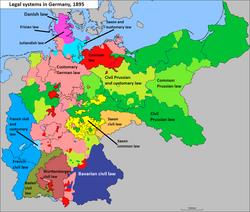
Key Facts
- Promulgation: First introduced in 1792; fully codified in 1794.
- Scope: Contained over 17,000 articles covering civil, penal, family, public, and administrative law.
- Architects: Codified by Carl Gottlieb Svarez and Ernst Ferdinand Klein under Frederick II.
- Purpose: To create a uniform, clear set of laws to eliminate arbitrary interpretations.
- Historical Context: A transitional code bridging the gap between feudalism and capitalism.
The Development of the ALR
From Vision to Codification
The desire for a uniform legal system began with Frederick I, but the project only gained momentum during the reign of Frederick II. The King's primary goal was to ensure that laws were transparent and immune to the whims of different interpreters. An early attempt between 1749 and 1751, known as the Project eines Corporis Juris Fridericiani by Samuel von Cocceji, ultimately proved unsuccessful.
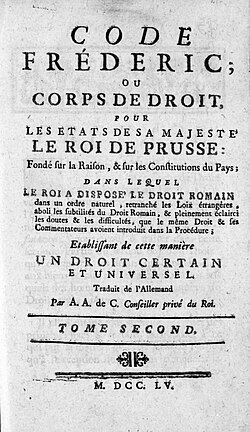
Political Motivations and the Miller Arnold Case
The drive toward codification was not purely academic; it was also a matter of political prestige. Frederick II, who viewed himself as an Enlightened Absolutist (a monarch who applies Enlightenment principles to their rule), faced a crisis of legitimacy during the "Miller Arnold case." In this instance, Frederick overruled his own judiciary and imprisoned judges who had ruled against the miller, Arnold.
To repair his image and address this breach of the rule of law, Frederick pushed for a formal codification. The first version, the General Code for the Prussian states (Allgemeines Gesetzbuch für die Preußischen Staaten, or AGB), appeared in 1792, leading to the final codified version in 1794.
Usage and Legal Impact
Contradictory Interpretations
Historians and legal scholars hold conflicting views on how the ALR functioned in practice. Some argue the code was praised for being simple and practical, focusing on everyday regulation without excessive abstraction. Conversely, others claim that while it was written in German, the language was overly casuistic (dealing with specific, detailed cases rather than general principles) and imprecise, which made it difficult to apply consistently.
Integration and Transition
The ALR served as a tool for political integration. Following the second partition of Poland, the code was applied to annexed territories as subsidiary law to accelerate their integration into the Prussian state.
Structurally, the Landrecht reflected a society in flux. It existed as a bridge between feudalism and capitalism. This is evident in how the code maintained feudal remnants—such as nobility privileges, class divisions, and the subjection of peasants—while simultaneously introducing modern legal concepts, such as a formal definition of property.
The End of the ALR
The ALR remained in effect until the system underwent a major overhaul during the Stein–Hardenberg reforms. These reforms removed the remaining feudal elements of the law, rendering the Landrecht obsolete.
| Feature | Details |
|---|---|
| Official Name | Allgemeines Landrecht für die Preußischen Staaten (ALR) |
| Key Figures | Frederick II, Carl Gottlieb Svarez, Ernst Ferdinand Klein |
| Volume | 17,000+ articles |
| Legal Fields | Civil, Penal, Family, Public, and Administrative Law |
| Era | Transition from Feudalism to Capitalism |
| Replacement | Stein–Hardenberg reforms |
Frequently Asked Questions
What was the primary goal of the ALR?
The primary goal was to create a uniform, clear, and comprehensive set of laws for the Prussian states to eliminate the possibility of manipulation through varying interpretations.
Who were the main figures responsible for the ALR?
The code was commissioned by Frederick II (Frederick the Great) and was codified by the legal experts Carl Gottlieb Svarez and Ernst Ferdinand Klein.
How did the Miller Arnold case influence the law?
After Frederick II imprisoned judges who ruled against him in the Miller Arnold case, he sought to restore his reputation as an Enlightened Absolutist by establishing a formal, codified rule of law.
Why is the ALR considered a "transitional" law?
It is considered transitional because it blended old feudal institutions, such as nobility privileges and peasant subjection, with modern legal concepts like the definition of property.
What eventually replaced the General State Laws?
The ALR ceased to function after the Stein–Hardenberg reforms, which modernized the legal system and removed feudal remnants.