Bunce Court: The New Herrlingen School That Escaped Nazi Germany
In the quiet village of Otterden, Kent, there once stood a sanctuary for children fleeing one of history's darkest eras. The New Herrlingen School, better known as Bunce Court, was more than just a private boarding school; it was a lifeline for Jewish refugees escaping the rise of Nazism in Germany. Founded on the principles of progressive education, the school provided a safe haven where students could continue their intellectual and personal growth far from the persecution of their homeland.
Key Facts
- Founder: Anna Essinger, along with Paula Essinger and Klara Weimersheimer.
- Location: Otterden, Kent, England.
- Operational Years: 1933 to 1948.
- Student Body: Co-educational, serving 64 to 140 pupils, primarily Jewish refugees.
- Educational Approach: Progressive education with small class sizes (5–8 pupils).
- Legacy: Produced notable alumni in arts, science, and diplomacy.
The Origins: Landschulheim Herrlingen
Before the school arrived in England, Anna Essinger established Landschulheim Herrlingen in southern Germany. However, the political climate shifted violently after Adolf Hitler and the Nazi Party seized power in January 1933. As antisemitism grew, the school became increasingly Jewish, as non-Jewish parents withdrew their children due to social and political pressure.
The situation reached a breaking point in April 1933. In a symbolic act of defiance, Essinger organized a school outing so that the building would be empty when the Nazi flag and swastika were ordered to be flown. This gesture led to Nazi scrutiny and the eventual prohibition of her oldest students from taking the abitur—the essential school-leaving certificate required for university entrance.
The Great Escape to Kent
Recognizing that her school had no future in Germany, Anna Essinger began a daring operation to bring her pupils to safety. In the summer of 1933, she arrived in England with 13 students who had been barred from their exams. These pioneers settled at Bunce Court, where they prepared for British matriculation exams in just a few weeks.
By autumn 1933, a coordinated evacuation took place. Three separate groups of children and staff traveled from different parts of Germany, crossing through the Netherlands and Switzerland before arriving at the ferry in Dover. They were transported by red buses to Kent, where classes commenced almost immediately.
While the New Herrlingen School flourished in England, the original site in Germany was seized by the Nazis in 1934. It later served as a forced home for Jewish seniors before being closed in 1942, with its residents sent to extermination camps. Between 1943 and 1945, the buildings were occupied by Erwin Rommel and his family.
Life at Bunce Court
The early years at Bunce Court were marked by meager finances and makeshift facilities. Initially, British education inspectors were skeptical, but they soon became impressed by the school's viability. By 1937, the Ministry of Education praised the school, noting that the enthusiasm and personality of the teachers outweighed the lack of expensive teaching apparatus.
The school operated as a co-educational boarding institution with an average class size of only 5 to 8 students. The curriculum was rooted in progressive education, emphasizing holistic development. Students were not only taught academic subjects but also participated in practical life, such as working in the kitchen under the cook, Gretel Heidt.
Wartime Challenges and Evacuation
The school faced significant disruptions during World War II. In 1940, the school was evacuated to Trench Hall. This location was cramped for the 140 pupils, and the school lost its ability to maintain its pigs, chickens, and beehives. Enrollment declined after 1941, when the Nazi regime banned Jewish emigration. The school finally returned to the Bunce Court campus in 1946 after the military had vacated the grounds.
School Administration and Staff
The success of Bunce Court was driven by a dedicated staff of educators and support personnel who often shared the refugees' experiences. Key figures included:
- Anna Essinger: Headmistress and co-founder.
- Paula Essinger: Head of the kindergarten and school nurse.
- Dr. Walter Isaacsohn: Teacher of Scripture and Jewish subjects.
- Lotte Kalischer: Music teacher (violin and piano).
- Hans Meyer: Teacher of carpentry, sports, and gardening.
Legacy and Notable Alumni
Bunce Court closed its doors on July 27, 1948, but its impact endured. Alumni frequently described the school as a "Shangri-La" and a place of "holy ground," organizing reunions for 55 years after the closure.
The school's influence is evident in the achievements of its former students, which include:
- Frank Auerbach: Renowned British painter.
- Richard W. Sonnenfeldt: Chief interpreter for the U.S. prosecution at the Nuremberg Trials.
- Gerard Hoffnung: British humorist.
- Leslie Brent: British immunologist.
Architectural Significance
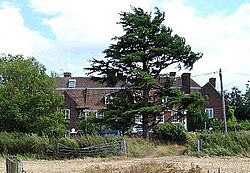
The main house at Bunce Court is a Grade II listed building, recognized by English Heritage. Dating back to 1547, the structure features 18th-century mathematical tiles on the front and wings added in 1896 and 1910. Today, the historic building has been renovated and divided into four separate residences.
| Feature | Details |
|---|---|
| Founded | 1933 (as New Herrlingen School) |
| Closed | July 27, 1948 |
| Location | Otterden, Kent, England |
| Enrollment | 64–140 pupils |
| Annual Fees | £100 per year |
| Religious Affiliations | Jewish, Quaker |
Frequently Asked Questions
Why was the school moved from Germany to England?
The school was moved because the rise of the Nazi Party and increasing antisemitism made it impossible to operate. Specifically, the Nazis prohibited Jewish students from taking the abitur exam, which was necessary for university education, prompting Anna Essinger to find a safe haven in England.
What was the educational philosophy of Bunce Court?
Bunce Court followed a progressive education system, which focused on the individual needs of the student, small class sizes, and a blend of academic and practical learning, including gardening and carpentry.
Who were the primary students at the school?
The school primarily served Jewish refugees fleeing Nazism, though it was co-educational and included some non-Jewish students and staff.
What happened to the original Landschulheim Herrlingen site?
After the school moved to England, the site was seized by the Nazis in 1934. It later became a forced home for Jewish seniors before being closed in 1942. Between 1943 and 1945, it was occupied by Erwin Rommel and his family.
Is the Bunce Court building still standing?
Yes, the main house is a Grade II listed building dating from 1547. It was renovated in 1984 and is currently divided into four separate residences.