Anna Essinger: The Educator Who Saved Hundreds from Nazi Germany
Anna Essinger was more than an educator; she was a lifeline for children fleeing the horrors of the Third Reich. A German Jewish woman of immense courage and conviction, Essinger is best remembered for the audacious act of relocating her entire school—students, staff, and all—from Germany to England in 1933 to escape the rising tide of Nazism.
Her life was defined by a commitment to humanitarianism and a belief in a holistic approach to education. From her early influences in the United States to her final years in Kent, Essinger dedicated her existence to the motto: "Give children a hand, give them a chance."
Key Facts
- Born: September 15, 1879, in Ulm, Germany.
- Major Achievement: Moved the Landschulheim Herrlingen school and 66 children to England in 1933.
- Bunce Court School: The English successor to her German school, which eventually cared for over 900 children.
- Humanitarian Work: Established a reception camp for 10,000 children arriving via the Kindertransports.
- Educational Philosophy: Emphasized physical exercise, spoken languages, and learning through living.
Early Life and Quaker Influence
Born in Ulm to Leopold and Fanny Essinger, Anna was the eldest of eight children. At age 20, she moved to Nashville, Tennessee, to live with her aunt. It was here that she encountered the Quakers (the Religious Society of Friends), whose peaceful and humanitarian attitudes profoundly shaped her worldview.
Essinger pursued higher education with determination, financing her studies by teaching German and running a private student hostel. She earned a Master of Arts in education from the University of Wisconsin, where she also lectured in Madison. In 1919, she returned to Germany on a Quaker war relief mission, working to establish kitchens to ensure children had at least one hot meal a day.
The Founding of Landschulheim Herrlingen
In 1912, Anna's sister, Klara Weimersheimer, had founded an orphanage in Herrlingen for children with disabilities or those deemed "problem children." By 1926, the family expanded this vision, transforming the orphanage into a Landschulheim (a rural boarding school). Anna Essinger took the helm as headmistress, creating a private institution that began with just 18 children.
Essinger's approach to education was revolutionary for its time. She believed in "learning through living," integrating education into daily activities like walks in the woods and household tasks. The school emphasized physical health, requiring exercise before breakfast, and linguistic fluency, utilizing "English" and "French" tables during meals to encourage spoken language over rote writing.
Escaping the Third Reich
As Adolf Hitler rose to power, Essinger recognized the imminent danger to her mostly Jewish student body. She quietly boycotted the regime; most notably, when ordered to fly the Nazi swastika flag on Hitler's birthday in 1933, she organized a hiking trip for her pupils so the flag would fly over an empty building.
Realizing the school had no future in Germany, Essinger secured parental permission and orchestrated a disguised exodus. On September 5, 1933, she led 66 children and her staff to southern England. To ensure a continued sanctuary in Germany, she did not formally close the school but handed it over to Hugo Rosenthal, who maintained it as a center for Jewish life.
Bunce Court and the Kindertransports
In the village of Otterden, Kent, Essinger established the Bunce Court School in a manor house dating back to the era of Henry VIII. Despite meager funds and initial skepticism from British inspectors, the school became a beacon of stability and integration, involving children in local English community life through concerts and sports.
Following Kristallnacht in 1938, Essinger's humanitarian efforts expanded. She established a reception camp in Dovercourt to process 10,000 children arriving via the Kindertransports (the organized rescue effort that brought Jewish children from Nazi-controlled territories to Britain). She was deeply critical of the placement process, which she likened to a "cattle market" due to the superficial way children were selected by host families.
During World War II, the school was forced to evacuate to "Trench Hall" in Shropshire to avoid the defense zones of southern England, returning to Bunce Court only in 1946.
Later Years and Lasting Legacy
By the time Bunce Court closed in 1948, Anna Essinger had cared for over 900 children from Germany, Austria, Poland, Czechoslovakia, and England. Her final years of teaching were the most challenging, as she welcomed survivors of Nazi concentration camps who struggled to readjust to normal life.
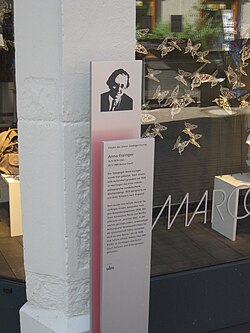
Essinger retired to Bunce Court, where she remained a beloved figure to her former pupils, who affectionately called her "Tante Anna" (Aunt Anna) or "TA." Her legacy lives on through her students, many of whom achieved distinction in the arts and sciences, and through the schools in Ulm that now bear her name.
| Institution | Location | Period | Primary Focus |
|---|---|---|---|
| Landschulheim Herrlingen | Herrlingen, Germany | 1926–1933 | Rural boarding school for Jewish children |
| Bunce Court School | Otterden, Kent, England | 1933–1948 | Refugee education and sanctuary |
| Dovercourt Camp | Dovercourt, England | Post-1938 | Reception for Kindertransport children |
Frequently Asked Questions
What was the Bunce Court School?
Bunce Court was a boarding school established by Anna Essinger in Kent, England, after she rescued her students and staff from Nazi Germany in 1933. It served as a sanctuary and educational center for over 900 refugee children, including survivors of concentration camps.
How did Anna Essinger move her school out of Germany?
With the approval of the parents, Essinger arranged a well-disguised trip for 66 children and her teachers. They arrived in southern England on September 5, 1933, effectively relocating the entire institution to escape Nazi persecution.
What was Essinger's philosophy on education?
She believed in a holistic, "learning through living" approach. This included a strong emphasis on physical exercise before breakfast, the use of immersive language tables (English and French) during meals, and integrating arts and nature into the daily curriculum.
What role did Essinger play in the Kindertransports?
Essinger established and managed a reception camp in Dovercourt for 10,000 German children arriving in England. She also helped find foster families and integrated some of these refugee children into her own school.
How is Anna Essinger remembered today?
She is honored with a commemorative plaque in Ulm, and both a realschule (secondary school) and a gymnasium in her hometown of Ulm are named after her. She is also included in the Oxford Dictionary of National Biography.