Buffalo Bill's Wild West: The Legend and Legacy of Cody's Global Spectacle
Long before the cinematic Westerns of Hollywood, William "Buffalo Bill" Cody created a living spectacle that brought the American frontier to the world. What began as a modest stage debut evolved into a massive, international touring phenomenon that blended history, skill, and theatrical flair, shaping the global perception of the American West for generations.
Cody's journey into entertainment started in December 1872 in Chicago. Alongside his friend Texas Jack Omohundro, he appeared in The Scouts of the Prairie, produced by Ned Buntline. While critics were unimpressed—one famously compared Cody's acting to that of a "diffident schoolboy"—the public loved it, and the shows consistently sold out.
The Evolution of the Show
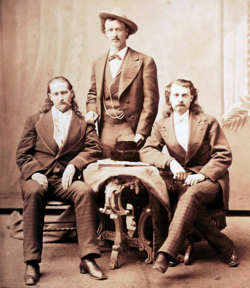
In 1873, Cody expanded his troupe by inviting the legendary Wild Bill Hickok to join the play Scouts of the Plains. However, Hickok proved ill-suited for the stage; he often hid behind scenery and once even shot at the spotlight when it focused on him, leading to his departure after a few months. By 1874, Cody founded the Buffalo Bill Combination, a troupe that toured for a decade while Cody spent his off-seasons scouting the prairies.
The true turning point came in 1883 in North Platte, Nebraska, where Cody established Buffalo Bill's Wild West. Contrary to popular belief, the word "Show" was not part of the official title. This circus-like attraction grew in scale and sophistication, particularly after Cody partnered with theatrical manager Nate Salsbury and big-game hunter Evelyn Booth in 1886.
Musical and Artistic Integration
A key component of the experience was the Buffalo Bill's Cowboy Band. Led by cornet player William Sweeney from 1883 to 1913, the band provided the soundtrack for the spectacle, with Sweeney composing and arranging the majority of the music performed.
The Spectacle: Performers and Events
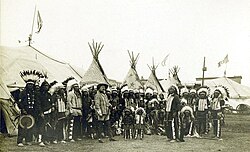
By 1893, the production was renamed Buffalo Bill's Wild West and Congress of Rough Riders of the World. The event opened with a grand equestrian parade featuring cowboys, American Indians, and international horse-culture representatives, including Turks, gauchos, Arabs, Mongols, and Georgians in traditional attire.
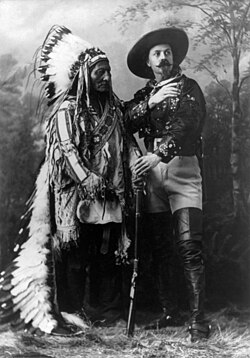
The show featured a roster of genuine frontier celebrities. Sharpshooters Annie Oakley and Frank Butler were headline acts, alongside Gabriel Dumont and Lillian Smith. The legendary Sitting Bull also appeared, accompanied by 20 of his soldiers.
Performances included high-energy reenactments of the Pony Express, stagecoach robberies, and Indian attacks on wagon trains. While legend suggests the show ended with Custer's Last Stand (with Cody as General Custer), the actual finale was typically a portrayal of an attack on a settler's cabin, where Cody and his cowboys would ride in to save a family. This finale was a staple of 23 out of 33 tours between 1886 and 1907. In 1893, the famous storyteller Calamity Jane also joined the cast.
Global Conquest and Royal Endorsements
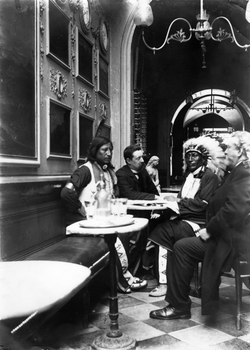
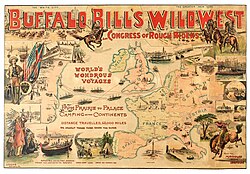
Buffalo Bill's Wild West was not just an American hit; it was a global sensation. In 1887, Cody took the show to Great Britain for Queen Victoria's Golden Jubilee. After a private preview impressed the Prince of Wales, Queen Victoria requested a command performance. This royal endorsement, along with accolades from generals like William T. Sherman and Philip H. Sheridan, catapulted Cody to international fame.
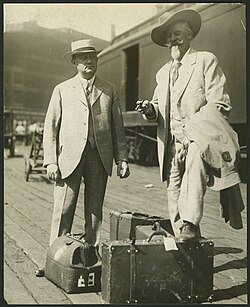
During this period, Governor John M. Thayer of Nebraska appointed Cody as an aide-de-camp with the rank of colonel. While largely honorary, the British press embraced the title, and he became known worldwide as "Colonel Cody."
European Tours and Cultural Impact
The show toured Europe eight times between 1887 and 1906. Highlights included:
- Paris (1889): Performed during the Exposition Universelle, coinciding with the debut of the Eiffel Tower.
- Italy (1890): Cody met Pope Leo XIII and performed in the ancient Roman amphitheater at Verona.
- Germany (1891): A performance in Karlsruhe's Südstadt Quarter was so impactful that residents there are still nicknamed Indianer (American Indians) today.
- Scotland (1891-92): A successful run in Dennistoun, Glasgow.
![Buffalo Bill statue commemorating his 1891–92 Wild West Show at Dennistoun, Glasgow.[45]](/images/ce/f6/cef6ff27c30a430837fdbe6395d5b4936ec069a90fd00a1686114f9e4e8b35cb.jpg)
However, the tours were not without tragedy. Several Native American performers, including Surrounded by the Enemy, Paul Eagle Star, Long Wolf, and White Star Ghost Dog, died of disease or accidents during the European tours. Many were buried in London's Brompton Cemetery before their remains were repatriated to South Dakota in the late 1990s.
The Decline and Cinematic Legacy
Cody's success allowed him to build the 4,000-acre Scout's Rest Ranch in Nebraska, featuring an eighteen-room mansion. However, the show faced a devastating blow on October 29, 1901, when a freight train collided with the show's train near Lexington, North Carolina. The crash killed 110 horses and three young Native Americans, and left Annie Oakley with severe injuries. This disaster significantly disrupted the business.
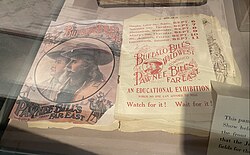
In 1908, Cody partnered with Pawnee Bill for the "Two Bills" show, but the venture ended in foreclosure in Denver, Colorado.
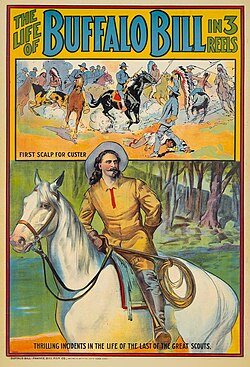
Cody's influence transitioned into early cinema. In 1894, Edison Studios filmed an early silent movie titled Buffalo Bill. Later, in 1912, the Buffalo Bill and Pawnee Bill Film Company produced The Life of Buffalo Bill, a three-reel film now held by the Library of Congress.
Key Facts
- Founder: William "Buffalo Bill" Cody.
- Peak Title: Buffalo Bill's Wild West and Congress of Rough Riders of the World (from 1893).
- Famous Performers: Annie Oakley, Sitting Bull, and Calamity Jane.
- Global Reach: Toured Europe eight times between 1887 and 1906.
- Royal Patronage: Received command performances for Queen Victoria and visits from King Edward VII.
- Tragedy: A 1901 train crash killed 110 horses and three performers, contributing to the show's decline.
| Year | Event/Milestone | Significance |
|---|---|---|
| 1872 | Stage Debut | First appearance in The Scouts of the Prairie. |
| 1883 | Founding of Wild West | Established the annual touring attraction in Nebraska. |
| 1887 | First UK Tour | Performed for Queen Victoria; Cody named "Colonel." |
| 1890 | Italian Tour | Met Pope Leo XIII; performed in Verona. |
| 1901 | North Carolina Crash | Major loss of livestock and life; crippled the show. |
| 1912 | The Life of Buffalo Bill | Release of the three-reel motion picture. |
Frequently Asked Questions
Was the show actually called "Buffalo Bill's Wild West Show"?
No. Contrary to popular belief, the word "Show" was not part of the official title; it was known as Buffalo Bill's Wild West (and later Buffalo Bill's Wild West and Congress of Rough Riders of the World).
Who were the most famous performers in the troupe?
The most prominent figures included the sharpshooters Annie Oakley and Frank Butler, the Lakota leader Sitting Bull, and the storyteller Calamity Jane.
How did Cody get the title of "Colonel"?
In 1887, Governor John M. Thayer of Nebraska appointed Cody as an aide-de-camp on the Governor's staff. While the rank had little official authority, the English press adopted the title "Colonel Cody" during his UK tours.
What caused the eventual demise of the show?
While several factors contributed, a catastrophic train crash in 1901 near Lexington, North Carolina, which killed 110 horses and several performers, put the show out of business for a period and likely accelerated its decline.
Did the show really reenact Custer's Last Stand?
While it is a common legend that the show ended with a reenactment of Custer's Last Stand, this is more myth than fact. The actual finale was typically a portrayal of an Indian attack on a settler's cabin.