British Burma: The History of Colonial Rule and the Path to Independence
The era of British colonial rule in Burma spanned from 1824 to 1948, a period marked by three major wars, shifting administrative structures, and a growing tide of nationalism. What began as a series of territorial acquisitions eventually evolved from a division of the Bengal Presidency into a province of British India, and finally into a separate Crown colony before achieving full independence.
Key Facts
- Duration: British rule lasted from 1824 to 1948.
- Administrative Evolution: Transitioned from a division of the Bengal Presidency (1824–1862) to a province of India (1862–1937), and then a Crown colony (1937–1948).
- Major Conflicts: Three Anglo-Burmese Wars led to the gradual annexation of the entire territory.
- Independence: Burma became a fully independent republic on January 4, 1948.
- World War II: The colony experienced a Japanese occupation from 1942 to 1945.
The Arrival of the British and the Anglo-Burmese Wars
Conflict between the British and the Konbaung dynasty began when Burma expanded into Arakan in the state of Assam, near British-held Chittagong. This tension sparked the First Anglo-Burmese War (1824–1826). British naval forces captured Rangoon in 1824, and after the defeat of General Maha Bandula at Danuphyu, Burma was forced to cede Assam and other northern provinces via the Treaty of Yandabo in 1826.
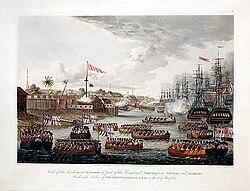
The First Anglo-Burmese War was the longest and most expensive in the history of British India, costing between 5 and 13 million pounds sterling and causing an economic crisis in British India by 1833. Following this, the Second Anglo-Burmese War led to the annexation of Lower Burma in 1852.
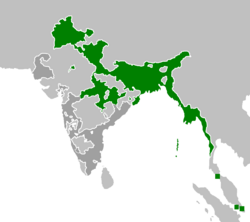
The final stage of conquest occurred during the Third Anglo-Burmese War in November 1885. The British government justified the invasion by claiming King Thibaw Min was a tyrant conspiring with France. British troops entered Mandalay on November 28, 1885, leading to the total annexation of Upper Burma.
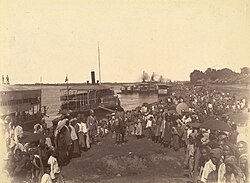
Following the war, King Thibaw was taken into exile in India, ensuring he would never return to his homeland.
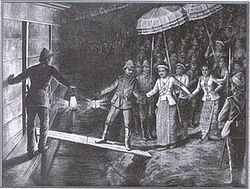
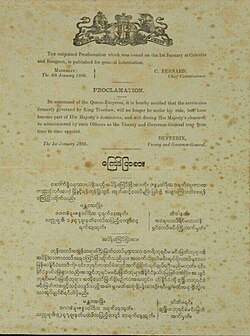
On January 1, 1886, the territory was officially proclaimed a province of the British Empire.
Colonial Administration and Economy
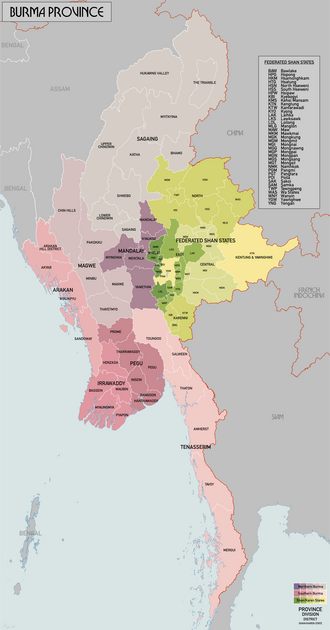
From 1886, Burma was administered as a province of British India. By 1897, it became a major province under a lieutenant-governorship. The administration was divided into Ministerial Burma (including the Pegu, Irrawaddy, and Tenasserim divisions) and Scheduled Areas, which included the Shan States and the Chin and Kachin tracts.
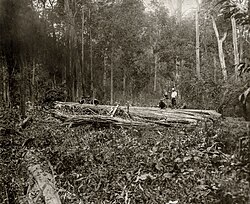
The colonial economy saw significant shifts, including large-scale resource extraction. This period was marked by environmental changes, including widespread deforestation driven by commercial interests.
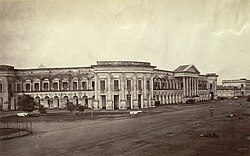
Urban centers like Rangoon grew rapidly, becoming hubs for judicial and public administration.
The Rise of Burmese Nationalism
Nationalist sentiment began to coalesce in the early 20th century. The Young Men's Buddhist Association (YMBA), formed in 1906, used religious association status to establish schools and organize. This movement was later succeeded by the General Council of Burmese Associations (GCBA).
By the 1920s, social discontent grew, fueled by economic disparities between the local population and Indian and Chinese migrants. Protests intensified in 1920 when the British government ignored calls for constitutional reforms in Burma that had been granted in India.
Separation from India and the 1300 Revolution
On April 1, 1937, Burma was separated from British India and established as a separate Crown colony. While this granted a fully elected assembly, many Burmese viewed it as a tactic to prevent them from benefiting from further Indian reforms. In 1938, the 1300 Revolution erupted, starting with strikes against the Burmah Oil Company (BOC). This period saw violent clashes in Mandalay and Rangoon, including the death of student Bo Aung Kyaw, who is still honored as a martyr.
World War II and the Path to Independence
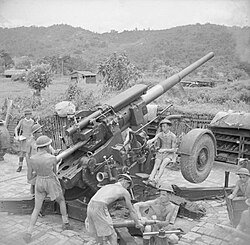
The Japanese Empire invaded in December 1941, controlling most of the colony by 1942. A puppet state, the State of Burma, was proclaimed in 1943 under Ba Maw. However, British-led forces, primarily from the British Indian Army, recaptured Rangoon in May 1945.
Post-war tensions led to strikes by the Rangoon police and government employees in 1946. Governor Sir Hubert Rance resolved the crisis by collaborating with Aung San and the Anti-Fascist People's Freedom League (AFPFL). This led to the Aung San-Attlee Agreement on January 27, 1947.
The Final Transition
Tragedy struck on July 19, 1947, when U Saw engineered the assassination of Aung San and several cabinet members. This date is now commemorated as Martyrs' Day. Thakin Nu subsequently formed a new cabinet and presided over the transition to independence. On January 4, 1948, Burma became a fully independent republic, opting not to remain a British Dominion.
| Period | Administrative Status | Key Capital(s) | Governing Body/Authority |
|---|---|---|---|
| 1824–1862 | Division of the Bengal Presidency | Moulmein (1826–1852) | British East India Company / Crown |
| 1862–1937 | Province of British India | Rangoon (1853–1942) | Government of India |
| 1937–1948 | Crown Colony of the United Kingdom | Rangoon (1945–1948) | Burma Office / Secretary of State |
Frequently Asked Questions
Why did the British first invade Burma?
The conflict began because the Konbaung dynasty expanded into Arakan in the state of Assam, which was close to British-held Chittagong in India, leading to the First Anglo-Burmese War.
What was the 1300 Revolution?
The 1300 Revolution was a wave of strikes and protests in 1938 that began in the oilfields of central Burma due to the mistreatment of workers by the British-owned Burmah Oil Company.
How did Burma's independence differ from India's?
Unlike India and Pakistan, which initially attained dominion status, Burma chose to become a fully independent republic upon its independence on January 4, 1948.
Who was Bo Aung Kyaw?
Bo Aung Kyaw was a Rangoon University student who became the first student martyr killed while fighting the British during protests at the Secretariat in Rangoon.
What happened during the Japanese occupation?
From 1942 to 1945, Japan controlled much of Burma and established a puppet state in 1943 led by Ba Maw, though insurgent activity remained pervasive until British-led forces recaptured the territory.