Bridge Engineering: Evolution, Design, and Structural Forms
A bridge is a critical engineering structure designed to span an obstacle—such as a river, valley, or railway—to allow vehicles, pedestrians, and other loads to pass safely across. At its most basic level, a bridge consists of a flat deck supported by beams, arches, or cables. This entire assembly rests on a foundation engineered to transfer the bridge's weight to the subsoil without settling, ensuring long-term stability.
The form of a bridge is dictated by its location, intended purpose, and the construction technologies available at the time of its creation. While early bridges were simple logs or rope crossings, the field has evolved into a sophisticated science. By 2022, the maximum achievable span for bridges reached 2 kilometers (1.2 miles), showcasing the incredible progress in material science and structural analysis.
Key Facts
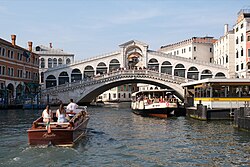
- Maximum Span: Modern engineering allowed bridge spans to reach 2 kilometers by 2022.
- Material Evolution: Bridges progressed from timber and stone to cast iron, mass-produced steel, and reinforced concrete.
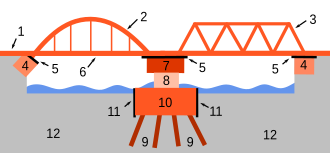
- Primary Components: Most bridges are divided into a superstructure (the deck and supports) and a substructure (piers and foundations).
- Critical Function: The primary goal of bridge design is the efficient transfer of loads from the deck to the subsoil.
The Evolution of Bridge Construction
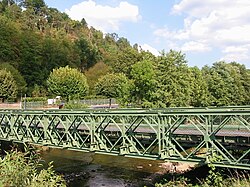
Antiquity and the Classical Era
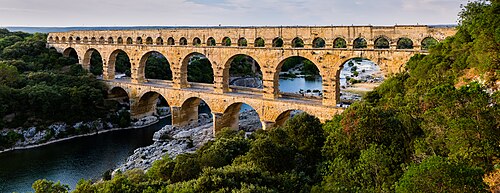
Ancient civilizations laid the groundwork for modern bridging. The Romans and ancient Chinese developed major arch bridges using timber, stone, and brick. These structures utilized the arch's natural ability to compress materials, allowing for greater durability and weight capacity.
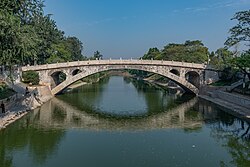
Further east, the Chinese developed innovative designs such as the shallow segmental arch, which allowed for more efficient water flow and material use.
The Renaissance to the Industrial Revolution
During the Renaissance, advances in science and engineering led to more elegant designs and wider spans. However, the most significant shift occurred during the Industrial Revolution with the advent of mass-produced steel. This material enabled the creation of complex forms, such as truss and cantilever bridges, which could cross deep valleys and wide rivers that were previously impassable.
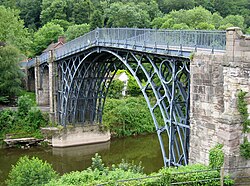
The transition to metal began with cast iron, as seen in the first major bridges of the late 18th century.
The Modern Era
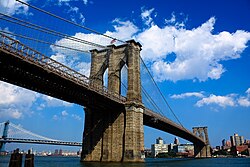
The 19th century saw the introduction of steel cables, which revolutionized suspension bridges. Steel's high tensile strength allowed for the longest spans in history. In the 20th and 21st centuries, the perfection of concrete and the development of cable-stayed and extradosed designs have further expanded the possibilities of bridge architecture.
Structural Forms and Types
Arch and Beam Bridges
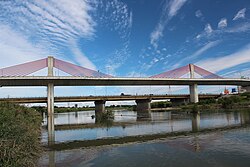
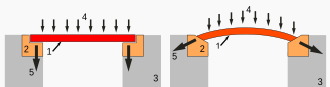
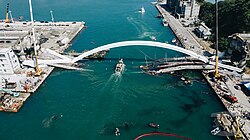
Beam bridges are the simplest form, consisting of horizontal beams supported at each end. Arch bridges use a curved structure to transfer vertical loads into diagonal compression forces, which are then absorbed by the abutments.
Truss and Cantilever Bridges
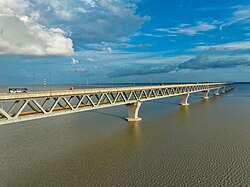
Truss bridges utilize a web of triangles to distribute loads, while cantilever bridges use structures that project horizontally into space, supported on only one end. These are often used for heavy rail traffic or wide crossings.
Suspension and Cable-Stayed Bridges
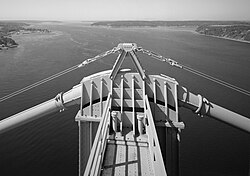
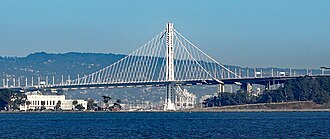
Suspension bridges use high-strength steel cables draped over towers and anchored at the ends to support the deck. Cable-stayed bridges differ by connecting the deck directly to the towers via straight cables in fan or harp patterns.
Specialized Bridge Forms
- Movable Bridges: Including drawbridges and swing bridges, these allow tall ships to pass.
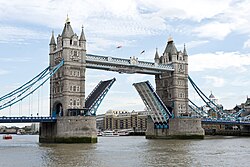
Tower Bridge in London is a movable bridge.[121] - Viaducts: Long, multi-span bridges used to cross wide valleys.
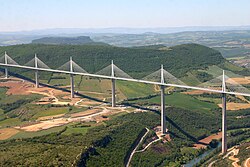
The Millau Viaduct crosses the Tarn river valley in France.[128] - Pontoon Bridges: Floating structures supported by concrete or metal pontoons.
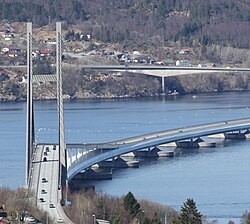
Floating concrete pontoons support the weight of the Nordhordland Bridge as it crosses a deep fjord in Norway.[146] - Water Bridges: Specialized structures that carry navigable waterways over other obstacles.
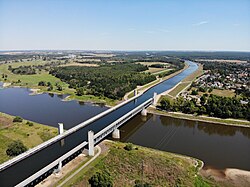
The Magdeburg Water Bridge in Germany carries boats across a valley.[55]
Engineering and Design Process
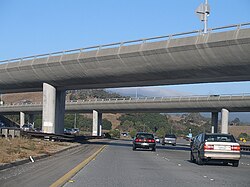
The Substructure and Superstructure
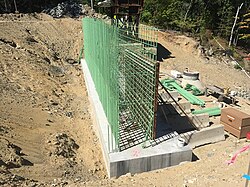
Bridge design is split into two main parts. The substructure includes the footings, pilings, and piers that anchor the bridge to the earth. In aquatic environments, steel cofferdams are often used to create dry work areas for pouring concrete piers.
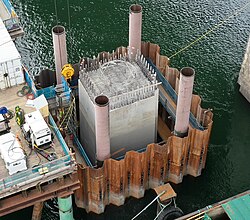
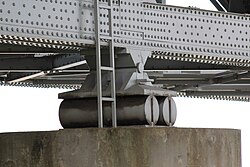
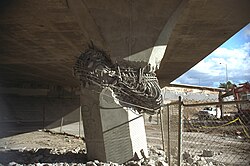
The superstructure consists of the deck, beams, and towers. To prevent damage from thermal expansion or seismic activity, bearings are placed between the superstructure and substructure to permit small, controlled movements.
Construction Techniques
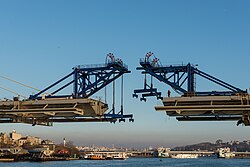
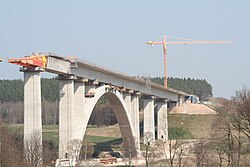
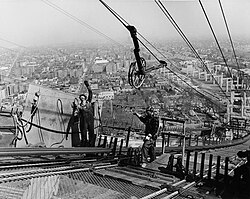
Modern bridges are assembled using various methods. Gantries may be used to gradually extend the deck, while jacks can be used to push arch decks horizontally into place. For suspension bridges, spinning wheels are used to pull individual wires to build massive cables.
Maintenance and Failure Prevention
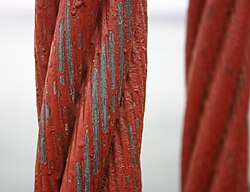
Steel components require periodic painting to prevent corrosion, which can lead to catastrophic structural failure if undetected. Regular inspections and monitoring are essential to ensure the safety of the bridge and its users.
| Bridge Type | Primary Support Mechanism | Typical Use Case | Key Material |
|---|---|---|---|
| Beam | Vertical support | Short spans, overpasses | Concrete/Steel |
| Arch | Compression | Valleys, aesthetic crossings | Stone/Concrete/Steel |
| Suspension | Tension (Cables) | Very long spans, deep water | High-strength Steel |
| Cable-Stayed | Direct cable tension | Medium to long spans | Steel/Concrete |
| Truss | Triangulated framework | Railways, heavy loads | Steel |
Frequently Asked Questions
What is the difference between a suspension bridge and a cable-stayed bridge?
In a suspension bridge, the deck is hung from vertical suspenders attached to main cables that drape over towers and are anchored at the ends. In a cable-stayed bridge, the cables run directly from the tower to the deck, creating a fan-like or harp-like appearance.
Why are bearings used in bridge construction?
Bearings are installed between the superstructure and the substructure to allow for small movements caused by temperature changes (expansion and contraction) or seismic vibrations, preventing the bridge from cracking or collapsing under stress.
What is a cofferdam?
A cofferdam is a temporary, watertight enclosure pumped dry to allow construction work—such as pouring a concrete bridge pier—to take place below the waterline.
How do engineers prevent steel bridges from corroding?
Engineers use protective coatings, such as paint, to seal the steel from moisture and oxygen. These bridges must be repainted periodically to maintain structural integrity and prevent corrosion-related failures.
What is the purpose of a viaduct?
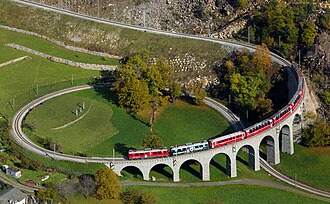
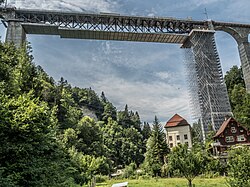
A viaduct is a specific type of long, multi-span bridge designed to carry a road or railway across a wide valley or a series of low-lying areas, maintaining a relatively level grade for transportation.