Brevet Ranks: The History and Evolution of Honorary Military Promotion
In the complex world of military hierarchy, a brevet is a warrant that grants a commissioned officer a higher rank as a reward, without necessarily providing the authority, privileges, or pay associated with that rank. Essentially, it allows an officer to hold a title—such as "Bvt. Maj. Gen."—that reflects their merit or service rather than their permanent position in the military structure.
It is important to distinguish a brevet from a Brevet d'état-major (a specific award in Francophone military circles) or a temporary commission. While a brevet is often honorary, its application has varied wildly across different nations and eras, serving as a tool for recognition, a solution for staffing shortages, or a means of managing seniority.
Key Facts
- Definition: An honorary or reward-based promotion that grants a higher title without always granting the corresponding authority or pay.
- US History: First used during the American Revolutionary War to accommodate foreign officers.
- Civil War Impact: Widely used in the Union Army for gallantry, often awarded posthumously or at the war's end.
- UK Application: Limited to ranks between captain and lieutenant-colonel and focused on distinguished field service.
- Modern Equivalent: While obsolete in the regular US military since 1922, the practice of frocking serves a similar purpose today.
Global Perspectives on Brevet Systems
France
In France, the term brevet has a broader meaning, referring to any document that certifies a person's capacity or qualification. For example, completing a military parachutism course results in the award of a brevet. Historically, the most prestigious was the brevet from the École de guerre (Staff College); between 1870 and 1940, graduates were known as officiers brevetés.
Unlike other nations, the French military does not use brevets for higher standing, preferring temporary commissions. A notable example is Charles de Gaulle, who was promoted to "provisional brigadier general" in 1940.
Germany and Spain
The Prussian and German forces utilized a similar concept called Charakter rank. This was often bestowed upon officers on the day of their retirement as a mark of honor. For instance, an Oberst (Colonel) might receive the Charakter als Generalmajor.
Spain employed a dual system in the 19th century, distinguishing between empleo (permanent rank) and graduación (honorary brevet rank). This was visually represented by stars for rank and gold lace on cuffs for the actual post. Though dropped in 1908, the system was revived by Nationalist forces during the Spanish Civil War (1936–39) to address a shortage of trained officers.
United Kingdom
In the British Army, brevet commissions were matters of courtesy, often granted during coronations or after major wars. By 1854, during the Crimean War, the government restricted these awards to cases of distinguished field service and seniority.
A unique aspect of the British system was that the brevet rank applied to the army overall, but not within the officer's own regiment. In the regiment, only the permanent rank counted. However, brevet rank could determine command of temporary units or staff positions. This created scenarios where a regimental major holding a brevet lieutenant-colonelcy could potentially command a brigade that included his own regiment.
The Brevet System in the United States
The U.S. Army established the use of brevets in 1776. Initially, these commissions allowed officers to be identified by a higher rank but had limited impact on pay or command unless the President specifically assigned the officer to a duty at that brevet rank.
During the American Revolutionary War, brevets were frequently used for foreign officers, such as Jacques Antoine de Franchessin, who received the first U.S. brevet on July 20, 1776. In the 19th century, brevets helped the Army manage limited congressional quotas for permanent ranks, allowing officers to command frontier forts at a rank appropriate for the mission.
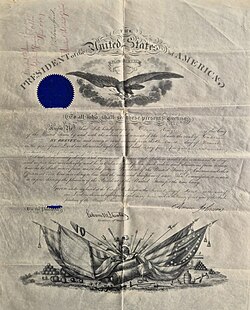
The American Civil War
The Civil War saw a massive surge in brevet awards. An act of Congress on March 3, 1863, extended these awards to officers of the United States Volunteers. Because officers could hold ranks in both the Regular Army and the Volunteers, some held up to four different ranks simultaneously.
For example, Ranald S. Mackenzie was simultaneously a brevet major general of volunteers, a full-rank brigadier general of volunteers, a brevet brigadier general in the Regular Army, and a Regular Army captain. Most Union brevets were honorary, conferred for gallantry or awarded posthumously as the war ended in March 1865.
Confederate and Marine Corps Usage
The Confederate States of America also utilized brevets, based largely on U.S. Army regulations. A notable example is Stephen Dodson Ramseur, who became the youngest West Point graduate promoted to major general in the Confederate Army at age 27.
The U.S. Marine Corps also issued brevets, later creating a rare Brevet Medal for living officers who had been brevetted between 1861 and 1915.
Modern Evolution and Current Usage
The formal practice of brevetting in the U.S. military ended in the 19th century and was declared obsolete in 1922, replaced by a system of medals. However, a similar practice called frocking persists. Frocking allows an officer selected for promotion to wear the rank and hold the title of the higher grade before the official promotion date, often to meet the requirements of a specific assignment.
Additionally, the 2019 John S. McCain National Defense Authorization Act reintroduced 770 brevet positions to the Army. This modern program allows for temporary promotion to a higher rank in critical billets, including the associated pay and benefits, to provide greater flexibility in talent management.
| Country | Term/Type | Primary Purpose | Key Characteristic |
|---|---|---|---|
| United States | Brevet Commission | Reward/Staffing | Often honorary; limited pay/authority unless assigned. |
| United Kingdom | Brevet Commission | Distinguished Service | Rank applied to Army, but not to the officer's regiment. |
| France | Brevet | Certification | Broadly refers to qualification documents (e.g., parachutism). |
| Germany | Charakter rank | Honorary | Frequently awarded upon retirement. |
| Spain | Graduación | Honorary | Distinguished from permanent rank (empleo) via uniforms. |
Frequently Asked Questions
What is the difference between a brevet rank and a permanent rank?
A permanent rank is the officer's actual grade in the military hierarchy, determining their base pay and seniority. A brevet rank is an honorary or temporary title granted as a reward or for a specific assignment, which may not carry the same pay or authority as a permanent promotion.
Did brevet ranks provide more money to officers?
Generally, no. In most systems, such as the Union Army during the Civil War, brevet ranks were honorary. However, in the U.S. Army, if the President specifically assigned an officer to duty at their brevet rank, they would receive the pay associated with that higher rank for the duration of the assignment.
What is "frocking" in the modern military?
Frocking is the modern equivalent of brevetting. It allows an officer who has been selected for promotion to wear the insignia and hold the title of the higher rank before the official promotion date, typically to ensure they have the necessary perceived authority for a specific role.
How did the British Army handle brevet ranks within regiments?
In the British Army, a brevet rank was recognized across the army but ignored within the officer's own regiment. For duties within the regiment, only the permanent rank counted; however, the brevet rank could be used to determine command when the officer was part of a larger, multi-unit formation.
Why were brevets so common during the American Civil War?
Brevets were used extensively to reward gallantry and meritorious service without increasing the number of permanent high-ranking officers. They were also used to manage the complex overlap between the Regular Army and the United States Volunteers.