Brain Vesicles: The Early Architecture of the Vertebrate Brain
The development of the vertebrate brain begins not as a complex organ, but as a series of bulge-like enlargements known as brain vesicles. These structures emerge from the early neural tube, serving as the foundational blueprints that eventually differentiate into the sophisticated regions of the adult brain.
The Timeline of Vesicle Formation
Vesicle formation begins shortly after the rostral (head-end) closure of the neural tube. The timing of this process varies significantly across different species, reflecting the diverse developmental rates of vertebrates:
- Humans: Occurs during the fourth and fifth gestational weeks.
- Mice: Begins around embryonic day 9.0.
- Chickens: Forms approximately 48 hours post-conception.
- Zebrafish: Forms approximately 24 hours post-conception.
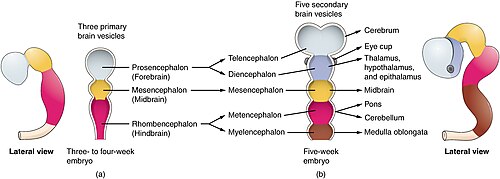
From Primary to Secondary Vesicles
The brain does not reach its final form immediately. It progresses through two distinct stages of organization: the primary vesicles and the secondary vesicles.
The Three Primary Vesicles
Initially, the neural tube expands into three primary regions:
- Prosencephalon: The forebrain.
- Mesencephalon: The midbrain.
- Rhombencephalon: The hindbrain.
The Five Secondary Vesicles
As development continues, these primary structures further subdivide to create five secondary vesicles. The mesencephalon remains unchanged, while the others split:
- The prosencephalon divides into the telencephalon and diencephalon.
- The rhombencephalon divides into the metencephalon and myelencephalon.
| Primary Vesicle | Secondary Vesicle(s) | Common Name |
|---|---|---|
| Prosencephalon | Telencephalon & Diencephalon | Forebrain |
| Mesencephalon | Mesencephalon | Midbrain |
| Rhombencephalon | Metencephalon & Myelencephalon | Hindbrain |
Cellular Growth and Neurogenesis
The rapid expansion of these vesicles is driven by specialized cells located within the walls of the neural tube. This region is known as the neuroepithelium (or the ventricular zone), which contains neural stem cells.
Initially, these stem cells divide rapidly to fuel the growth of the early brain. Over time, they transition from simple proliferation to neurogenesis—the biological process by which these stem cells generate neurons, building the actual circuitry of the nervous system.
Key Facts
- Brain vesicles are the precursors to the vertebrate brain, originating from the neural tube.
- Development begins with three primary vesicles: prosencephalon, mesencephalon, and rhombencephalon.
- These eventually evolve into five secondary vesicles: telencephalon, diencephalon, mesencephalon, metencephalon, and myelencephalon.
- The neuroepithelium (ventricular zone) is the site where neural stem cells reside and divide.
- Neurogenesis is the process where neural stem cells begin producing neurons.
Frequently Asked Questions
What are brain vesicles?
Brain vesicles are bulge-like enlargements of the early neural tube in vertebrate embryos that eventually develop into the different regions of the brain.
When do brain vesicles form in humans?
In human embryos, brain vesicle formation occurs during the fourth and fifth gestational weeks.
What is the difference between primary and secondary vesicles?
Primary vesicles are the first three enlargements (forebrain, midbrain, and hindbrain). Secondary vesicles are the five more refined structures that result when the forebrain and hindbrain subdivide.
What is the role of the neuroepithelium?
The neuroepithelium, also called the ventricular zone, contains the neural stem cells that divide rapidly to grow the brain and eventually undergo neurogenesis to create neurons.
What is neurogenesis?
Neurogenesis is the process by which neural stem cells in the developing brain generate neurons.