Boutell and the Legacy of English Heraldry
The study of heraldry—the system by which coats of arms and other hereditary symbols are devised and granted—owes much of its popular accessibility to the work of Boutell. A man of diverse academic and ecclesiastical interests, Boutell transitioned from a career in the church to become one of the most influential authors of heraldic handbooks in the 19th century.
Early Life and Academic Foundation
Boutell was born in Pulham St Mary, Norfolk, to the Rev. Charles Boutell. His academic journey began at St John's College, Cambridge, where he earned his BA in 1834. He furthered his education at Trinity College, Oxford, receiving his MA in 1836.
Ecclesiastical Career
Before establishing himself as a heraldic authority, Boutell served the church in several capacities. He began as a curate in Hemsby, Norfolk, and later served at St Leonard's Church in Sandridge, Hertfordshire, from 1837 to 1846. It was during this tenure, in 1839, that he was ordained as a priest.
His leadership roles continued as he became the rector of Downham Market (1847–1850) and the vicar of Wiggenhall St Mary Magdalen, Norfolk (1847–1855). Upon relocating to London in 1855, he continued his religious service, including a role as a reader at St Luke's, Lower Norwood, Surrey, between 1860 and 1867.
Contributions to Archaeology and Architecture
Beyond the pulpit, Boutell was deeply invested in the preservation of history. He served as the secretary of the St Albans Architectural Society, which was established in 1845. In 1855, he helped found the London and Middlesex Archaeological Society.
Boutell also maintained a long-standing relationship with the Surrey Archaeological Society. For the first forty years of the society's existence, he was a regular lecturer during their annual excursions, sharing his expertise with fellow historians and enthusiasts.
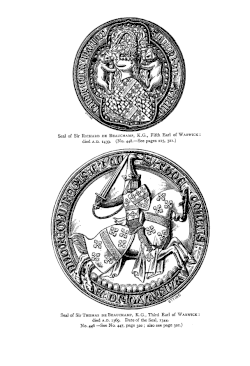
The Definitive Works on Heraldry
Boutell's most enduring legacy is his contribution to heraldic literature. In 1863, he published A Manual of Heraldry, Historical and Popular. The book was an immediate success, requiring a second edition—retitled Heraldry, Historical and Popular—within just two months, followed by a third edition in 1864.
He later released a more concise companion volume, English Heraldry, in 1867. This work saw a second edition in 1871 and was subsequently revised by other experts, including S.T. Aveling in 1892 and A.C. Fox-Davies in 1907.
These texts became standard references for the public. In 1931, V. Wheeler-Holohan edited Boutell's Manual of Heraldry, synthesizing both of Boutell's original works. The lineage of these publications continued through the mid-to-late 20th century with revisions by C.W. Scott-Giles (1950–1966) and J.P. Brooke-Little (1963–1983), eventually titled simply as Boutell's Heraldry.
Key Facts
- Education: BA from St John's College, Cambridge (1834) and MA from Trinity College, Oxford (1836).
- Ordination: Ordained as a priest in 1839.
- Societies: Co-founder of the London and Middlesex Archaeological Society (1855) and secretary of the St Albans Architectural Society.
- Major Work: A Manual of Heraldry, Historical and Popular (1863).
- Longevity: His heraldic works remained in print and were revised as late as 1983.
| Title | First Published | Notable Revisions/Editors |
|---|---|---|
| A Manual of Heraldry, Historical and Popular | 1863 | V. Wheeler-Holohan (1931) |
| English Heraldry | 1867 | S.T. Aveling (1892), A.C. Fox-Davies (1907) |
| Boutell's Heraldry | Later Revisions | C.W. Scott-Giles, J.P. Brooke-Little |
Frequently Asked Questions
Where was Boutell born?
Boutell was born in Pulham St Mary, Norfolk, as the son of the Rev. Charles Boutell.
What were Boutell's most successful books?
His most successful works were A Manual of Heraldry, Historical and Popular and the shorter companion volume, English Heraldry.
Which archaeological societies was Boutell involved with?
He was the secretary of the St Albans Architectural Society, a founder of the London and Middlesex Archaeological Society, and a long-term lecturer for the Surrey Archaeological Society.
Who revised Boutell's work in the 20th century?
His work was revised by V. Wheeler-Holohan in 1931, C.W. Scott-Giles between 1950 and 1966, and J.P. Brooke-Little between 1963 and 1983.
What was Boutell's professional background before writing?
Boutell was a priest who served as a curate in Hemsby and Sandridge, the rector of Downham Market, and the vicar of Wiggenhall St Mary Magdalen.