Bombyx mori: The Biology and History of the Domestic Silk Moth
The Bombyx mori, commonly known as the domestic silk moth, is one of the most economically significant insects in human history. For millennia, this species has been the cornerstone of sericulture—the practice of breeding silk moths to produce raw silk. From its origins in ancient China to its current role as a vital model organism in genetic research, the silkworm represents a unique intersection of agriculture, industry, and science.
Domesticated from the wild silk moth Bombyx mandarina, the B. mori has been selectively bred for thousands of years. While its wild ancestor is found across northern India, China, Korea, Japan, and eastern Russia, the domestic variety is derived specifically from Chinese stock.
Key Facts
- Origin: Domesticated in China over 5,000 years ago.
- Primary Product: Raw silk fibers, ranging from 300 to 900 meters per cocoon.
- Diet: Primarily mulberry leaves, though some strains can use artificial diets.
- Global Production: At least 32 million kilograms of raw silk are produced annually.
- Scientific Role: Used as a model organism for studying genetics, pheromones, and arthropod biology.
Life Cycle and Physical Description
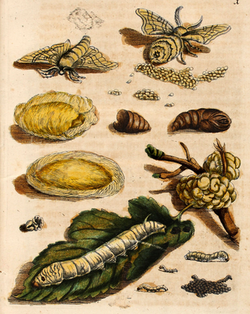
The life cycle of Bombyx mori is a classic example of complete metamorphosis, progressing from egg to larva, pupa, and finally the adult moth.
Larvae (The Silkworm)
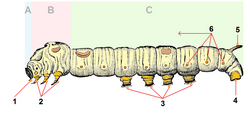
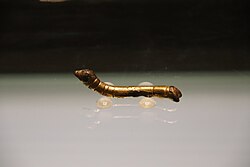
The larval stage is where the majority of the insect's growth occurs. These larvae are highly specialized feeders. While they primarily consume mulberry leaves, research has identified specific nutritional requirements; for instance, the removal of glutamate and aspartate can impede their development.
Pupae and the Silk Cocoon
When the larva reaches the pupal stage, it spins a cocoon made of a single continuous thread of raw silk. These fibers are remarkably fine, measuring approximately 10 μm in diameter. A single cocoon can contain between 300 and 900 meters of silk.
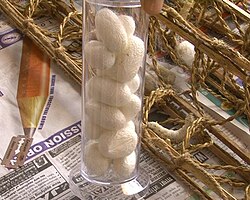
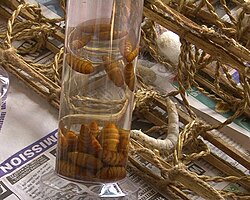
To harvest the silk, the conventional sericulture process involves killing the silkworm while it is still in the pupal stage. It takes approximately 4,000 to 7,000 cocoons to produce one kilogram of final silk yield.
The Adult Moth
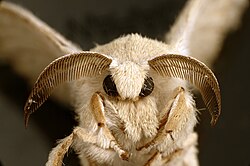
The adult phase is characterized by a white, hairy body and a wingspan of 3–5 cm. There is a notable difference in size between the sexes: females are two to three times bulkier than males because they carry a large volume of eggs. Interestingly, adult moths in the Bombycidae family have reduced mouthparts and do not feed, focusing their short lives entirely on reproduction.
Scientific Research and Genomic Insights
Because they are easy to culture and small in size, B. mori is a primary model organism for lepidopteran and general arthropod biology. Researchers have used silkworms to make fundamental discoveries in physiology and brain structure.
Pheromones and Genetics
The silkworm was instrumental in the molecular identification of bombykol, the first known pheromone. Due to the tiny amount produced by each insect, extracts from 500,000 individuals were required for its identification. In genetics, over 400 Mendelian mutations have been described, and up to 1,000 inbred domesticated strains are maintained worldwide.
Genomic Breakthroughs
The full genome of the domestic silk moth, published in 2008, consists of approximately 432 million base pairs. About 43.6% of the genome is composed of repetitive sequences. Scientists have discovered that the silkworm's ability to digest toxic mulberry leaves is linked to specialized sucrase genes likely acquired from bacteria.
Modern Biotechnology
Recent innovations have pushed the boundaries of what silkworms can produce. Collaborative efforts between Kraig Biocraft Laboratories and various universities successfully created genetically altered silkworms that produce spider silk. Additionally, researchers at the MIT Media Lab have used silkworms to weave complex architectural structures, such as a silk pavilion.
Domestication and Cultural Impact
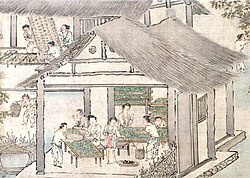
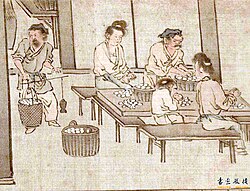
Archaeological evidence links the domestication of the silk moth to the Yangshao culture of northern China more than 5,000 years ago. This early agricultural success was often paired with aquaculture; common carp were raised in ponds on silk farms and fed with silkworm larvae and feces.
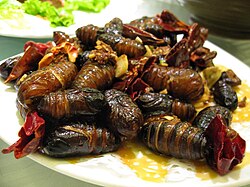
Beyond industry, silkworms have a place in gastronomy and medicine. In some cultures, roasted pupae are sold as food, and silkworm droppings are used in traditional Chinese medicine.
Disease and Management
The most significant threat to sericulture is Pébrine, a disease caused by the parasitic microsporidian Nosema bombycis. This parasite is transmitted through contaminated food and can be passed from moths to eggs. Infected larvae exhibit slow growth, pale bodies, and tiny black spots on their skin. Because 100% of silkworms hatched from infected eggs die, farmers must use microscopes to check the body fluid of moths to ensure only healthy eggs are used.
| Feature | Detail |
|---|---|
| Scientific Name | Bombyx mori |
| Wild Ancestor | Bombyx mandarina |
| Cocoon Silk Length | 300 – 900 meters |
| Silk Fiber Diameter | ~10 μm |
| Genome Size | ~432 million base pairs |
| Primary Diet | Mulberry leaves |
Frequently Asked Questions
How much silk does one silkworm produce?
A single silkworm produces a cocoon containing a thread of raw silk that is between 300 and 900 meters (1,000 to 3,000 feet) long.
Do adult silk moths eat?
No, all adult Bombycidae moths, including Bombyx mori, have reduced mouthparts and do not feed during their adult stage.
What is the difference between the male and female moth?
Females are significantly larger—approximately two to three times bulkier than males—because they carry many eggs.
How is Pébrine disease prevented in silk farming?
Prevention is achieved by screening the body fluid of female moths under a microscope to identify and rule out those infected with Nosema bombycis before they lay eggs.
Can silkworms eat things other than mulberry leaves?
While mulberry leaves are their natural primary food, research has developed strains of silkworms capable of feeding on artificial diets.