Blondins: The Evolution of Industrial Quarry Cableways
In the demanding environment of 19th-century mining, transporting heavy raw materials across deep pits and rugged terrain presented a significant engineering challenge. The solution arrived in the form of the Blondin, a specialized aerial cableway system designed to move heavy loads efficiently across vast distances and depths.
The Origins of the Blondin System
The Blondin was developed by John Fyfe, a Scottish quarry engineer. Fyfe pioneered the technology in 1872 when he installed the first system at the Kemnay granite quarry in Garioch. These early iterations relied on iron ropes to support and move the loads.
As industrial demands grew, the technology evolved. In 1896, John M. Henderson and Co. launched the first commercially available Blondin system. This version marked a critical technical leap by replacing iron ropes with steel ropes, which offered significantly greater strength and durability.
Implementation in the Slate Industry
The adoption of Blondins expanded into the Welsh slate industry at the turn of the century. In 1899, the Pen-yr-Orsedd quarry became the first Welsh slate site to implement the system, installing a pair of Blondins powered by stationary steam engines.
One of the most notable applications occurred at the Penrhyn quarry in Bethesda. This site featured a massive central pit exceeding 400 feet in depth, which was worked through a series of terraces. To manage the logistics of moving slate from these terraces to the processing mills, the quarry utilized a combination of transport methods.
While Penrhyn already employed an extensive internal narrow gauge railway and various inclines, Blondins were introduced in 1913 to bridge the gap to more remote terraces. These systems were unique because they transported rock using railway wagons slung from cradles.
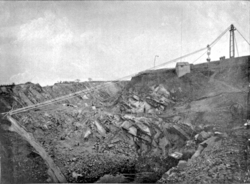
The operational flow was highly efficient: the ropeways traveled horizontally or nearly horizontally until the cradle reached a designated stop. At this point, the wagons were automatically lowered to ground level, where they were integrated back into the rail system for final loading or unloading.
Key Facts
- Inventor: Developed by Scottish engineer John Fyfe.
- First Installation: 1872 at Kemnay granite quarry.
- Material Evolution: Shifted from iron ropes to steel ropes in 1896 via John M. Henderson and Co.
- Power Source: Early Welsh installations used stationary steam engines.
- Penrhyn Application: Used to connect remote terraces in a pit over 400 feet deep.
Blondin System Summary
| Milestone/Location | Year | Key Feature/Contribution |
|---|---|---|
| Kemnay Granite Quarry | 1872 | First installation by John Fyfe (iron ropes) |
| John M. Henderson and Co. | 1896 | First commercial system (steel ropes) |
| Pen-yr-Orsedd Quarry | 1899 | First Welsh slate installation (steam powered) |
| Penrhyn Quarry | 1913 | Integration of railway wagons in cradles |
Frequently Asked Questions
Who invented the Blondin system?
The Blondin was developed by John Fyfe, a Scottish quarry engineer, with the first example installed in 1872.
How did the materials used in Blondins change over time?
The original systems used iron ropes, but by 1896, John M. Henderson and Co. introduced commercial systems that utilized stronger steel ropes.
How were Blondins powered in early Welsh quarries?
At the Pen-yr-Orsedd quarry, the Blondin systems were powered by stationary steam engines.
How did the Penrhyn quarry use Blondins differently?
Penrhyn used Blondins to connect remote terraces to mills by slinging railway wagons from cradles, which were then automatically lowered to ground level for rail transport.
What was the depth of the pit at Penrhyn quarry?
The single large pit at Penrhyn quarry was over 400 feet deep.