Bird Species and the Impact of Climate Change
Anthropogenic (human-caused) climate change is fundamentally altering the natural world, and birds are among the most visible indicators of these shifts. From changes in physical appearance to the timing of migration, avian species are struggling to adapt to a rapidly warming planet. Researchers are now using a combination of modern tracking and the analysis of museum specimens to understand how these changes unfold and to predict future extinction risks.
While the transition to green energy—such as wind power—presents its own set of environmental challenges, experts estimate that the direct impact of wind turbines is significantly less threatening to bird populations than the overarching effects of global warming.
Key Facts
- Temperature Rise: The Earth has warmed by approximately 1.1 °C (2.0 °F) since the Industrial Revolution.
- Extinction Risk: Every degree of warming is estimated to result in 100 to 500 land bird extinctions.
- Physical Shifts: Some species are completing the transition from nesting to adult plumage earlier in their lifecycles.
- Habitat Loss: Under high-warming scenarios, over 50% of bird species could lose at least some of their habitat by 2100.
- Vulnerable Regions: Tropical environments are predicted to see the highest percentage of extinctions.
The Drivers of Avian Change
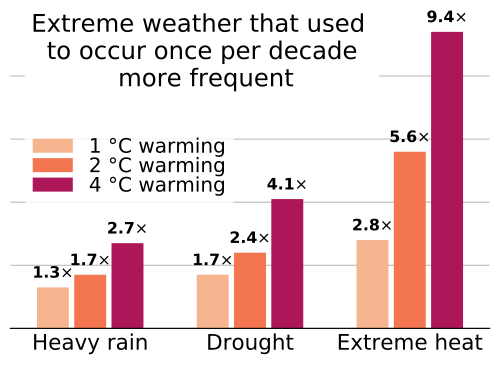
The primary driver of these changes is the increase in global temperatures caused by greenhouse gas emissions. Depending on future mitigation efforts, warming by the end of the century could range from a modest increase of less than 0.4 °C (following the 1.5 °C Paris Agreement goal) to as much as 3.5 °C (4.5 °C from preindustrial levels) if emissions continue to rise sharply.
Physical and Morphological Alterations
Climate change is not just affecting where birds live, but how they look. By comparing modern birds with museum specimens from the 1800s, scientists have discovered that juvenile passerines (perching birds) now switch from nesting feathers to adult plumage earlier. Interestingly, females now complete this shift earlier than males, reversing the historical trend.
![Museum specimens of Collared flycatcher (top) and Eurasian blackbird (bottom) juveniles compared with modern-day birds. Nesting feathers are replaced with adult plumage earlier, and females now complete the shift earlier than males, while in the past it was the opposite.[10]](/images/0f/be/0fbec6a0bb63bdaea3647a953678bc897eb361c392dfb991e1bb0bfb8930562c.png)
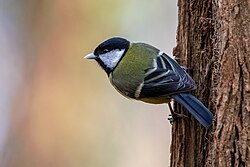
Coloration is also in flux. In Mediterranean France, studies conducted between 2005 and 2019 revealed that the contrasting blue and yellow feathers of blue tits have become less bright and intense.
Phenology and Extreme Weather Events
Phenology—the study of cyclic and seasonal natural phenomena—shows that birds are shifting their life cycles. However, these shifts can be disrupted by extreme weather. Climate change increases the frequency and severity of wildfires by drying out vegetation and reducing snowpack.
While many birds can fly away from immediate flames, wildfire smoke poses a lethal threat, particularly to migratory species. In 2020, an unprecedented event saw hundreds of thousands, and possibly up to a million, migratory birds die across five U.S. states and four Mexican states due to smoke inhalation.
![Differences in an Arctic shorebird phenology between a normal and a hotter year.[23]](/images/33/2d/332deb5dcf9e32002180f8bba884d24c00a7342906fa89a21ed038e931dc6a59.png)
Range Shifts and Habitat Loss
Changes in precipitation and temperature are forcing birds to move. Some species face a "geographic trap." For example, the Grey-headed robin in Australia's northeast Queensland requires the cool temperatures of high altitudes but cannot move too high up the mountains because it cannot tolerate the excessive precipitation found at those peaks.
In North America, the southwestern willow flycatcher's future depends heavily on the warming scenario. Under high-warming conditions, it could lose 62% of its population by 2100, though its evolutionary potential may offer some protection in low-warming scenarios. However, severe droughts during nesting seasons could override these protections, leading to losses of 93% or more.
Extinction Projections
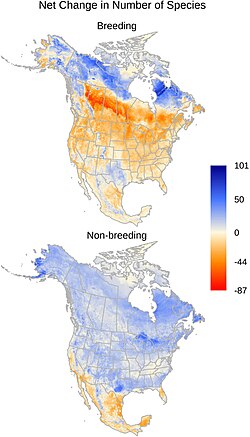
The risk of total species loss is significant. Research suggests that a 3.5 °C warming by 2100 could lead to 600 to 900 land bird extinctions, with 89% of these occurring in the tropics. Furthermore, a 2013 study indicated that while 6–9% of bird species on the IUCN Red List are highly vulnerable, another 17–41% of currently non-threatened species could become threatened due to climate change.
Recent 2023 data highlights the impact of aridity (extreme dryness). Under a high-warming scenario (SSP5–8.5), 51.8% of birds would lose some habitat, with 1.3% expected to lose their entire habitat by 2100.
| Scenario | Lose Some Habitat | Lose >50% Habitat | Lose Entire Habitat |
|---|---|---|---|
| High Mitigation (SSP1-2.6) | 22.8% | 0.7% | 0.5% |
| Intermediate (SSP2-4.5) | 38.7% | 2% | 1% |
| High Warming (SSP5-8.5) | 51.8% | 5.3% | 1.3% |
Frequently Asked Questions
How does climate change affect the appearance of birds?
Climate change has been linked to changes in feather moult timing and coloration. Some species now transition to adult plumage earlier in their lives, and others, like the blue tit, have shown a decrease in the intensity of their feather colors.
Why is wildfire smoke particularly dangerous for birds?
While birds can fly away from fires, smoke can fill vast areas. This is especially dangerous for migratory birds that may fly directly into smoke-filled regions during their seasonal journeys, leading to mass mortality events.
What is the "geographic trap" facing some mountain birds?
Some birds, like the Grey-headed robin, need the cool temperatures found at higher altitudes to survive warming. However, they cannot move indefinitely upward because the increased precipitation at the highest peaks becomes unsustainable for them.
How many bird species are at risk of extinction?
Estimates vary, but some research suggests every degree of warming could cause 100 to 500 land bird extinctions. Under a 3.5 °C warming scenario, between 600 and 900 species could go extinct, primarily in tropical regions.
Do wind turbines pose a greater threat than climate change?
No. While wind power has environmental impacts, research indicates that the continuing effects of climate change are much more threatening to global bird populations than the impact of wind energy infrastructure.