Bird Eggs: Anatomy, Evolution, and Biological Diversity
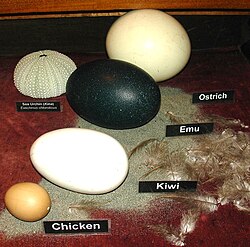
A bird egg is a sophisticated reproductive structure designed to protect and nourish a developing embryo. Consisting of a hard, calcareous (calcium-based) shell, the egg provides a self-contained environment that includes nutrient-dense yolk and protective albumen. From the tiny half-gram egg of a bee hummingbird to the massive 1.5 kg egg of an ostrich, these structures vary wildly in size, shape, and color to suit the specific ecological needs of the species.
While most birds lay fertilized eggs, some produce infertile eggs, often referred to as wind-eggs, which are common in solitary pet birds.
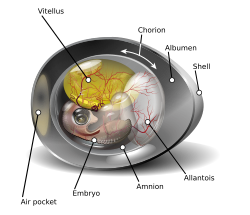
Key Facts
- Composition: Eggs consist of a porous shell, albumen (protein), vitellus (yolk), and protective membranes.
- Clutch Size: Varies from a single egg (condors) to as many as seventeen (grey partridge).
- Genetics: Egg color is typically inherited from the mother via the W chromosome.
- Evolution: Hard-shelled eggs evolved in dinosaurs; therefore, bird eggs are biologically dinosaur eggs.
- Shape: Egg geometry is influenced by flight adaptations, nesting sites, and incubation posture.
Anatomy of a Bird Egg
Every bird egg is engineered to support life through a series of specialized components:
- Embryo: The developing chick.
- Amnion: A membrane that fills with amniotic fluid to protect the embryo from physical shock.
- Allantois: A structure responsible for oxygen intake and the management of metabolic waste.
- Chorion: Together with the amnion, this forms the amniotic sac enclosing the embryo and vitellus.
- Vitellus (Yolk): The primary nutrient source, containing proteins, minerals, and fats.
- Albumen: Composed of globular proteins called ovalbumin, making up over half of the egg's total protein.
- Porous Shell: A protective barrier that allows oxygen to enter while blocking contaminants.
Coloration and Camouflage
The base color of vertebrate eggs is white, derived from calcium carbonate. However, many birds produce pigments to aid in survival. Biliverdin creates blue or green hues, while protoporphyrin produces reds, browns, and spotting.
Coloration often depends on the nesting environment. Birds nesting in trees frequently lay blue or greenish eggs, whereas ground-nesting birds—such as nightjars and sandgrouse—lay speckled eggs for camouflage. Some parasitic cuckoos have evolved to lay eggs that mimic the appearance of their host's eggs to avoid detection.
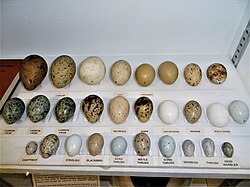
The Role of Calcium and Spotting
Eggshell spotting, or maculation, may serve a structural purpose. When calcium is scarce in the soil, shells become thinner. Protoporphyrin speckling can compensate for this weakness, acting as a solid-state lubricant to reduce brittleness. Consequently, eggs laid later in a clutch often show more spotting as the female's calcium stores deplete.
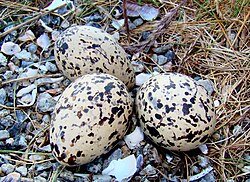
Species-Specific Identification
In crowded colonies, such as those of the common guillemot, females lay eggs with highly distinct markings. This allows them to identify and retrieve their own eggs among thousands of others on cliff ledges.
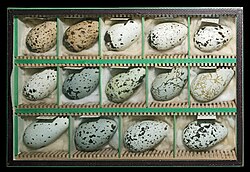
Shell Diversity and Shape
Shell textures vary by species: cormorant eggs are chalky, tinamou eggs are shiny, duck eggs are oily and waterproof, and cassowary eggs are heavily pitted. A domestic hen's egg, for example, contains approximately 7,500 pores to facilitate respiration.
Egg shapes range from nearly spherical (little bee-eater) to conical or pyriform (common murre). While it was once believed that the shape was caused by muscle contractions in the oviduct (peristalsis), X-ray research has shown that shape is determined in the oviduct isthmus before calcification.
Biological Significance of Shape
Shape is often an evolutionary adaptation. Conical eggs are common in cliff-nesting birds because they roll in a tight circle rather than rolling off the ledge. Furthermore, a pointed shape ensures the egg sits with the blunt end upward. This is critical because the blunt end contains the air sac and a higher density of pores, improving oxygen flow to the developing brain and eyes.
Recent mathematical modeling suggests a strong correlation between egg shape and flight ability. Birds capable of high-powered flight often evolve elliptical eggs to maximize size while maintaining a streamlined body plan.
Size, Quantity, and Predation
Egg size generally scales with the adult bird, though the kiwi is a notable exception; its egg can reach 20% of the female's body weight, allowing chicks to forage almost immediately after hatching.
The number of eggs in a brood is called the clutch. Birds are categorized as either determinate layers (fixed number of eggs) or indeterminate layers (can adjust the number of eggs based on the current clutch size).
Eggs are a high-energy food source for many predators, including snakes, foxes, and raccoons. Some birds also engage in brood parasitism, where species like cowbirds or cuckoos lay their eggs in the nests of other birds, forcing the host to raise the offspring.
| Feature | Variation/Example | Biological Purpose |
|---|---|---|
| Size | 0.5g (Bee Hummingbird) to 1.5kg (Ostrich) | Proportional to adult size/offspring readiness |
| Shape | Spherical to Conical | Flight efficiency and nesting stability |
| Color | White, Blue, Green, Speckled | Camouflage and individual recognition |
| Texture | Chalky, Shiny, Oily, Pitted | Environmental protection (e.g., waterproofing) |
Frequently Asked Questions
Why are some bird eggs speckled?
Speckling provides camouflage for ground-nesting birds and can also strengthen the shell in areas where calcium is deficient, reducing brittleness.
How is egg color determined?
Egg color is genetically influenced and inherited through the mother, suggesting the responsible gene is located on the female-specific W chromosome.
What is the difference between determinate and indeterminate layers?
Determinate layers lay a predetermined number of eggs regardless of changes to the clutch, while indeterminate layers can adjust the number of eggs they lay in response to the addition or removal of eggs.
Why do cliff-nesting birds have pointed eggs?
Pointed eggs are less likely to roll away from the nest, instead rolling in a tight circle, and they ensure the air sac is positioned upward for better oxygen flow to the embryo's head.
Are bird eggs related to dinosaur eggs?
Yes. The hard-shelled egg structure evolved in dinosaurs during the Jurassic period, specifically associated with the Maniraptora, making bird eggs a continuation of this evolutionary trait.