bird anatomyornithology termsavian topographybird feathersbird beak types

Bird Anatomy and Terminology: A Comprehensive Guide to Avian Features

Bird Anatomy and Terminology: A Comprehensive Guide to Avian Features Birds are warm-blooded vertebrates of the class Aves and represent the only living lineage of dinosaurs. Defined by t...

Bird Anatomy and Terminology: A Comprehensive Guide to Avian Features

Birds are warm-blooded vertebrates of the class Aves and represent the only living lineage of dinosaurs. Defined by their feathers and a high metabolic rate, these creatures have evolved a suite of specialized biological adaptations that allow most species to master the skies. From a four-chambered heart to a strong yet lightweight skeleton, every aspect of a bird's physiology is finely tuned for efficiency and survival.

To study birds—a field known as ornithology—experts use a precise vocabulary to describe topography (the external anatomy and layout of the body). Because birds exhibit such immense diversity across approximately 11,000 recognized species, these terms provide a universal language for describing everything from the microscopic structure of a feather to the specific shape of a beak.
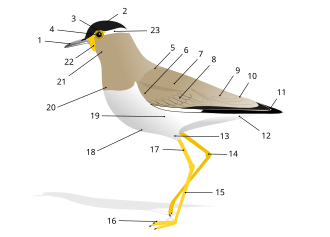
External anatomy (topography) of a typical bird: 1 beak, 2 head, 3 iris, 4 pupil, 5 mantle, 6 lesser coverts, 7 scapulars, 8 coverts, 9 tertials, 10 rump, 11 primaries, 12 vent, 13 thigh, 14 tibio-tarsal articulation, 15 tarsus, 16 feet, 17 tibia, 18 belly, 19 flanks, 20 breast, 21 throat, 22 chin, 23 eyestripe

Key Facts

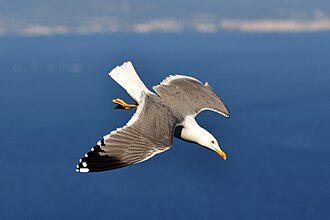
A yellow-legged gull (Larus michahellis) in flight. Apical spots tinge the row of feathers on the trailing edges of its wings.
  • Evolutionary Link: Birds are the only extant species of dinosaurs.
  • Flight Adaptations: Most birds fly, though roughly 60 extant species are flightless.
  • Physical Traits: They are characterized by toothless beaked jaws, hard-shelled eggs, and lightweight skeletons.
  • Feather Complexity: Feathers are composed of complex structures including the rachis, barbs, and barbules.
  • Metabolism: Birds possess a high metabolic rate and a four-chambered heart to support the energy demands of flight.

Avian Topography and External Anatomy
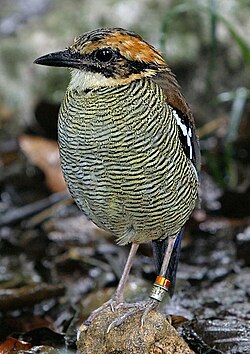
A female Javan banded pitta (Hydrornis guajanus), with a numbered ring banding its left leg

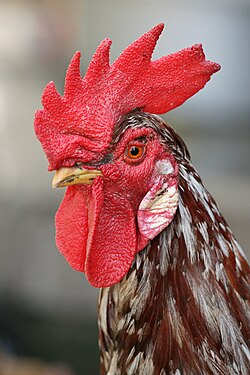
Understanding a bird's body requires looking at specific regions. The head includes the culmen (the upper ridge of the beak) and the lores (the area between the eye and the beak). Some species possess a casque, a bony growth on the head, or a comb, a fleshy crest often seen in galliformes.
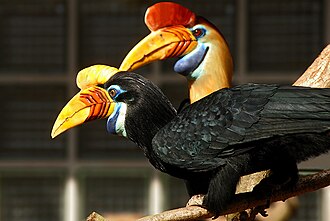
A pair of knobbed hornbills with prominent casques on display

A rooster with a large red comb

The body is divided into several key zones: the mantle (upper back), the rump (area above the tail), and the crissum (the area around the cloaca). The vent is the external opening of the cloaca, used for excretion and reproduction.
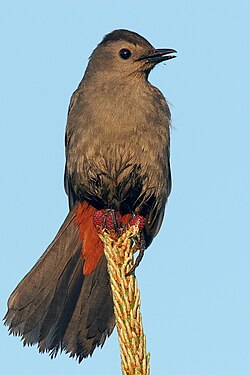
A grey catbird, with its distinctly coloured crissum on display

The Beak and Feeding Adaptations

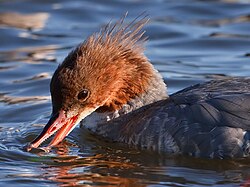
The beak, or bill, is a primary tool for survival. It consists of the upper and lower mandibles. The outer layer is made of a keratinous sheath called the rhamphotheca. Depending on the diet, beaks vary wildly in shape—from the hooked nails of ducks to the sawtooth tomia (cutting edges) of mergansers used to grip fish.
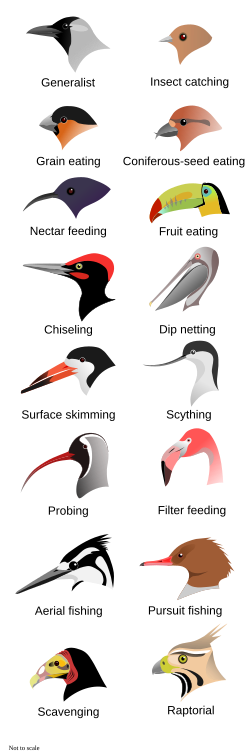
Comparison of bird bills, displaying different shapes adapted to different feeding methods (not to scale)

The sawtooth serrations of a common merganser's tomia help it to hold tight to its fish prey.

Some birds exhibit specialized feeding behaviors, such as canopy feeding, where they use their wings or bodies to create a shade that attracts prey.
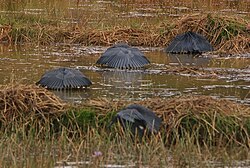
Black herons canopy feeding.

The Science of Feathers and Plumage

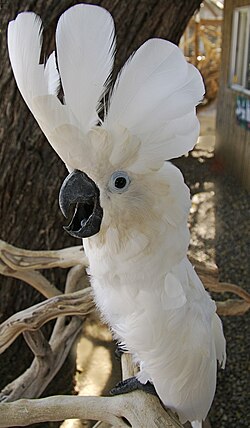
A white cockatoo, also called the umbrella cockatoo from the shape of its crest

Feathers are perhaps the most iconic avian feature. They are categorized by their function and structure. Pennaceous feathers have a stiff vane and are used for flight, while plumulaceous feathers are soft and downy, providing insulation.
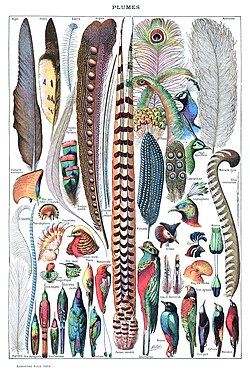
Feather variations
Feather variations

Feather Structure

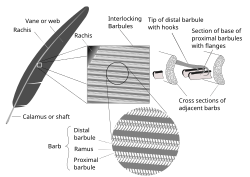
A typical feather consists of a calamus (the quill) and a rachis (the central shaft). Branching off the rachis are barbs, which further divide into barbules. These barbules interlock like a zipper to create a solid, wind-resistant vane.
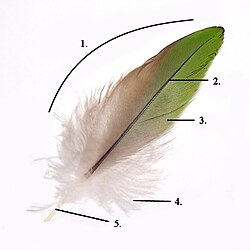
Parts of a feather: vanerachisbarbafterfeathercalamus

Explanatory diagram showing the interlocking of the barbs of feathers

Types of Feathers

  • Primaries: The outermost flight feathers of the wing.
  • Secondaries: The inner flight feathers.
  • Tertials: The innermost flight feathers.
  • Coverts: Smaller feathers that cover the bases of the flight feathers.
  • Filoplumes: Hair-like feathers used for sensing feather position.
  • Down: Soft feathers used for warmth.

Topside of a chicken wing showing all major feather groups

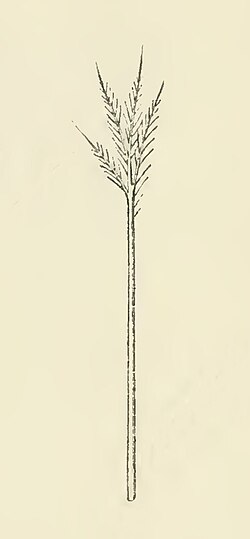
Illustration of a goose filoplume feather, from The Structure and Life of Birds (1895).

Plumage and Molting

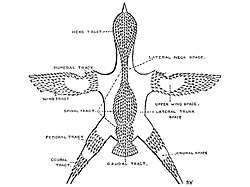
Birds undergo moult, the process of shedding and replacing feathers. Pterylosis refers to the specific arrangement of feather tracts on the body. Many birds change their appearance based on the season or breeding status, transitioning between basic plumage (non-breeding) and alternate plumage (breeding/nuptial).
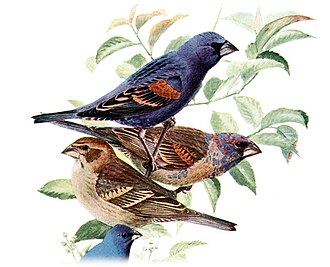
The differences in plumage of blue grosbeak, from top to bottom, between a breeding male (alternate plumage), a non-breeding male (basic plumage), a female and a related indigo bunting

Reproduction and Development

refer to caption
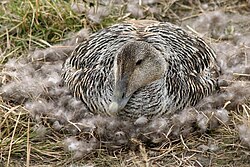
A female common eider sits on her nest, surrounded by down feathers

Birds lay hard-shelled eggs, and the development of the chick varies by species. Precocial chicks are relatively mature and mobile when hatched, whereas altricial chicks are born blind, featherless, and entirely dependent on their parents.
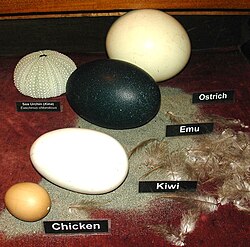
Eggs of: ostrich, emu, kiwi and chicken

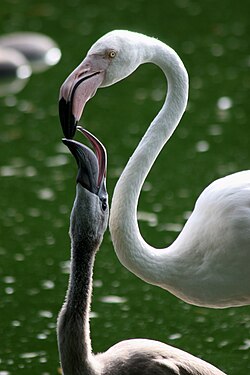
To break through the shell, chicks use a temporary egg tooth located on the upper mandible. Some species, like pigeons and flamingos, produce crop milk—a nutrient-rich secretion from the crop used to feed their young.
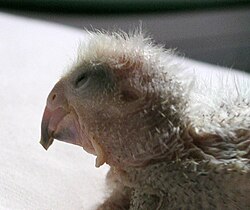
A Senegal parrot chick at about two weeks after hatching. The egg tooth is near the tip of its beak on the upper mandible.

A greater flamingo chick being fed crop milk

Summary of Avian Terminology

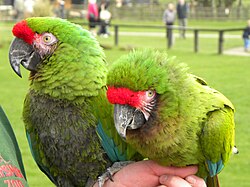
The military macaw on the left is displaying signs of feather-plucking.
Category Term Definition
Anatomy Nictitating Membrane A translucent third eyelid that protects and moistens the eye.
Anatomy Syrinx The vocal organ of birds, located at the base of the trachea.
Feathers Alula The "bastard wing," a small group of feathers used to prevent stalling.
Feathers Speculum A brightly colored patch of feathers on the wing.
Behavior Preening The act of cleaning and arranging feathers with the beak.
Behavior Philopatry The tendency of an organism to stay in or return to its home area.

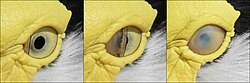
The nictitating membrane as it covers the eye of a masked lapwing

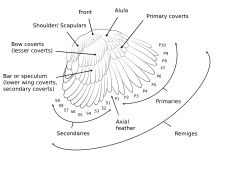
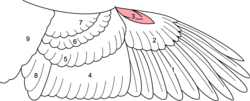
Drawing of the various parts of a bird's wing
Location of the alula on a bird's wing

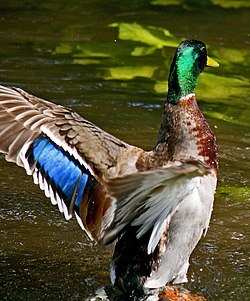
A male mallard. Note the white-edged, blue and black speculum seen on the wing.

Bird with a wing outstretched, rearranging feathers with the tip of its bill
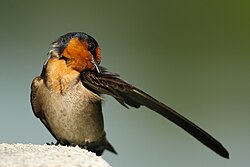
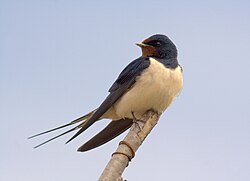
Barn Swallow preening; one of many maintenance behaviours

Frequently Asked Questions
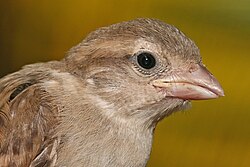
The gape flange on this juvenile house sparrow is the yellowish region at the base of the beak.
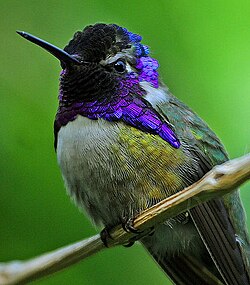
Male Costa's hummingbird (Calypte costae) with an iridescent gorget
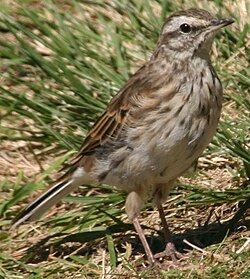
New Zealand pipit Anthus novaeseelandiae novaeseelandiae, displaying a prominent moustachial stripe
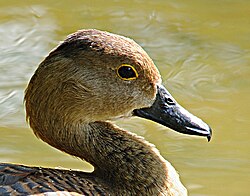
Close up of a lesser whistling duck. Note the hooked nail at the tip of the beak.
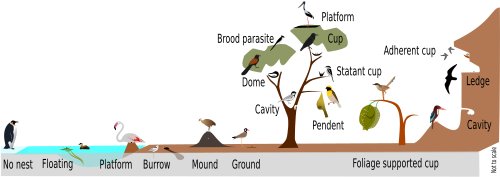
An overview of the diversity in nest placement and construction
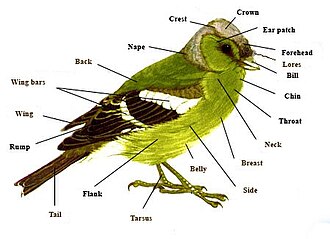
Topography of a typical passerine
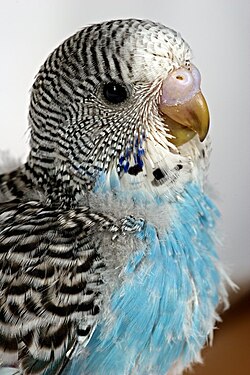
A budgerigar with pin feathers showing on its breast.
Pterylosis (feather arrangement) of a typical passerine
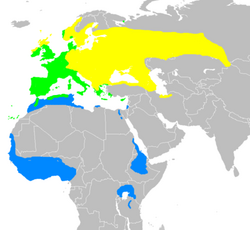
Breeding summer visitor Resident year-round Winter visitorRange map for Eurasian blackcaps—corresponding to the example use of "resident" in its definition at the left
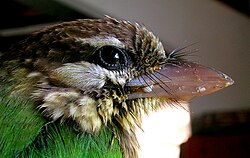
Rictal bristles of a white-cheeked barbet
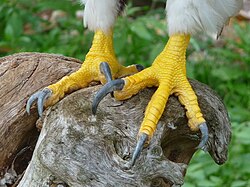
Scales on the talons of a Steller's sea eagle (Haliaeetus pelagicus)
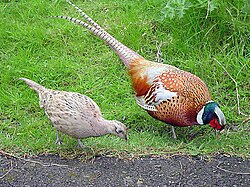
Sexually dimorphic female (left) and male (right) common pheasant, illustrating the dramatic difference in both colour and size between the species' sexes
A barn swallow displaying tail streamers
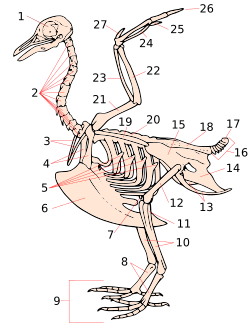
Pigeon skeleton. Number 8 indicates both left and right tarsometatarsus
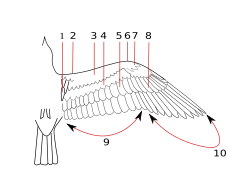
Underwing of bird showing feather nomenclature: 1 axillaries, 2 margin (marginal underwing coverts), 3 lesser underwing coverts, 4 median underwing coverts (secondary coverts), 5 greater underwing coverts (secondary coverts), 6 carpal joint, 7 lesser underwing primary coverts, 8 greater underwing primary coverts, 9 secondaries, 10 primaries
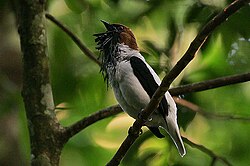
An adult male bearded bellbird calling in the Arima Valley of Trinidad. Note the beard-like wattles sprouting from its chin and throat area, for which the bird is named.
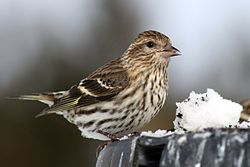
A female pine siskin with white wing bars.
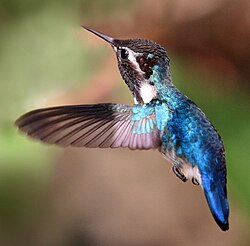
Male bee hummingbird in flight; the bird with the smallest wingspan at 6.6 cm (2.6 in).

What is the difference between basic and alternate plumage?

Basic plumage is the non-breeding plumage that most birds maintain for the majority of the year. Alternate plumage, also known as nuptial plumage, is the specialized coloration developed during the breeding season to attract mates.

What is the purpose of the alula?

The alula is a small group of feathers on the leading edge of the wing that acts like a slat on an airplane wing, allowing the bird to maintain lift at slow speeds and prevent stalling during landing.

How do birds produce sound without a larynx like humans?

Birds use a specialized vocal organ called the syrinx, located at the junction of the trachea and the bronchi. This allows some birds to produce two different sounds simultaneously.

What is the difference between precocial and altricial chicks?

Precocial chicks are born advanced; they can often walk and feed themselves shortly after hatching. Altricial chicks are born underdeveloped, requiring constant warmth and food from their parents until they fledge.

What is a nictitating membrane?

The nictitating membrane is a semi-transparent third eyelid that can be drawn across the eye. It protects the eye from debris and keeps it moist without completely blocking the bird's vision.

References

  1. Ornithologists from the American Museum of Natural History suggested in a 2016 article published in PLOS ONE, that the use of the "biological species concept"—classifying a grouping of birds as making up a single species by their ability to breed—is outdated and should be discarded in favour of a species' model that looks to similarity and dissimilarity in characteristics such as plumage, pattern and colouring to individuate bird species. Under such a model, it is suggested that there are ±18,000 individual living bird species in the world as of 2016.[4]
  2. Emus and cassowaries are an exception in that their afterfeathers are neither downy nor diminutive in relation to the vanes, but are comparable in size to them; such feathers are thus sometimes referred to as being "double plumed". The feathers of ostrich and rhea, also flightless birds, are by contrast "soft and filmy" in makeup, lacking any barbules to add the stiffness needed in working flight feathers.[7]
  3. Birds that undergo a second, non-breeding season moult (third moult overall) include: ptarmigans (Lagopus) (in the summer); long-tailed duck (Clangula hyemalis) (in the winter); ruff (Philomachus pugnax) (in the late winter or early spring); and may occur in other members of the sandpiper (Scolopacidae) family.[31]
  4. In relation to flanks being defined as under parts, in the treatise Ornithology in Laboratory and Field, the author states: "[a]lthough technically the sides of the body belong to both the upper parts and the lower parts, the imaginary line separating the two surfaces is so high on the trunk that the sides of the body are generally considered under parts only."[96]
  5. Prum, Richard O. (19 December 2008). "Who's Your Daddy?". Science. 322 (5909): 1799–1800. doi:10.1126/science.1168808. PMID 19095929. S2CID 206517571.