Biomes: Classifying Earth's Diverse Biological Communities
A biome is a distinct geographical region characterized by its specific climate, vegetation, animal life, and overall ecosystem. Essentially, it is a biological community that has evolved in response to its physical environment and regional climate. While the concept was popularized by the International Biological Program (1964–74), the foundation was strengthened in 1935 when A.G. Tansley integrated climatic and soil aspects into the definition, introducing the term ecosystem.
Depending on the scientific context, the term "biome" can vary. In international terminology, it refers to a non-regional category; for example, a tropical rainforest is called such regardless of which continent it is on. However, in German literature, it is sometimes used similarly to a biotope (a concrete geographical unit). In Brazilian literature, it may be used as a synonym for a biogeographic province or a "morphoclimatic and phytogeographical domain," which often encompasses multiple biomes.
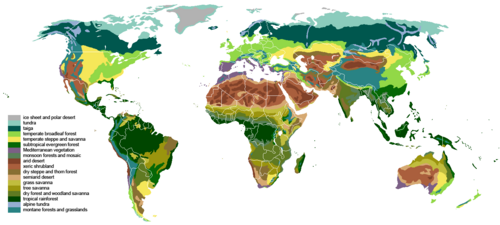
Key Facts
- Definition: A large-scale biological community shaped by regional climate and physical environment.
- Diversity: Biomes are categorized into terrestrial, freshwater, and marine systems.
- Drivers: Temperature and precipitation are the primary gradients used to classify most biomes.
- Human Impact: Anthropogenic biomes (human-created) now include croplands, dense settlements, and indoor environments.
- Climate Sensitivity: Biomes are shifting geographically due to global climate change.
Major Classification Systems
Over the decades, various scientists have developed frameworks to categorize the world's biological zones based on different environmental parameters.
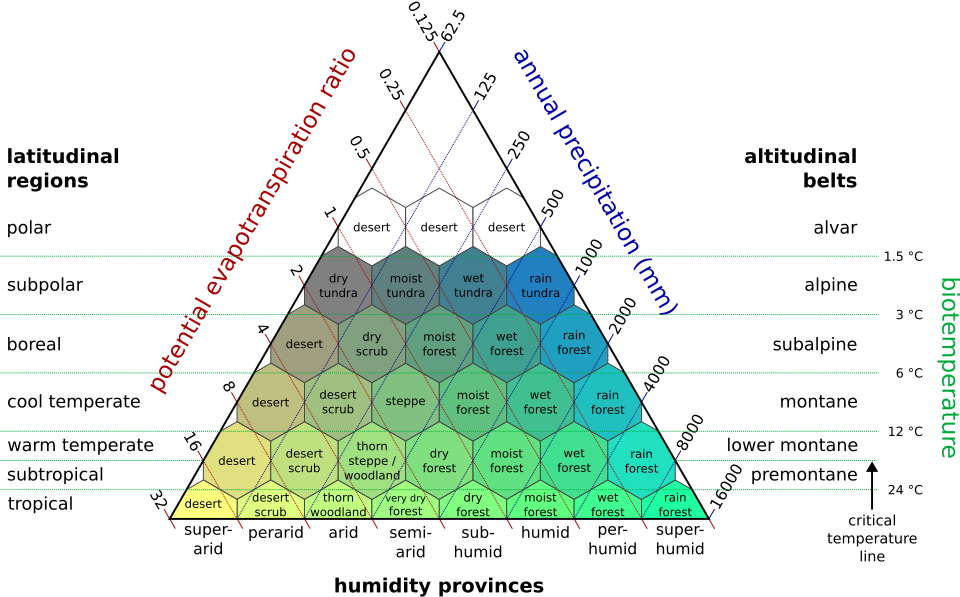
Holdridge Life Zones
Developed by L.R. Holdridge, this system uses a three-dimensional approach to classify life zones, typically visualized as a triangular array of hexagons.
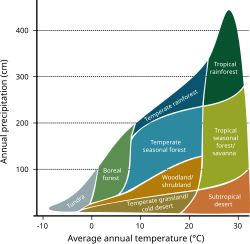
Whittaker's Biome-Types
Robert Whittaker's classification focuses on qualitative trends along three primary gradients: climatic moisture, altitude-based temperature, and latitude-based temperature. This allows for a detailed breakdown of rainforests, woodlands, shrublands, grasslands, and deserts.
Walter's Zonobiomes
H. Walter's system links zonobiomes directly to zonal soil types and vegetation. For example, ZB I (Equatorial) is characterized by equatorial brown clays and evergreen tropical rainforests, while ZB IX (Polar) features tundra humus soils and low, treeless vegetation.
The WWF and Global 200 Scheme
Used by the World Wildlife Fund (WWF), this modern approach divides the biosphere into biogeographic realms, which are further split into ecoregions. Each ecoregion is characterized by a specific biome type.
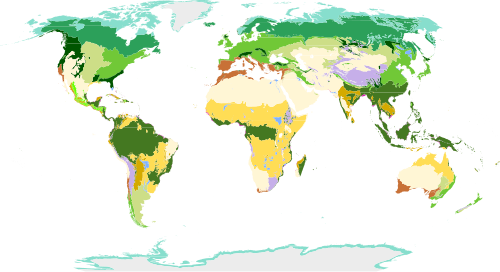
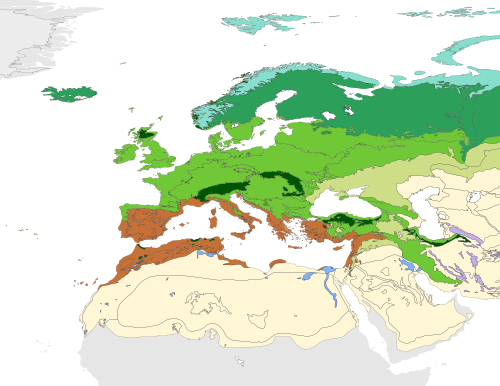
The western Palearctic ecozone, for instance, contains 9 of the 14 terrestrial biomes identified by Olson and Dinerstein.
Satellite data from the International Geosphere-Biosphere Programme shows strong similarities between these 14 bioregions and 17 land cover classes, including natural vegetation, croplands, and barren lands.
![Similarities can be seen between the 14 terrestrial bioregions of Olson & Dinerstein et al. and the 17 land cover classes of the International Geosphere-Biosphere Programme, "which includes 11 natural vegetation classes, 3 developed and mosaicked land classes, and 3 non-vegetated land classes", as detected by satellites.[31] Deciduous Broadleaf Forest Open Shrubland Savannas Cropland/Natural Vegetation Mosaic Barren or Sparsely Vegetated](/images/9a/53/9a530f3f80bd29f2d575d46ac5c2a07bdd0b684d7ab154cb79fe54c2fa4b98b9.png)
Terrestrial, Marine, and Freshwater Biomes
Biological communities are broadly divided by their medium: land, fresh water, or salt water.
Terrestrial Biomes
These are primarily defined by vegetation structure and climate. Key examples include:
- Tundra: Cold, treeless regions with permafrost.
- Taiga (Boreal Forest): Cold-temperate needle-leaved forests.
- Tropical Rainforests: High rainfall and constant warmth.
- Savannas and Grasslands: Semi-arid regions dominated by grasses.
- Deserts: Arid regions with xeric shrublands.
Aquatic Biomes
Aquatic systems are split into freshwater and marine categories. Freshwater biomes include large lakes, river deltas, and montane freshwaters. Marine biomes are categorized by depth and location, such as the neritic zone (coastal and continental shelf), the pelagic zone (open sea), and the abyssal zone (deep ocean).
Other specialized marine habitats include hydrothermal vents, cold seeps, and coral reefs.
Anthropogenic and Specialized Biomes
In recent centuries, human activity has created anthropogenic biomes. These include dense urban settlements, croplands, rangelands, and even indoor environments. Additionally, scientists recognize microbial biomes and endolithic biomes (organisms living inside rock).
Climate Change and Biome Shifts
Climate change is causing significant shifts in the distribution of Earth's biomes. Depending on emission scenarios, regions may fully transition into entirely different biome zone types by the end of the century.
![Predicted changes for Earth's biomes under two different climate change scenarios for 2081–2100. Top row is low emissions scenario, bottom row is high emissions scenario. Biomes are classified with Holdridge life zones system. A shift of 1 or 100% (darker colours) indicates that the region has fully moved into a completely different biome zone type.[46]](/images/67/b8/67b8a43aaea40842e632edffcfc015823f1055678a26b6dc7fa6d6e899446f6f.jpg)
Summary of Biome Classifications
| System | Primary Focus | Key Characteristics |
|---|---|---|
| Holdridge | Climate Zones | Triangular array of life zones based on precipitation and temperature. |
| Whittaker | Environmental Gradients | Moisture and temperature gradients (latitude/altitude). |
| Walter | Zonobiomes | Integration of soil types and vegetation. |
| WWF / Global 200 | Ecoregions | Hierarchical: Realm → Ecoregion → Biome. |
| Bailey | Domains | Four domains: Polar, Humid Temperate, Dry, and Humid Tropical. |
Frequently Asked Questions
What is the difference between a biome and an ecosystem?
A biome is a broader, regional-scale category defined by climate and general vegetation (e.g., all tropical rainforests globally), whereas an ecosystem refers to the specific interaction of biological communities and their physical environment in a particular area.
What are anthropogenic biomes?
Anthropogenic biomes are regions significantly altered by human activity, such as cities (dense settlements), agricultural fields (croplands), and managed pastures (rangelands).
How does climate change affect biomes?
Climate change alters temperature and precipitation patterns, forcing biomes to shift their geographical boundaries. This can result in a region transitioning completely from one biome type to another.
What is a zonobiome?
A zonobiome is a term used in the Walter classification system to describe a region where a specific climate zone, zonal soil type, and zonal vegetation type coincide.
What are the primary factors that determine a terrestrial biome?
The primary determining factors are temperature and precipitation, which together dictate the type of vegetation that can survive and the animals that follow.