Biological Symmetry: The Patterns of Life from Bacteria to Humans
In the natural world, patterns are everywhere. From the spiral of a pine cone to the balanced features of a human face, biological symmetry describes the organized distribution of duplicate body parts or shapes within an organism. While mathematical symmetry is often perfect, biological symmetry is almost always approximate; a leaf may appear symmetrical, but it rarely matches perfectly when folded in half.
Symmetry can be observed externally, such as the shape of an animal, or internally, such as the cylindrical tubes in the human body responsible for transporting nutrients and waste. These patterns are not merely aesthetic; they are fundamental blueprints that define the body plans of plants, animals, fungi, and even certain bacteria and viruses.
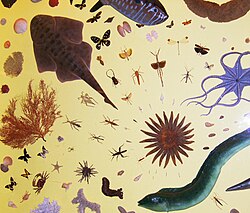
Key Facts
- Bilateral symmetry is shared by 99% of all animals.
- Radial symmetry involves repeating parts around a central axis, such as in flowers or jellyfish.
- Icosahedral symmetry is a common structure in many viruses to save genomic space.
- Asymmetry can be an evolutionary advantage, helping species like owls or flatfish survive.
- Biradial symmetry serves as an intermediate form between radial and bilateral patterns.
Major Types of Biological Symmetry
Most multicellular organisms are defined by specific symmetry types. While sponges and placozoans are notable for being asymmetrical (lacking symmetry), most other life forms follow one of several established geometric patterns.
Bilateral Symmetry
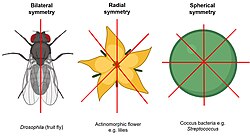
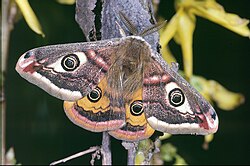
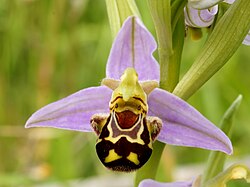
Organisms with bilateral symmetry possess a single plane of symmetry, known as the sagittal plane. This plane divides the body into roughly mirror-image left and right halves. This group, known as the Bilateria, includes over a million described species. However, even in bilaterally symmetrical animals, internal organs like the human heart or liver are often positioned asymmetrically.

Radial and Biradial Symmetry
Radial symmetry occurs when an organism shows a repeating pattern around a central axis. These organisms can be divided into identical pieces, like slices of a pie, by cutting through the center. This often involves repeating parts in multiples of four, five, six, or eight (known as tetramerism, pentamerism, hexamerism, and octamerism).

Biradial symmetry is a hybrid form where an organism exhibits features of both bilateral and radial symmetry. Unlike radial organisms that can be cut along many planes, biradial organisms can only be divided equally along two specific planes. Ctenophores are a primary example of this, as are some species of Hydra.
![The Ediacaran phylum Trilobozoa possess a wide variety of body shapes, mostly tri-radial symmetry, although their most famous member, Tribrachidium, possesses a triskelion body shape.[25]](/images/2b/e8/2be80c0adb28100d7ab8d86aab731f6c4bd573a50579e4ee3a1a17b1b1b21818.jpg)
Spherical and Icosahedral Symmetry
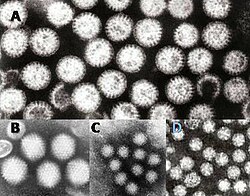
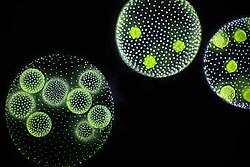
Some organisms exhibit spherical symmetry, appearing similar to a ball. In the viral world, many particles exhibit icosahedral symmetry. An icosahedron is a shape with 20 equilateral triangle faces and 12 corners. This structure allows viruses to build complex shells using a limited number of repetitive protein subunits, which helps conserve space in their small genomes.
Summary of Symmetry Types
| Symmetry Type | Defining Characteristic | Common Examples |
|---|---|---|
| Bilateral | Single plane dividing body into left/right halves | Humans, insects, most animals |
| Radial | Repeating parts around a central axis | Flowers, jellyfish |
| Biradial | Can be divided equally along only two planes | Ctenophores |
| Icosahedral | 20 triangular faces; highly efficient for viruses | Canine parvovirus |
| Asymmetry | No regular pattern or plane of symmetry | Sponges, certain specialized adaptations |
The Role of Asymmetry and Symmetry Breaking
While symmetry is a dominant theme, asymmetry is often an evolutionary adaptation. For example, owls have asymmetrical ear positioning to better locate prey, and flatfish have both eyes on one side to blend into the ocean floor. Even in humans, internal asymmetry is vital, such as the different sizes of the left and right lungs.
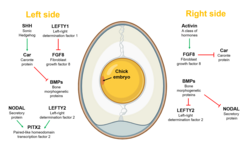
The process of symmetry breaking—where a symmetrical embryo begins to develop distinct left and right sides—is a complex genetic event. In chick embryos, specific genes like NODAL and LEFTY2 signal the development of left-side structures, while the absence of these signals on the right side allows for different development. Similar genetic mechanisms have been observed in plants like Arabidopsis.

Frequently Asked Questions
Why do some viruses have icosahedral symmetry?
Icosahedral symmetry allows a virus to build a protective shell using a limited number of repetitive protein subunits. This efficiency helps the virus save precious space within its genome.
Is all biological symmetry perfect?
No. Unlike mathematical symmetry, biological symmetry is almost always approximate. Natural variations mean that parts rarely match perfectly when mirrored or folded.
What is the difference between radial and biradial symmetry?
Radial symmetry allows an organism to be divided into equal parts along many different planes through a central axis. Biradial symmetry is more restrictive, allowing equal division along only two specific planes.
Can asymmetry be an advantage for an organism?
Yes. Asymmetry can be a highly effective adaptation. For instance, the scale-eating cichlid has an asymmetrical mouth and jaw to more effectively remove scales from its prey.
What is fluctuating asymmetry?
Fluctuating asymmetry refers to small, random deviations from perfect bilateral symmetry in features like the face, eyes, or limbs, which can vary between individuals.