Billy Murray: The Voice of the Early Phonograph Era
Long before the era of digital streaming and high-fidelity audio, one man dominated the American airwaves. Billy Murray was not just a singer; he was a recording phenomenon. As the best-selling artist of the first quarter of the 20th century, Murray bridged the gap between the theatrical energy of Vaudeville and the emerging technology of the phonograph, selling an estimated 300 million records.
Known for his impeccable timing and crystal-clear delivery, Murray became the gold standard for vocalists during a time when recording technology required immense power and precision to be heard. From the bustling streets of Tin Pan Alley—the center of American popular music publishing—to the early animation studios of New York, Murray's voice defined the sound of an era.
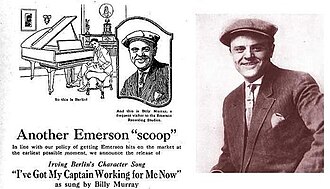
Key Facts
- Record Sales: Sold over 300 million records, making him the top-selling artist of the early 1900s.
- Nickname: Known as "The Denver Nightingale."
- Vocal Style: A strong tenor characterized by conversational delivery and precise enunciation.
- Prolific Output: Estimated to have made between 6,000 and 10,000 recordings over 45 years.
- Versatility: Performed across genres including Jazz, Comedy, Barbershop Quartet, and Tin Pan Alley.
Early Life and Rise to Fame
Born William Thomas Murray in Philadelphia, Pennsylvania, on May 25, 1877, to Irish immigrants, Murray spent much of his youth in Denver, Colorado. His passion for performance led him to join a traveling vaudeville troupe in 1893, where he also performed in minstrel shows. His recording career began in 1897 in San Francisco with Peter Bacigalupi, though none of these early cylinder records are known to have survived.
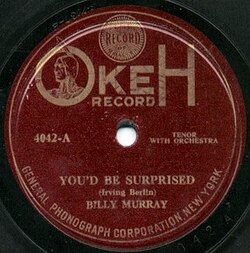
By 1903, Murray relocated to the New York City and New Jersey area. This move placed him at the heart of the American music industry, allowing him to record for nearly every major label of the time, including Edison, OkeH, and the Victor Talking Machine Company.

The "Denver Nightingale" Style
Murray's success was rooted in his unique vocal approach. Unlike the bel canto style (a classical Italian singing technique emphasizing legato and agility) common among singers of the time, Murray used a conversational delivery. His enunciation was so sharp that he became a favorite of Thomas Edison, whose own hearing impairment made Murray's precise vocals easier to understand.
While he was skilled in romantic ballads, Murray excelled in comedy and novelty songs. To enhance the humor of his comic tracks, he would often deliberately sing slightly flat. This versatility allowed him to collaborate with other stars of the era, most notably Ada Jones, with whom he recorded several popular duets.
Baseball and Pop Culture
Outside the studio, Murray was a devoted baseball enthusiast. He reportedly played exhibition games with the New York Highlanders (now the New York Yankees) and was known to skip recording sessions to attend games. His love for the sport bled into his work; he recorded a version of "Tessie, You Are the Only, Only, Only" with modified lyrics that became the unofficial theme of the 1903 World Series.
Adapting to Technological Change
The mid-1920s brought a seismic shift in music: the electric microphone. This invention gave rise to crooning, a style of singing softly and intimately. Murray's established method—which he called "hammering" because it involved essentially yelling into an acoustic recording horn—did not translate well to the new technology.
Despite this, Murray remained active. He found work with lower-budget labels that were slow to adopt microphones and later transitioned into voice acting. He provided voices for Max Fleischer's "Bouncing Ball" sing-along cartoons and the character Bimbo, as well as performing on the radio.
Final Years and Legacy
Murray's final recordings took place on February 11, 1943, collaborating with Jewish dialect comedian Monroe Silver. Due to heart problems, he retired to Freeport, Long Island, in 1944. He passed away from a heart attack at Jones Beach on August 17, 1954, at the age of 77.
| Category | Details |
|---|---|
| Active Years | 1893–1944 |
| Primary Genres | Tin Pan Alley, Comedy, Jazz, Barbershop Quartet |
| Estimated Records | 6,000 to 10,000 |
| Total Sales | Over 300 million records |
| Key Collaborators | Ada Jones, Elsie Baker, American Quartet |
Frequently Asked Questions
Why was Billy Murray a favorite of Thomas Edison?
Thomas Edison suffered from impaired hearing, and Billy Murray's precise enunciation and clear, conversational delivery made his recordings much easier for Edison to understand and appreciate compared to other singers.
What was the "hammering" style of singing?
The "hammering" style was a technique used during the acoustic recording era where singers had to project their voices loudly—essentially yelling—into a recording horn to ensure the sound was captured on the disc.
How did the electric microphone affect Murray's career?
The microphone allowed for a softer, more intimate style called crooning. Murray's powerful acoustic style became less fashionable, forcing him to either soften his voice or seek work with labels that still used older recording methods.
What was Billy Murray's connection to animation?
In his later career, Murray transitioned into voice acting, providing voices for Max Fleischer's "Bouncing Ball" sing-along cartoons and the character Bimbo, as well as the short film "Finding His Voice" in 1929.
Which songs is Billy Murray most remembered for?
He is remembered for a vast catalog including "Alexander's Ragtime Band," "Come Josephine in My Flying Machine" (with Ada Jones), and "Tessie," among many other Tin Pan Alley hits.