Bernd and Hilla Becher: Documenting Industrial Typologies
Meeting as students at the Kunstakademie Düsseldorf in 1957, Bernd and Hilla Becher embarked on a lifelong collaboration that would redefine the intersection of photography, architecture, and art. Starting in 1959, the couple dedicated themselves to documenting the disappearing industrial architecture of Germany, beginning in the Ruhr Valley—a region deeply connected to Bernd's family history in the steel and mining industries.
The Bechers were captivated by the recurring shapes and formal qualities of functional buildings. They observed that structures such as cooling towers, gas tanks, and coal bunkers often shared distinctive design patterns, suggesting a surprising level of attention to design within purely utilitarian architecture.
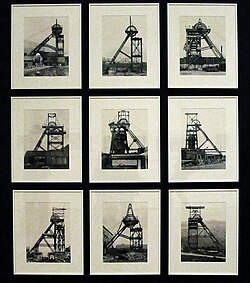
Key Facts
- Focus: Documentation of industrial structures like blast furnaces, water towers, and grain elevators.
- Method: Use of a "typology" approach, grouping similar structures in grids for comparison.
- Equipment: Transitioned from 6x9cm cameras to a large format Plaubel Peco 13x18cm monorail camera.
- Style: Black and white, objective viewpoints, and overcast lighting to eliminate distracting shadows.
- Legacy: Influenced the New Topographics movement and taught a generation of world-renowned photographers at Kunstakademie Düsseldorf.
Technical Precision and Methodology
To achieve a consistent, "objective" point of view, the Bechers employed rigorous technical standards. They primarily used a monorail camera—a professional camera system with adjustable standards that allowed them to control perspective and maintain perfectly parallel lines.
Their technical toolkit included:
- Optics: Lenses ranging from 90mm wide-angle to 600mm telephoto to ensure subjects appeared similarly sized regardless of the photographer's distance.
- Medium: They utilized black and white photography to emphasize three-dimensional volume and avoid the distractions of color. They moved from glass photographic plates to 25 ASA negative sheet film around 1970.
- Lighting: To ensure white skies and consistent lighting, they photographed on overcast days, during early mornings in spring and fall, or used blue filters when the sky was clear.
The workflow was a true partnership: Bernd developed the negatives while Hilla handled the printing. Each view typically involved two exposures, with times ranging from 10 seconds to one minute.
The Concept of Typology
The Bechers are most famous for their use of typology—the study and systematic classification of types. Rather than presenting a single image as a standalone piece, they arranged gelatin silver prints in grids of six, nine, or fifteen. This layout invited viewers to compare forms based on function, age, or regional differences.
This approach is central to their published series, Anonyme Skulpturen: Eine Typologie technischer Bauten and Typologien, Industrieller Bau, 1963–1975. Their work aligned with the philosophy of the New Topographics movement, focusing on man-altered landscapes with a detached, clinical precision.
| Category | Details |
|---|---|
| Primary Subjects | Cooling towers, gas tanks, coal bunkers, blast furnaces, water towers, grain elevators, and warehouses. |
| Geographic Reach | Germany (Ruhr Valley), Great Britain, France, Belgium, and the United States (NJ, MI, PA, Ontario). |
| Presentation | Gridded tableaux of small prints; later, large-scale individual images (24x20 inches). |
| Key Publications | Framework Houses (1977), Typologien, Industrieller Bau. |
Global Reach and Cultural Impact
While their work began in Germany, the Bechers expanded their scope internationally. In 1966, they spent six months documenting the coal industry in England and South Wales. By 1974, they traveled to North America to photograph structures ranging from wooden winding towers to coal breakers.
Beyond art, their work served a preservationist purpose. By highlighting the cultural value of industrial design, they helped secure protected landmark status for the Zollern II/IV Colliery in Dortmund-Bovinghausen.
Academic Influence and Legacy
In 1976, Bernd Becher began teaching at the Kunstakademie Düsseldorf, introducing photography to an institution that had previously focused almost exclusively on painting. He remained on the faculty until 1996, mentoring a generation of influential photographers, including Andreas Gursky, Thomas Ruff, Thomas Struth, Candida Höfer, Axel Hütte, and Elger Esser.
Following Bernd's death, Hilla Becher continued to curate and reassemble their collective body of work, ensuring the preservation of their industrial archive.
Frequently Asked Questions
What is a "typology" in the context of the Bechers' work?
A typology is an ordered set of photographs where structures with similar functions are displayed side-by-side in a grid. This allows the viewer to compare the formal qualities, designs, and regional variations of the buildings.
Why did the Bechers use black and white photography?
They chose black and white because it better captured three-dimensional volume without the distraction of color. Additionally, at the time, black and white materials were more reliable and cost-effective than color alternatives.
What equipment did they use to keep the lines in their photos parallel?
They used a Plaubel Peco 13x18cm monorail camera. The adjustable standards of this camera allowed them to control the perspective, ensuring that the vertical lines of the industrial buildings remained parallel.
Which famous photographers were students of Bernd Becher?
Bernd Becher taught several photographers who became world-renowned, including Andreas Gursky, Thomas Ruff, Thomas Struth, Candida Höfer, Axel Hütte, and Elger Esser.
Did the Bechers photograph locations outside of Germany?
Yes. They documented industrial architecture in Great Britain, France, and Belgium starting in 1965, and later traveled to the United States and southern Ontario, Canada, in 1974.