Bentham and Hooker Taxonomic System for Seed Plants
Between 1862 and 1883, British botanists George Bentham (1800–1884) and Joseph Dalton Hooker (1817–1911) published a monumental work titled Genera plantarum ad exemplaria imprimis in herbariis kewensibus servata definita. Spanning three volumes, this work established a comprehensive taxonomic system for seed plants based on specimens primarily housed at the Royal Botanic Gardens, Kew.
The Bentham and Hooker system is rooted in the principle of natural affinities—the grouping of organisms based on overall morphological similarities. Because it was developed without incorporating the theory of evolution, it is characterized as a pre-Darwinian system. Despite this, it provided a rigorous framework that classified an estimated 97,205 species into 202 families and 7,569 genera.
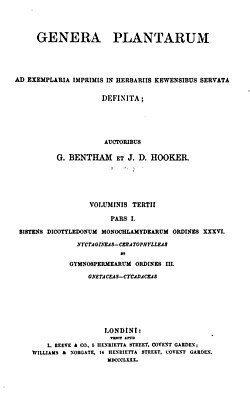
Key Facts
- Authors: George Bentham and Joseph Dalton Hooker.
- Publication Period: 1862–1883 (Three volumes).
- Scope: Approximately 97,205 species, 7,569 genera, and 202 families.
- Philosophy: Based on natural affinities; pre-Darwinian (non-evolutionary).
- Institutional Link: Closely affiliated with the Royal Botanic Gardens, Kew.
Structural Organization of Genera Plantarum
The system divides seed plants into three primary classes: Dicotyledones (dicots), Gymnospermae (gymnosperms), and Monocotyledones (monocots). The organization is detailed across the three volumes as follows:
| Class | Volume | Major Groups / Series |
|---|---|---|
| Dicotyledones | I, II, III | Polypetalae, Gamopetalae, Monochlamydeae |
| Gymnospermae | III (1) | Gnetaceae, Coniferae, Cycadaceae |
| Monocotyledones | III (2) | Microspermae, Epigynae, Coronarieae, etc. |
Dicotyledones
The dicots are the most extensively detailed group, split into three main categories based on petal and perianth characteristics:
- Polypetalae (Vol I): Divided into series such as Thalamiflorae, Disciflorae, and Calyciflorae.
- Gamopetalae (Vol II): Divided into series including Inferae, Heteromerae, and Bicarpellatae.
- Monochlamydeae (Vol III): Includes various series such as Curvembryeæ, Microembryeæ, and Unisexuales.
Gymnospermae and Monocotyledones
The third volume concludes the work by addressing the remaining seed plants. The Gymnospermae are categorized into three families: Gnetaceae, Coniferae, and Cycadaceae. The Monocotyledones are organized into several series, including the Microspermæ, Epigynæ, Coronarieae, and Glumaceæ (which includes the Gramineae or grasses).
Nomenclature and Terminology
It is important to note that Genera plantarum was published before the establishment of internationally accepted rules for botanical nomenclature. Consequently, the terminology used differs from modern standards:
- The term ordo was used to indicate a family.
- The term cohors (in volumes I and II) or series (in volume III) was used to indicate an order.
- In the first two volumes, series referred to a rank higher than that of an order.
While these designations differ from current practices, the International Code of Botanical Nomenclature (ICBN) provides the necessary provisions to reconcile these historical terms with modern classification.
Frequently Asked Questions
What is the primary basis of the Bentham and Hooker system?
The system is based on the principle of natural affinities, grouping plants by their shared physical characteristics rather than their evolutionary lineage.
Why is this system described as pre-Darwinian?
It is considered pre-Darwinian because it does not take evolution into account when classifying the relationships between plant species.
How many species and families were classified in Genera plantarum?
The work classified an estimated 97,205 species, organized into 202 families and 7,569 genera.
How does the terminology in this system differ from modern botany?
The system uses "ordo" for families and "cohors" or "series" for orders, which is the opposite of how these terms are used in modern botanical nomenclature.
Which institution provided the primary specimens for this work?
The classification was based primarily on specimens preserved in the herbaria of the Royal Botanic Gardens, Kew.