Understanding Hylotelephium telephium: The Versatile Orpine
Known by a variety of colorful names including orpine, life-everlasting, and garden stonecrop, Hylotelephium telephium is a resilient succulent perennial. A succulent is a plant with fleshy tissues designed to retain water, allowing it to thrive in diverse environments. Native to Eurasia, this plant is celebrated both for its hardy nature and its striking appearance, featuring dense flower heads that range from reddish to yellowish-white hues.
In many gardens, you may encounter popular hybrids such as 'Herbstfreude' (also known as 'Autumn Joy'), which is a cross between this species and Hylotelephium spectabile (the iceplant). While primarily a garden favorite, this plant is so robust that it occasionally escapes cultivation to naturalize in new regions, including parts of North America.
Key Facts
- Common Names: Orpine, livelong, frog's-stomach, life-everlasting, live-forever, midsummer-men, orphan John, witch's moneybags, and garden stonecrop.
- Native Range: Eurasia.
- Family: Crassulaceae.
- Flower Colors: Reddish or yellowish-white.
- Habitat: Fields, hedges, hills, and gravelly or calcareous (calcium-rich) soils.
Scientific Classification
The taxonomic hierarchy of Hylotelephium telephium places it within a specific group of flowering plants. Below is a summary of its scientific standing:
| Rank | Taxonomic Name |
|---|---|
| Kingdom | Plantae |
| Clade | Embryophytes, Tracheophytes, Angiosperms, Eudicots |
| Order | Saxifragales |
| Family | Crassulaceae |
| Genus | Hylotelephium |
| Species | H. telephium |
Taxonomic History and Evolution
The history of this plant's classification spans centuries. It was documented by the ancient Greek physician Dioscorides around 40–90 AD under the name Telephion. Later, Carl Linnaeus formally described it in 1753 as one of the 15 species within the genus Sedum.
However, modern botanical science has refined this classification. Researchers discovered that these species differed significantly from the rest of the Sedum genus in terms of their flowers, leaves, blooming times, and chromosome numbers. In 1977, Ohba segregated these species into the separate genus Hylotelephium, establishing H. telephium as the type species. Subsequent molecular phylogenetic studies—which use DNA to determine evolutionary relationships—confirmed that these plants form a distinct clade (a group of organisms sharing a common ancestor) separate from the larger, paraphyletic Sedum genus. This group is now recognized as the tribe Telephieae.
Subspecies and Natural Distribution
Hylotelephium telephium is divided into several subspecies, each occupying specific geographic regions:
- subsp. fabaria: Found in West and Central Europe.
- subsp. maximum: Located across Europe and Western Asia.
- subsp. ruprechtii: Native to North-east Europe.
- subsp. telephium: Found in Central and East Europe, as well as East Asia.
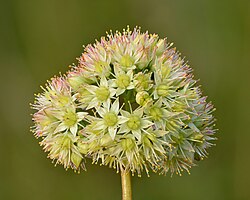
While endemic to Europe and Asia, the plant has been widely introduced to other parts of the world, most notably North America. It is highly adaptable, often found growing in woodland areas, near hedges, or on hilly terrain with gravelly soils.
Historical Uses and Folklore
Throughout history, Hylotelephium telephium has served various practical and cultural purposes. The name Telephium is thought to be linked to King Telephus, who famously suffered from a wound that would not heal, reflecting the plant's historical medicinal associations. The Romans used the plant to treat wounds, and in later eras, it was applied to internal ulcers.
Beyond medicine, the plant has deep roots in folklore. Because its stems and leaves can store water, it was used in "love-divination" rituals. A girl intending to marry might hang the stems in a room; if the stems grew together, it was seen as a sign of a blessed marriage, whereas stems growing apart or dying were viewed as bad omens. Additionally, the name "live-forever" refers to its extreme hardiness, as the plant can survive being uprooted or cut. Children have also been known to use the outer leaves to create "witch's moneybags."
From a culinary perspective, the very young leaves can be eaten raw, while both the young leaves and the firm tubers are suitable for cooking.
Frequently Asked Questions
What are the most common names for this plant?
Common English names include orpine, livelong, life-everlasting, live-forever, frog's-stomach, harping Johnny, midsummer-men, orphan John, witch's moneybags, and garden stonecrop.
Is Hylotelephium telephium edible?
Yes, the very young leaves can be consumed raw, and both the young leaves and the firm tubers can be cooked.
Why was the plant moved from the Sedum genus to Hylotelephium?
Botanists moved the species because it possesses distinct characteristics—such as different ovary and ovule structures, flowering stems, and chromosome numbers—that set it apart from the rest of the Sedum genus. DNA studies have since confirmed it belongs to its own distinct clade.
Where can I find this plant in the wild?
It is native to Eurasia and can be found in fields, around hedges, on hills, and in gravelly or calcareous soils. It has also been introduced to North America.
Why is it called "live-forever"?
The name "live-forever" is a reference to the plant's remarkable hardiness, specifically its ability to survive even after being cut or uprooted.