Benjamin of Tudela: The Medieval Jewish Traveler Who Mapped the Old World
Long before Marco Polo chronicled his adventures in the East, a Jewish traveler from the Kingdom of Navarre was documenting the vast landscapes of Europe, Asia, and Africa. Benjamin of Tudela (1130–1175), also known as Benjamin ben Jonah, was a 12th-century polyglot and geographer whose vivid accounts provided a rare window into the interconnectedness of the medieval world.
His seminal work, The Travels of Benjamin (originally written in Hebrew as Masa'ot Binyamin or Sefer ha-Masa'ot), serves as more than just a personal diary. It is a critical historical record of the geography, ethnography, and the state of Jewish communities during the Middle Ages. Because of his broad education and linguistic skills, Benjamin is regarded as a pivotal figure in both Jewish history and medieval geography.
Key Facts
- Lifespan: 1130–1175.
- Origin: Tudela, Kingdom of Navarre.
- Active Years: Approximately 1159 to 1173.
- Scope of Travel: Visited 300 cities across Europe, Asia, and Africa.
- Primary Work: The Travels of Benjamin, a detailed itinerary of Jewish communities and urban life.
- Historical Significance: Preceded Marco Polo's descriptions of Western Asia by a century.
The Journey of a Medieval Polymath
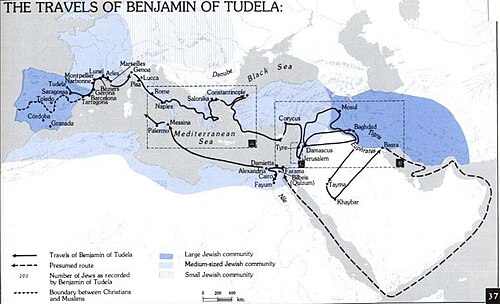
While scholars do not agree on his exact route, it is believed that Benjamin followed popular travel paths of the 12th century. Setting out from the northeast Iberian Peninsula around 1165, his journey likely began as a pilgrimage to the Holy Land. However, evidence suggests his motives were multifaceted; his frequent interest in the coral trade indicates he may have been a professional gem-merchant.
Beyond commerce and faith, Benjamin appears to have had a mission to catalog Jewish communities. By documenting where hospitality could be found, he created a vital guide for other Jews traveling to Israel or fleeing persecution.
Route and Destinations
Benjamin's itinerary was expansive. He began in Zaragoza and traveled through Tarragona, Barcelona, and Girona before moving into France and sailing from Marseille. His journey then took him through the heart of Italy—visiting Genoa, Lucca, Pisa, Florence, and Rome—before he headed toward Greece and Constantinople.
From there, he ventured deep into Asia, visiting Syria, Lebanon, the Land of Israel, and northern Mesopotamia (which he referred to as Shinar) before arriving in Baghdad. His travels extended into Persia and across the Arabian Peninsula to Egypt and North Africa, finally returning to the Iberian Peninsula in 1173.
Observations and Discoveries
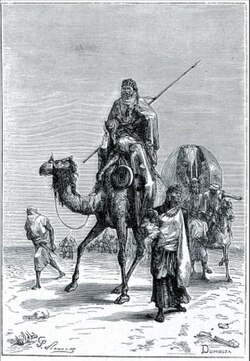
Benjamin's accounts are praised for their accuracy regarding everyday medieval life. He provided one of the earliest precise descriptions of the ruins of ancient Nineveh near Mosul. He also visited historically significant Jewish centers such as Susa, Sura, and Pumbedita. His curiosity extended to the fringes of the known world, recording information about Tibet, China, and the Al-Hashishin (the "hemp smokers"), introducing Western Europeans to cultures far beyond their previous experience.
In Africa, he described a significant Jewish community in the region of modern-day Ethiopia, though the exact locations he visited remain a subject of scholarly debate due to inconsistent historical spellings.
The Legacy of 'The Travels of Benjamin'
Benjamin's writing is characterized by an emphasis on urban life and the demographics of the communities he encountered. He wrote with particular admiration for Baghdad and the virtues of the Caliph, often highlighting the respect and coexistence between Judaism and Islam.
While generally viewed as a trustworthy source, some historians note that Benjamin occasionally relied on earlier writers. For example, his identification of Laish (Tel Dan) with Baniyas is disputed by other historical sources, such as Eusebius of Caesarea.
| Category | Details |
|---|---|
| Full Name | Benjamin ben Jonah |
| Birthplace | Tudela, Kingdom of Navarre |
| Primary Language | Hebrew |
| Key Regions Visited | Iberia, Italy, Greece, Levant, Mesopotamia, Persia, North Africa |
| Major Contribution | Detailed ethnographic and geographic records of 12th-century Jewish diaspora |
Commemoration and Influence
Benjamin's influence persists in literature and urban geography. In the 19th century, a traveler adopted the pseudonym "Benjamin II," and the renowned Russian Jewish writer Mendele Mocher Sforim wrote The Wanderings of Benjamin III, a work often compared to Don Quixote.
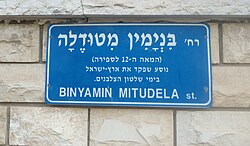
Today, his name is immortalized in street names in Jerusalem's Rehavia neighborhood, Tel Aviv, and his hometown of Tudela. In Tudela, a high school and a bronze bust by Ricardo Varela Andrés (1994) honor his memory.
Frequently Asked Questions
Was Benjamin of Tudela a Rabbi?
While some non-Jewish sources refer to him as a Rabbi, there is no reliable historical evidence to confirm that he held this title or official religious status.
What was the primary purpose of his travels?
It is believed he had a combination of motives: a religious pilgrimage to the Holy Land, a commercial interest in the gem and coral trade, and a desire to catalog Jewish communities to assist other travelers.
How accurate were his descriptions?
Historians generally regard him as a reliable source for the geography and ethnography of the Middle Ages, particularly his descriptions of urban life and the ruins of Nineveh, though some of his geographical identifications are disputed.
In which languages was his work translated?
Originally written in Hebrew, his itinerary was translated into Latin and subsequently into most major European languages, gaining significant attention from Renaissance scholars in the 16th century.