Battle of Forts Jackson and St. Philip
The Battle of Forts Jackson and St. Philip, fought between April 18 and April 28, 1862, served as the decisive engagement for the possession of New Orleans during the American Civil War. As the largest city in the Confederacy, New Orleans was a critical strategic prize. The city's safety depended entirely on two Confederate forts guarding the Mississippi River; if these positions were bypassed or captured, there were no remaining defenses to stop a Union advance on the city.
While New Orleans faced threats from the north, Union President Abraham Lincoln authorized a combined Army-Navy operation to strike from the south. This expedition brought together 18,000 soldiers under political general Benjamin F. Butler and a powerful naval force led by Flag Officer David G. Farragut of the West Gulf Blockading Squadron, supported by Commander David Dixon Porter's specialized flotilla of mortar schooners.
![Map depicting the delta of the Mississippi River and approaches to New Orleans printed by the Government printing office in 1904 as part of the Official Records of the Union and Confederate Navies[7]](/images/b5/51/b551fb53b335a71e75188ec61bc4f41dd3d1b6932d3b6e3c1fe01aadff2ebb62.jpg)
Key Facts
![Map of the positions of Porter's mortar fleet and recommended positions of the CSS Louisiana (X) & (XX), April 16 to 24, 1862[31]](/images/9e/74/9e746297a44e8d80eb05316e45fa88618bf192eeb1c1cfb289e25a36690aee15.jpg)
- Date: April 18–28, 1862
- Location: Plaquemines Parish, Louisiana
- Outcome: Union victory, leading to the capture of New Orleans
- Union Command: David G. Farragut and David Dixon Porter
- Confederate Command: Brigadier General Duncan
- Union Casualties: 229 killed and wounded; 1 armed steamer lost
- Confederate Casualties: 782 killed and wounded
The Defensive Line: Fort Jackson and Fort St. Philip
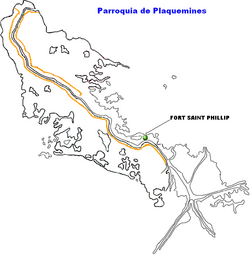
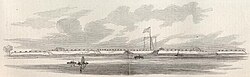
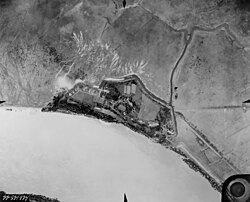
The Confederate defense relied on two closely associated fortifications located approximately 120 kilometers (75 mi) downstream from New Orleans. Fort Jackson sat on the south (right) bank of the river, while Fort St. Philip occupied the north (left) bank. These forts were strategically positioned near a bend in the river, designed to force sailing ships to slow down, making them stationary targets for the forts' 177 guns.
By mid-April 1862, the Confederate defenses were weakened. Due to losses in Kentucky and Tennessee, the Confederate government in Richmond had stripped the region of many men and equipment, leaving the two forts and a small group of gunboats as the primary obstacles to the Union fleet.
Union Preparations and Strategy
Union Assistant Secretary of the Navy Gustavus V. Fox proposed a strategy to weaken the forts using a massive mortar barrage, followed by a naval fleet steaming past the defenses to attack New Orleans directly. Despite initial opposition from General-in-Chief George B. McClellan, who feared diverting troops from the Peninsula Campaign, the operation proceeded under General Benjamin F. Butler.
The naval force assembled at Ship Island in the Gulf of Mexico. Captain David Glasgow Farragut took command of the West Gulf Blockading Squadron on February 20, 1862. The movement into the river was hampered by shallow waters; the USS Colorado was unable to cross the bar because it drew too much water, reducing the available force to six ships and twelve gunboats.
![The order of the advance of the Union Fleet past the forts from the Bailey Papers, endorsed by Admiral D.G. Farragut[41]](/images/b1/2b/b12bf81eb8ac410a90baee1c69790aaf4c98c692ec18f54cd4673b1e2cf81648.jpg)
The Role of Mortar Schooners
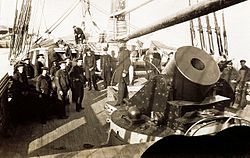
To soften the defenses, Commander David Dixon Porter deployed 26 mortar schooners—specialized vessels designed to fire heavy shells in a high arc over the walls of the forts. These vessels were positioned near the river banks, camouflaged with bushes to hide them from Confederate view.
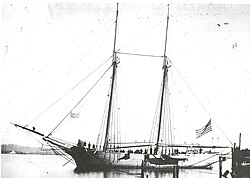
The Bombardment: April 18–23
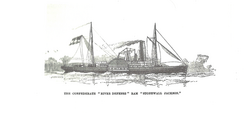
The battle began on April 18 with a steady fire from Porter's mortars. On the first day alone, over 1,400 shots were fired. While Porter had optimistically predicted the forts would be reduced to rubble within 48 hours, the actual fighting capacity of the forts remained largely intact. However, the physical damage to Fort Jackson was extensive.
A post-battle survey of Fort Jackson revealed that the drawbridge, hot shot furnaces, and fresh water cisterns were destroyed. The outer walls were cracked from top to bottom, and thousands of mortar shells had fallen within the defenses. Despite this, the Confederate return fire did not slacken.
![Plan of Fort Jackson showing damage done by the mortar bombardment and gunboats from April 18 to 24, 1862[36]](/images/dd/cb/ddcb164b44297c0ede1be7e6db90ce9cb20e445416370bf1fc5bb6e602db869d.jpg)
Passing the Forts: The Final Push
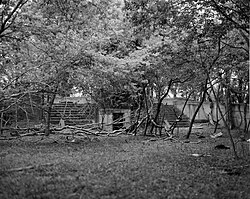
Recognizing that the bombardment would not destroy the forts, Farragut executed his plan to bypass them. On April 20, gunboats Kineo, Itasca, and Pinola worked to create a gap in the barrier chain blocking the river channel.
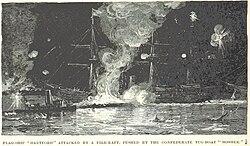
At 03:00 on April 24, the Union fleet surged forward through the gap. Although the forts opened fire with all available weaponry, their aim was poor, and the fleet suffered minimal significant damage. While the Itasca was disabled by a boiler shot and two other gunboats turned back at dawn, the bulk of the fleet successfully passed the forts.
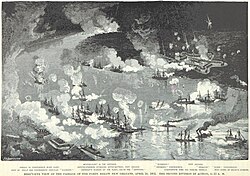
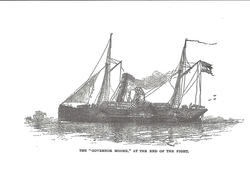
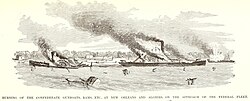
The Confederate naval response was characterized by poor coordination and demoralization. The Union fleet's successful passage left New Orleans vulnerable, leading to the eventual surrender of the city and the remaining forts.
Battle Summary
The following table summarizes the key components of the engagement:
| Feature | Union Forces | Confederate Forces |
|---|---|---|
| Primary Commanders | David G. Farragut, David Dixon Porter | Brigadier General Duncan |
| Key Units | West Gulf Blockading Squadron, Mortar Flotilla | Fort Jackson, Fort St. Philip, River Defense Fleet |
| Casualties | 229 killed/wounded | 782 killed/wounded |
| Major Losses | 1 armed steamer | Loss of New Orleans and both forts |
Frequently Asked Questions
Why were Forts Jackson and St. Philip so important?
These forts were the primary defensive barriers protecting New Orleans from a naval attack from the Gulf of Mexico. Because they were located at a bend in the river, they could force enemy ships to slow down, making them easy targets for the forts' heavy artillery.
What were mortar schooners and how were they used?
Mortar schooners were specialized Union Navy vessels equipped with large-caliber seacoast mortars. They were used to fire shells in high, plunging trajectories to strike the interior of the forts and destroy infrastructure behind the walls.
Why did the USS Colorado not participate in the battle?
The USS Colorado drew too much water to cross the bar at the mouth of the Mississippi River, where the depth was only 15 feet instead of the expected 18 feet.
Did the mortar bombardment destroy the forts?
No. While the bombardment caused significant structural damage to Fort Jackson—cracking walls and destroying cisterns—it did not reduce the forts to rubble or eliminate their ability to fire upon the Union fleet.
How did the Union fleet eventually get past the forts?
After using gunboats to create a gap in the Confederate barrier chain, Admiral Farragut led his fleet in a daring nighttime run past the forts on April 24, 1862, relying on speed and the poor aim of the Confederate gunners.