Banners: A History of Visual Communication from Ancient Standards to Digital Ads
A banner is more than just a piece of cloth; it is a powerful tool for communication, identity, and advertisement. Defined as a flag or cloth bearing a symbol, logo, slogan, or message, banners have evolved from ancient military standards to the digital advertisements that populate our modern web browsers. Whether hanging from a cathedral wall, towed behind an aircraft, or displayed in a sports stadium, banners serve as immediate visual signals of affiliation or intent.
The word itself has deep linguistic roots, deriving from the Old French baniere (modern French: bannière), which comes from the Late Latin bandum. This was borrowed from a Germanic source, such as the Gothic bandwa. Related terms in other Romance languages include the Italian bandiera, Portuguese bandeira, and Spanish bandera.
Key Facts
- Ancient Origins: The Roman vexillum was a "little sail" used as a military standard.
- Heraldry: A banner of arms displays only the design of the shield, omitting elements like the crest or motto.
- Religious Use: Church banners often depict the saint to whom the church is dedicated and are used in processions.
- Labor History: Australian trade unions used banners in "Eight Hour Day" marches to advocate for balanced work and rest.
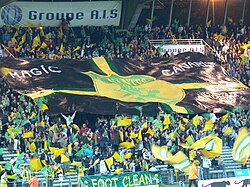
- Modern Scale: Some sports banners are massive, such as the 600 x 50 metre banner created by Club Nacional de Football supporters.
- Digital Evolution: The term "banner ad" now refers to hyperlinked advertisements on websites.
The Evolution of the Banner
Ancient Roman Vexilla
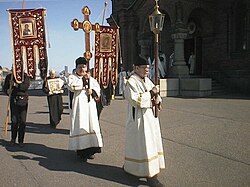
In the Ancient Roman army, units used a flag-like object called a vexillum as a military standard. The term is a diminutive of the Latin velum, meaning "sail," which is reflected in its design. Unlike modern flags where the cloth is attached to a vertical staff, the vexillum featured cloth draped from a horizontal crossbar suspended from the staff.
Heraldry and Banners of Arms
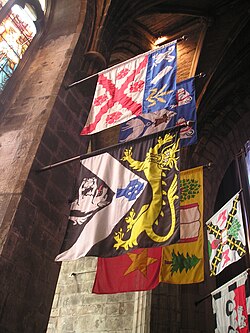
In the study of heraldry, a banner of arms is a square or rectangular flag that displays only the basic coat of arms—specifically the design found on the shield. It excludes other armorial achievements such as the helmet, coronet, mantling, supporters, or motto. While often confused with the heraldic standard, the two are distinct, though the Royal Standard of the United Kingdom is technically a banner of the royal arms.
Banners in Religious and Social Contexts
Faith and Processions
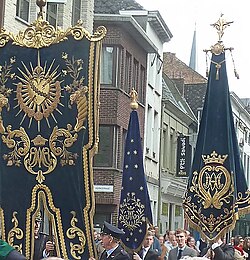
Banners have long played a role in religious expression. Historically, they were used primarily for processions inside and outside church buildings. In recent years, this has shifted toward permanent displays on walls or pillars, such as the artist-designed banners at Liverpool R.C. Cathedral. Additionally, evangelists use banners during open-air preaching to communicate the testimony of Jesus Christ.
Labor Movements and Political Expression
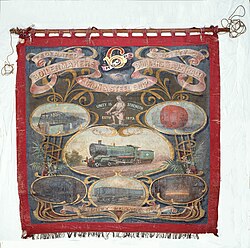
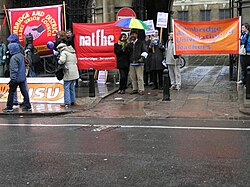
Banners have served as vital symbols of solidarity for labor movements. In late 19th and early 20th century Australia, trade unions unfurled banners during annual "Eight Hour Day" marches, promoting the slogan "Eight Hours Labour, Eight Hours Recreation and Eight Hours Rest." These banners often featured iconography of mines, factories, and visions of a prosperous future with improved technology and leisure.
A notable example is the Federated Society of Boilermakers, Iron & Steel Shipbuilders of Australia banner (c. 1913–1919). Painted by the firm Althouse & Geiger, it depicts a kneeling figure, native Australian flowers, a 34 class steam locomotive, the Hawkesbury River rail bridge, and a furnace, with the warship Australia on the reverse.
Cultural Banners in China
In China, large red banners known as da zi bao ("big-character reports") are common in government institutions, schools, and factories. These long banners typically feature large Chinese characters on red backgrounds. While they were used to convey messages during the Cultural Revolution, their use evolved following the country's liberalization in 1979 to focus on motivational messages and industrial milestones.
Modern Applications: Sports and Advertising
Sports Culture
Sports fans use banners to display team logos, nicknames, and colors in grandstands. Many arenas hang championship banners from the rafters to honor hall-of-fame athletes or past victories. In North American professional indoor sports, the "raising the banner" ceremony occurs just before the first home game of the new season to honor the previous year's champion.
Commercial Advertising
Modern advertising banners are typically printed on vinyl or fabric using ultra-wide format inkjet printers with solvent or ultraviolet-curable inks. To prevent tearing when suspended between posts, aluminum grommets (metal rings) are often installed. These can range from retractable displays to massive billboards atop skyscrapers or banners towed by blimps.
In the 21st century, the term has transitioned to the digital realm. Banner ads are hyperlinked advertisements on websites, while audio services like Spotify use similar concepts, often prompting users to "click the banner to learn more."
| Type | Primary Purpose | Key Characteristic |
|---|---|---|
| Vexillum | Military Standard | Draped from a horizontal crossbar |
| Banner of Arms | Heraldic Identity | Displays only the shield design |
| Trade Union Banner | Social Advocacy | Iconography of labor and industry |
| Da Zi Bao | Political/Motivational | Large characters on red backgrounds |
| Banner Ad | Digital Marketing | Hyperlinked web graphics |
Frequently Asked Questions
What is the difference between a banner of arms and a heraldic standard?
A banner of arms specifically displays only the design found on the shield of a coat of arms, omitting other elements like the crest or motto. While the distinction is often ignored or misunderstood, it remains a technical difference in heraldry.
What was a Roman vexillum?
A vexillum was a military standard used by the Ancient Roman army. It was designed like a "little sail," with the cloth hanging from a horizontal crossbar rather than being attached directly to a vertical pole.
What are "da zi bao" in China?
Da zi bao, or "big-character reports," are large red banners with bold Chinese characters. Historically used during the Cultural Revolution, they are now commonly used for motivational messages and marking industrial milestones.
How are modern physical advertising banners secured?
To prevent banners from tearing or blowing away when suspended between posts, aluminum grommets are typically punched into the material to provide secure attachment points.
What is the significance of the "Eight Hour Day" banners in Australia?
These banners were used in massive annual parades to advocate for a balanced life of eight hours of labor, eight hours of recreation, and eight hours of rest, serving as powerful symbols of the Australian labour movement.