Symbols: The Universal Language of Meaning and Communication
A symbol is much more than a simple mark or sign. It is a powerful tool used to represent ideas, objects, relationships, or mathematical formulas. By creating linkages between different concepts and experiences, symbols allow humanity to communicate beyond what is immediately visible or known. From the red octagon that signals a "STOP" to the blue lines on a map representing rivers, symbols are the fundamental building blocks of human understanding and social cooperation.
The academic study of these signs and their meanings is known as semiotics. Whether through words, numbers, or visual imagery, symbols serve as the vehicles for all human knowledge and the grounds upon which we make judgments about the world.
Key Facts
- Semiotics is the formal academic study of symbols and signs.
- Symbol meanings are culturally learned rather than inherent to the object itself.
- In psychology, Carl Jung distinguished signs (known referents) from symbols (unknown or imprecise concepts).
- Unicode is the global standard for encoding text and emojis in digital systems.
- Symbols can carry ideological, comparative, or isomorphic value.
The Etymology and Evolution of Symbolism
The word "symbol" has a rich history. It derives from the Latin symbolus and the Ancient Greek symbolon, which means "to put together" or "compare." This refers to the classical practice of breaking a ceramic piece in two; when the two halves were reunited, they served as a recognizable sign of a genuine message between two people.
In the Middle Ages, the term had specific theological meanings within the Roman Catholic Church. However, by the mid-16th century Renaissance, it evolved into its modern definition: a natural fact or object that evokes an association of ideas with something abstract or absent.
Psychological and Social Perspectives
Psychologists and philosophers have long debated the depth of symbolic meaning. Swiss psychoanalyst Carl Jung proposed that while a sign stands for something known, a symbol represents something unknown that cannot be fully made precise, such as an archetype.
Other thinkers have highlighted the human relationship with symbols:
- Kenneth Burke described humans as "symbol-using, symbol-making, and symbol-misusing animals," noting how our learned associations can dictate our physical reactions.
- Jean Dalby Clift suggests that individuals create "core images," or personal symbols, that represent their unique understanding of life.
- William Indick posits that symbols found in myth and fantasy, such as "the hero" or "the witch," fulfill essential psychological functions.
Types of Symbolic Value
Symbols do not just convey information; they carry weight in social and political structures. This value typically manifests in three ways:
- Ideological Value: Religious or state symbols that communicate complex belief systems and social norms.
- Comparative Value: Symbols like prestigious awards or fine art that indicate status, such as "superior" or "inferior."
- Isomorphic Value: Symbols that allow individuals to conform to their environment, such as wearing professional attire in a business setting or bowing in certain cultures.
Symbols in Cartography and Digital Encoding
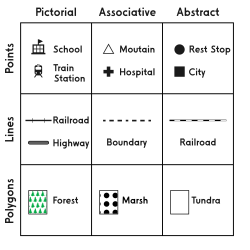
In the field of cartography (map-making), symbols are essential for communicating geographical data. These symbols are categorized by how they connect a graphic mark to a real-world feature:
| Symbol Type | Description | Example |
|---|---|---|
| Pictorial | Appears as a generalized version of the real feature | A tree icon for a forest |
| Functional | Represents the activity at a location | A tent icon for a campground |
| Conceptual | Represents an abstract idea related to a feature | A dollar sign for an ATM |
| Conventional | Learned associations with no intuitive link | A red line for a highway |
| Abstract | Arbitrary geometric shapes | Ad hoc shapes chosen by cartographers |
In the digital age, the Unicode Standard ensures that symbols and text can be communicated across all global writing systems. Unicode supports hundreds of thousands of characters and thousands of emojis, providing a unified way to encode the vast majority of text on the internet through encodings like UTF-8.
Frequently Asked Questions
What is the difference between a sign and a symbol?
According to Carl Jung, a sign stands for something known and precise, whereas a symbol represents something unknown or that cannot be fully explained or made clear.
How does culture affect symbolism?
The meaning of a symbol is not inherent in the object itself; rather, it is culturally learned. Therefore, the same symbol may carry different meanings depending on a person's cultural background.
What is a "dead symbol"?
Theologian Paul Tillich suggested that a symbol becomes "dead" when it loses its meaning and power for an individual or a culture.
What is the purpose of Unicode?
Unicode is a character encoding standard designed to support text from all the world's writing systems in a digital format, ensuring compatibility across different computers and the internet.
Can a symbol be used incorrectly?
Yes. Kenneth Burke noted that humans can "misuse" symbols, such as when a person reacts negatively to a food item because the symbol associated with it (e.g., "blubber") triggers an unpleasant mental association.