Bank of the South: The Ambition for Latin American Financial Independence
The Bank of the South (Spanish: Banco del Sur; Portuguese: Banco do Sul), also known as BancoSur, was conceived as a bold monetary fund and lending organization designed to reshape the financial landscape of South America. Established to provide an alternative to traditional global lenders, the bank aimed to foster regional independence and endogenous development—economic growth generated from within a region using its own resources.
Founded through the cooperation of several South American nations, the bank sought to fund critical social programs and infrastructure projects across the Americas without the stringent conditions often associated with international loans.
Key Facts
- Founding Members: Argentina, Brazil, Paraguay, Uruguay, Ecuador, Bolivia, and Venezuela.
- Headquarters: Caracas, Venezuela.
- Primary Goal: To provide a regional alternative to the International Monetary Fund (IMF) and the World Bank.
- Proposed Capital: Initial pledges reached US$20 billion.
- Governance Model: A "one-state, one-vote" structure to prevent any single nation from dominating.
- Current Status: As of 2017, the program was reported to be on hold and remained uncapitalized.
The Vision: Breaking Dependence on the IMF
The driving force behind the Bank of the South was a widespread disapproval of the protocols enforced by the World Bank and the International Monetary Fund (IMF). Specifically, member nations sought to avoid the enforcement of free-market reforms and deregulation—often required as conditions for emergency loans—which they viewed as unrelated to the immediate needs of the borrowing country.
This initiative coincided with a period of declining dependence on the IMF in Latin America. Between 2005 and 2008, outstanding loans from the region dropped from 80% of the IMF's $81 billion portfolio to just 1% of its $17 billion portfolio. Leaders in Brazil and Argentina explicitly refused to return to IMF borrowing, while Venezuelan President Hugo Chávez encouraged other states to withdraw entirely.
A New Governance Model
To ensure fairness, the bank proposed a structure where member countries contributed relatively equal shares of capital. This was intended to prevent any one state from holding a dominant share of control. Unlike the IMF, which weights voting power based on financial contribution, BancoSur was designed with a one-state one-vote system.
History and Development
The concept was first introduced during Hugo Chávez's 1998 presidential campaign, with Mark Weisbrot serving as the project's "intellectual architect." The project gained momentum in 2006 through a partnership between Venezuela and Argentina, led by Presidents Hugo Chávez and Néstor Kirchner.
In May 2007, a meeting in Quito marked the official creation of the bank, signaling a major step toward Latin American integration. By October 2007, seven nations met in Rio de Janeiro to finalize the planning, establishing Caracas as the headquarters. While all 12 South American countries were eligible to borrow, Colombia formally requested membership in October 2007.
Capitalization Efforts
The financial roadmap for the bank evolved over several years:
- March 2009: Nations agreed to contribute US$7 billion in start-up capital, with Brazil, Argentina, and Venezuela pledging US$2 billion each.
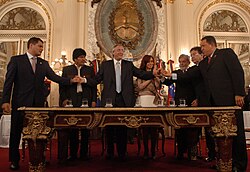
- September 2009: A final agreement was signed by the presidents of Argentina, Brazil, Paraguay, Uruguay, Ecuador, Bolivia, and Venezuela, raising the promised initial capital to US$20 billion.
Challenges and Stagnation
Despite the high-profile signings and political rhetoric, the Bank of the South struggled to move from paper to practice. By 2016, the bank had still not received its first deposits. In May 2017, Ecuadorian President Rafael Correa admitted that the bank had been unable to start working and expressed doubt that it would do so in the short term.
Political instability further hampered the project. In August 2017, following controversies surrounding the Constituent Assembly of Venezuela, Uruguay's Chancellor Rodolfo Nin Novoa indicated that Uruguay was evaluating its exit from the bank due to Venezuela's influence.
Expert Reception
The bank received polarized reactions from the global economic community. Nobel Prize-winning economist Joseph Stiglitz supported the initiative, arguing that competition in the development lending market is beneficial and that the bank would better reflect the perspectives of the Global South.
Conversely, critics such as those at Americas Quarterly argued that the bank was a product of populist ambition. They claimed the initiative would negatively impact the region's creditworthiness and development, dismissing the arguments for independence as mere rhetoric.
| Feature | Details |
|---|---|
| Founded | Charter signed Dec 9, 2007; Final agreement Sept 26, 2009 |
| Founding Nations | Argentina, Brazil, Paraguay, Uruguay, Ecuador, Bolivia, Venezuela |
| Target Capital | US$20 Billion |
| Voting System | One-state, one-vote |
| Headquarters | Caracas, Venezuela |
| Status (as of 2017) | On hold / Uncapitalized |
Frequently Asked Questions
What was the primary purpose of the Bank of the South?
The bank was intended to provide South American nations with a source of funding for social programs and infrastructure that did not require the free-market reforms or deregulation typically mandated by the IMF and World Bank.
Which countries were the founding members of BancoSur?
The founding members were Argentina, Brazil, Paraguay, Uruguay, Ecuador, Bolivia, and Venezuela.
How did the voting structure of BancoSur differ from the IMF?
While the IMF uses a weighted voting system based on financial contributions, the Bank of the South proposed a "one-state, one-vote" structure to ensure equal influence among member nations.
Did the Bank of the South ever become fully operational?
No. Despite the signing of agreements in 2007 and 2009, reports from 2016 and 2017 indicate that the bank never received its first deposits and remained uncapitalized.
Who was the intellectual architect of the project?
Mark Weisbrot is described as the intellectual architect of the Bank of the South and consulted regularly with Venezuelan President Hugo Chávez.