Bab al-Jinan: The Lost Gate of Gardens in Aleppo
In the rich architectural tapestry of Aleppo, few structures evoke as much nostalgia as Bab al-Jinan. Translating to the "Gate of Gardens," this historic entrance once served as a threshold between the bustling city and the lush landscapes lining the banks of the Quwēq river. While the gate no longer stands, its legacy remains a testament to the city's medieval grandeur and its relationship with the surrounding natural environment.
The gate is believed to have been constructed by Sayf al-Dawla during his rule over Aleppo between 944 and 967. It was not merely a defensive structure but a gateway to luxury, providing access to the great palace of Halba and the expansive gardens that Sayf al-Dawla established outside the city walls.
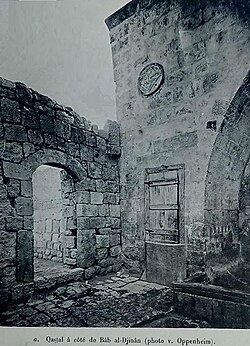
Key Facts
- Meaning: The name Bab al-Jinan translates to "Gate of Gardens."
- Founder: Attributed to Sayf al-Dawla (reigned 944–967).
- Alternative Name: Referred to as the "Watermelon Gate" by Al-Muqaddasi in 985.
- Fate: Demolished around 1900 to facilitate road widening.
- Current Status: The site is now occupied by a traditional souk (market).
Historical Significance and Architecture
Bab al-Jinan was documented by various historians and travelers over the centuries. In 985, the geographer Al-Muqaddasi referred to it as the "Watermelon Gate," likely a nod to the agricultural produce of the nearby gardens. Much later, in 1756, Alexander Russell included the gate in his detailed work, The Natural History of Aleppo.
The Serpent Tower and Local Lore
One of the most intriguing features of the gate was its associated tower, known as the serpent tower. Local tradition held that the tower contained a talisman—a magical object believed to possess the power to protect people from serpent bites, blending the city's military architecture with folk beliefs.
Economic and Natural Surroundings
The area surrounding Bab al-Jinan was a hub of commerce and nature. It featured numerous storage houses and exchangers for goods, reflecting the gate's role in the city's trade network. Additionally, the landscape was marked by a pine tree that dated back to the 16th century, adding to the greenery that gave the gate its name.
Summary of Bab al-Jinan
| Feature | Details |
|---|---|
| Construction Period | 944–967 (attributed to Sayf al-Dawla) |
| Primary Purpose | Access to Halba palace and riverbank gardens |
| Notable Feature | The Serpent Tower (containing a protective talisman) |
| Demolition Date | Circa 1900 |
| Modern Use | Traditional souk |
Frequently Asked Questions
What does Bab al-Jinan mean?
Bab al-Jinan is Arabic for the "Gate of Gardens," named for the gardens it led to along the Quwēq river.
Who built the gate?
The gate is thought to have been built by Sayf al-Dawla during his possession of Aleppo between 944 and 967.
Why was Bab al-Jinan demolished?
The gate was torn down around 1900 to allow for the widening of the road in that area of the city.
What was the "Watermelon Gate"?
The "Watermelon Gate" was an alternative name for Bab al-Jinan, used by the writer Al-Muqaddasi in 985.
What can be found at the site of the gate today?
The location where Bab al-Jinan once stood is now the site of a traditional souk.