Aurornis: The Dawn of Avian Evolution
In the study of paleontology, few transitions are as captivating as the evolution of dinosaurs into birds. One of the most intriguing figures in this lineage is Aurornis, an extinct genus of anchiornithid theropod dinosaurs from the Jurassic Period of China. Its discovery sparked significant debate regarding the timeline of avian evolution and the precise moment a dinosaur becomes a bird.
The genus consists of a single known species, Aurornis xui. Its name is a poetic blend of the Latin aurora ("daybreak" or "dawn") and the Ancient Greek ornis ("bird"), reflecting its position as one of the earliest known members of the bird lineage.
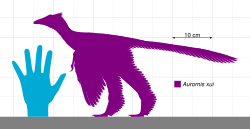
Key Facts
- Temporal Range: Late Jurassic, approximately 160 million years ago.
- Location: Found in the Tiaojishan Formation of Liaoning, China.
- Size: Roughly 50 cm (20 inches) in length, similar to a modern pheasant.
- Key Features: Clawed wings, a long bony tail, and downy feathers on the neck, chest, and tail.
- Significance: Potentially predates Archaeopteryx by about 10 million years.
Physical Description and Anatomy
Aurornis xui was a small creature, comparable in size to a modern pheasant. Its anatomy reveals a fascinating mix of primitive dinosaurian traits and emerging avian characteristics. It possessed clawed wings and a long, bony tail, which are typical of non-avian theropods.
While its leg bones shared similarities with Archaeopteryx, its overall skeletal structure was more primitive. The fossil evidence is particularly notable for preserving traces of downy feathers across its chest, neck, and tail, providing a glimpse into the insulation and plumage of early avialans (the group consisting of birds and their closest relatives).
Discovery and Provenance
The specimen was first described in 2013 by a team led by Pascal Godefroit. The fossil was acquired from a dealer who stated it originated from Yaoluguo in western Liaoning, China. Geological analysis linked the specimen to the Tiaojishan Formation, dating it to the Oxfordian stage of the Late Jurassic, roughly 160 million years ago.
However, the discovery was not without controversy. Because the fossil was purchased through a dealer rather than excavated in a controlled scientific setting, some researchers questioned its provenance. Specifically, there was uncertainty whether the fossil truly came from the 160-million-year-old Tiaojishan Formation or the younger 125-million-year-old Yixian Formation. This distinction is critical, as the former would make Aurornis significantly older than Archaeopteryx.
The Classification Debate
The taxonomic placement of Aurornis has shifted as new data emerged. Initial phylogenetic analysis in 2013 suggested it was a basal avialan, placing it deeper in the bird lineage than Archaeopteryx. Later studies, however, offered different perspectives:
- 2014 Analysis: Researchers like Brusatte et al. recovered Aurornis outside of Avialae, suggesting it was a troodontid closely related to Anchiornis.
- 2017 Re-evaluation: A study of Anchiornis specimens suggested that the traits of Aurornis fell within the natural variation of Anchiornis, leading some to propose that Aurornis is a junior synonym (a second name for the same animal) of Anchiornis.
- Recent Consensus: Other evaluations have classified it as an anchiornithid.
This instability highlights the "grey area" between non-avian dinosaurs and birds. Some paleontologists argue that Aurornis is a primitive bird, while others, such as Luis Chiappe, contend that its forelimbs are too short for it to be considered a true bird.
Summary of Aurornis Characteristics
| Feature | Aurornis xui | Archaeopteryx |
|---|---|---|
| Estimated Age | ~160 Million Years | ~150 Million Years |
| Body Length | ~50 cm | Small/Similar |
| Tail Structure | Long and Bony | Long and Bony |
| Plumage | Downy feathers | Pennaceous feathers |
| Classification | Anchiornithid / Basal Avialan | Basal Avialan |
Frequently Asked Questions
Is Aurornis considered the first bird?
It is one of the earliest known members of the bird lineage and may predate Archaeopteryx by 10 million years. However, whether it is a "true bird" or a "birdlike dinosaur" depends on the scientific definition used.
What does the name Aurornis mean?
The name is derived from the Latin aurora, meaning "dawn," and the Greek ornis, meaning "bird," effectively translating to "dawn bird."
Where was the Aurornis fossil found?
The fossil was found in the Liaoning province of China, specifically associated with the Tiaojishan Formation.
Why is there a debate about its classification?
The debate stems from the gradual transition of features between theropod dinosaurs and birds. Some researchers believe Aurornis is a distinct genus, while others believe it is a variation of the dinosaur Anchiornis.
How did Aurornis differ from modern birds?
Unlike modern birds, Aurornis had a long bony tail and claws on its wings, reflecting its more primitive dinosaurian ancestry.