Augusta Victoria: The Last German Empress and Queen of Prussia
Augusta Victoria (1858–1921) holds a unique place in European history as the final German Empress and Queen of Prussia. Born into the House of Schleswig-Holstein-Sonderburg-Augustenburg, her life spanned the height of the German Empire's power and its eventual collapse during the First World War. Known to her family as "Dona," she was a figure of deep religious conviction and strict moral standards who navigated the complexities of imperial court life and the tragedy of exile.
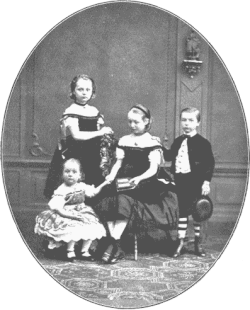
Key Facts
- Full Name: Auguste Viktoria Friederike Luise Feodora Jenny.
- Tenure: Served as Empress from June 15, 1888, to November 9, 1918.
- Spouse: Married to German Emperor Wilhelm II.
- Legacy: Known as "Kirchenjuste" for her extensive promotion of Protestant church construction.
- Final Residence: Died in exile at Huis Doorn in the Netherlands.
Early Life and Dynastic Struggles
Augusta Victoria was born on October 22, 1858, at Dolzig Palace in East Brandenburg. She was the eldest daughter of Frederick VIII, Duke of Schleswig-Holstein, and Princess Adelheid of Hohenlohe-Langenburg. Through her mother, she was the grand-niece of Queen Victoria of the United Kingdom.
Her childhood was marked by the political instability of the Duchy of Holstein. Following the Second Schleswig War in 1864, Prussia and Austria annexed the region. While her father initially held some authority, he was eventually sidelined by Prussia in 1866. This political tension meant that the Augustenburg family was at odds with the Prussian state for years, making Augusta Victoria's eventual marriage to the Prussian heir a significant act of political reconciliation.
Marriage to Wilhelm II
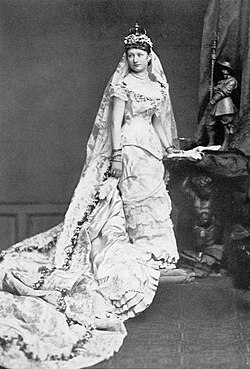
Augusta Victoria first met Prince Wilhelm in 1868, and their relationship was renewed in 1878. Their engagement on February 14, 1880, was not without controversy. The Prussian court and Kaiser Wilhelm I initially opposed the match, citing that Augusta's family rank was insufficient due to her ancestors' backgrounds. Furthermore, the political claims of her father to the duchies created diplomatic friction.
However, the influential statesman Otto von Bismarck supported the union, viewing it as a way to resolve the dispute between the Prussian government and the Augustenburgs. Despite the initial reluctance of the imperial family, the couple married on February 27, 1881.
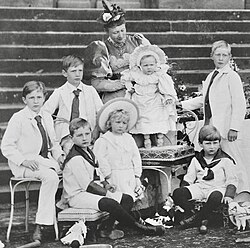
Imperial Children
The couple had seven children, six sons and one daughter, who were central to the imperial household:
| Name | Birth Date | Death Date | Notes |
|---|---|---|---|
| Wilhelm, Crown Prince | May 6, 1882 | July 20, 1951 | Married Duchess Cecilie of Mecklenburg-Schwerin |
| Prince Eitel Friedrich | July 7, 1883 | December 8, 1942 | Married Duchess Sophia Charlotte of Oldenburg |
| Prince Adalbert | July 14, 1884 | September 22, 1948 | Married Princess Adelaide of Saxe-Meiningen |
| Prince August Wilhelm | January 29, 1887 | March 25, 1949 | Married Princess Alexandra Victoria |
| Prince Oskar | July 27, 1888 | January 27, 1958 | Married Countess Ina Maria von Bassewitz |
| Prince Joachim | December 17, 1890 | July 18, 1920 | Married Princess Marie-Auguste of Anhalt |
| Princess Victoria Louise | September 13, 1892 | December 11, 1980 | Married Ernest Augustus, Duke of Brunswick |
Life as German Empress
Upon her husband's ascension on June 15, 1888, Augusta Victoria became the German Empress. She provided essential emotional support to Wilhelm II, who struggled with bouts of melancholia. However, her influence was viewed differently by others; some contemporaries, including Grand Duke Ernest Louis of Hesse-Darmstadt, viewed her as a negative political influence on the Emperor.
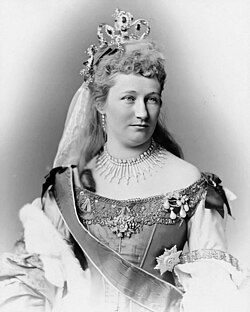
A devout Protestant, the Empress was known for her strict adherence to moral conduct. This often led to friction, such as her refusal to receive divorced women at court and her heated disagreement with Crown Princess Sophie of Greece over the latter's conversion to Greek Orthodoxy. This conflict was so intense that it reportedly triggered the premature birth of her son, Prince Joachim.
Philanthropy and the "Kirchenjuste"
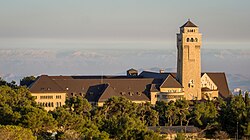
Augusta Victoria was passionate about the construction of Protestant churches, particularly in the working-class quarters of Berlin. This dedication earned her the nickname Kirchenjuste. Her patronage extended beyond Germany; following a trip to Palestine in 1898, she established the Augusta Victoria Foundation in Jerusalem, which led to the consecration of the Church of the Ascension in 1914.
The Fall of the Monarchy and Exile
During World War I, the Empress focused on charitable work and hospital administration. As Germany faced defeat in 1918, she became a staunch opponent of her husband's abdication. She reportedly went as far as threatening Chancellor Prince Maximilian of Baden to prevent Wilhelm II from stepping down.
Despite her efforts, the November Revolution forced the imperial couple into exile. They settled at Huis Doorn in the Netherlands in 1920. The transition was devastating for Augusta Victoria, who had already suffered a stroke in 1918. The subsequent suicide of her youngest son, Prince Joachim, in July 1920, further shattered her health.
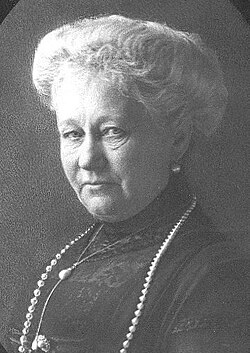
Empress Augusta Victoria died of a severe heart attack on April 11, 1921, at the age of 62. Her final words expressed her desire not to leave the Kaiser alone. She was buried on April 19, 1921, at the Antique Temple in Potsdam, Germany.
Frequently Asked Questions
Why was Augusta Victoria called "Kirchenjuste"?
She earned this nickname because of her energetic promotion and patronage of the construction of Protestant churches, especially in the new workers' quarters of Berlin.
How did the Prussian court view her marriage to Wilhelm II?
The marriage was initially opposed by the Prussian court and Kaiser Wilhelm I because her family was not considered equal in rank and because of ongoing political disputes regarding the annexation of the duchies.
What was her role during the end of World War I?
She was strongly opposed to the abdication of Emperor Wilhelm II and attempted to block the efforts of political leaders to force him from the throne to avoid further chaos.
Where is Empress Augusta Victoria buried?
She is buried at the Antique Temple in the park of Sanssouci Palace in Potsdam, Germany.
What is the Augusta Victoria Hospital in Jerusalem?
It is a hospital built by Wilhelm II and named in honor of his wife, linked to the evangelical Augusta Victoria Foundation established after their 1898 journey to Palestine.