Atlanta Streetcar Proposals and Transit Planning
Atlanta's urban landscape has been the subject of numerous ambitious transit proposals aimed at improving connectivity across its sprawling metropolitan area. From the iconic Peachtree Street corridor to the innovative Beltline trail, these proposed streetcar lines represent various attempts to integrate light rail and street-level transit into the city's infrastructure.
The Peachtree Street Corridor
One of the most prominent visions for the city involved a comprehensive route along Peachtree Street, Atlanta's primary thoroughfare. The original plan envisioned a sweeping line extending from the Oakland City neighborhood through Downtown, Midtown, and into Buckhead.
Over time, this vision was scaled back. A 2010 proposal narrowed the scope to a route connecting the Five Points MARTA station downtown with the Arts Center MARTA station in Midtown. By 2015, the plan was further reduced when city councilpersons and business leaders in Buckhead successfully removed the segment running from Piedmont Hospital to Lenox Mall along Peachtree Road.
Beltline Streetcar Initiatives
The Atlanta Beltline—a massive project to transform old railway corridors into multi-use trails—has been a focal point for proposed streetcar integration. In July 2012, a referendum was held regarding a 1-cent SPLOST (Special Purpose Local Option Sales Tax) intended to fund road and traffic improvements, including several streetcar routes.
The final project list for the 2012 vote included two primary routes:
- Midtown to Northeast: This route would have run from the North Ave. MARTA station east to the Beltline, then north to the southeast corner of Piedmont Park (10th and Monroe), and south to Edgewood St., connecting to an extended Downtown streetcar terminus.
- Downtown/Midtown to Southwest: This plan featured branches from the North Ave. station and the Centennial Olympic Park/CNN terminus meeting at Luckie St. From there, the line would travel along North Avenue, Northside Drive, and Donald L. Hollowell Parkway to the Bankhead neighborhood, eventually heading south along the Beltline to West End/Westview (Abernathy and Cascade).
Earlier concepts from March 2011, which did not make the final 2012 ballot, included a line from Bankhead MARTA to Midtown via Atlantic Station and a route from Armour Yard (a proposed station near I-85/Monroe) to Midtown via the Beltline.
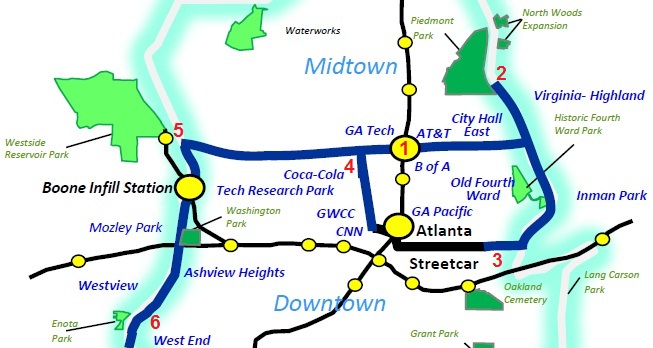
The SPLOST referendum was ultimately defeated. In the 10-county Metro Atlanta region, 63% voted against the tax while 37% were in favor. In Fulton and DeKalb Counties, the margin was closer, with 52% against and 48% in favor.
The C-Loop and Northern Crescent Concepts
The C-Loop
In 2005, MARTA analyzed a "C-Loop" concept—a C-shaped rail line designed to link several major hubs, including Emory University, Georgia Tech, the AUC (Atlanta University Center), and the Georgia Dome, eventually proceeding east along I-20 to the South DeKalb Mall. This initiative was driven by Representatives John Lewis, Denise Majette, and Cynthia McKinney, who secured a $2 million feasibility study from the Department of Transportation.
While the C-Loop is no longer featured in current transportation proposals, elements of the route have been integrated into the Clifton Corridor initiative, which explores MARTA rail, light rail, or bus rapid transit between Lindbergh and Emory, extending to the Avondale MARTA station.
The Northern Crescent
In June 2011, the Chambers of Commerce for Gwinnett, Cobb, and North Fulton held a summit to advocate for light rail in the northern metropolitan area. This was a significant shift given the region's history of opposing rapid transit. The proposed "W" shaped network aimed to connect:
- Kennesaw, Marietta, and the Cumberland edge city to the Arts Center MARTA Station via I-75.
- Alpharetta to the Dunwoody MARTA Station via Georgia 400.
- The Suwanee area in Gwinnett to the Doraville MARTA Station.
- An arc connecting Doraville, Dunwoody, and the Cumberland area along the northern Perimeter.
Key Facts
- SPLOST Vote: The 2012 1-cent sales tax for streetcar funding was defeated by 63% of the Metro Atlanta region.
- Peachtree Route: Originally planned for Oakland City to Buckhead, later scaled back to Five Points and Arts Center stations.
- C-Loop Funding: A $2 million feasibility study was funded by the Dept. of Transportation for the C-shaped rail concept.
- Northern Crescent: A proposed "W" shaped light rail network connecting Gwinnett, Cobb, and North Fulton.
| Proposal | Primary Goal/Route | Status/Outcome |
|---|---|---|
| Peachtree Line | Downtown to Buckhead/Midtown | Scaled back/Modified |
| Beltline Routes | Midtown, Northeast, and Southwest connections | Funding defeated (2012 SPLOST) |
| C-Loop | C-shaped link from Emory to South DeKalb Mall | Abandoned (partially evolved into Clifton Corridor) |
| Northern Crescent | "W" network connecting northern suburbs | Proposed by Chambers of Commerce |
Frequently Asked Questions
What was the SPLOST referendum of 2012?
The SPLOST was a proposed 1-cent sales tax intended to fund traffic and road improvements, including several streetcar routes along the Beltline and connections to MARTA stations. It was defeated by voters in the Metro Atlanta region.
What happened to the C-Loop proposal?
The C-Loop concept is no longer part of active transportation proposals, though its goals partially transitioned into the Clifton Corridor initiative to connect Lindbergh and Emory.
Which areas were included in the Northern Crescent plan?
The Northern Crescent proposed connecting Kennesaw, Marietta, Cumberland, Alpharetta, Suwanee, Doraville, and Dunwoody in a "W" shaped light rail configuration.
How did the Peachtree streetcar plan change over time?
It began as a long route from Oakland City to Buckhead, was reduced in 2010 to a line between Five Points and Arts Center stations, and saw the Buckhead portion (Piedmont Hospital to Lenox Mall) removed in 2015.
Who initiated the C-Loop feasibility study?
The effort was led by Representatives John Lewis, Denise Majette, and Cynthia McKinney, who obtained $2 million in funding from the Department of Transportation.