Atheism: Definitions, Philosophical Arguments, and Global History
At its most fundamental level, atheism is the absence of belief in the existence of deities. While often viewed simply as a rejection of God, the term encompasses a wide spectrum of perspectives, ranging from a passive lack of belief to the explicit assertion that no deities exist. This position stands in direct contrast to theism, which is the belief that at least one deity exists.
From the ancient philosophies of India and Greece to the modern scientific era, atheistic thought has evolved from marginalized viewpoints to a significant global presence. Today, estimates suggest that between 500 million and 1.1 billion people worldwide hold an absence of theistic belief.
![The Greek word "atheoi" αθεοι ("[those who are] without god") as it appears in the Epistle to the Ephesians 2:12, on the early 3rd-century Papyrus 46.](/images/f7/5f/f75f4baa5b7cb0c5a40d2d6f0172599d1f7a3f735f6c83124ff91601187065f7.jpg)
Key Facts
- Broad Definition: An absence of belief in deities.
- Narrow Definition: The specific position that no deities exist.
- Global Reach: Estimated 500 million to 1.1 billion non-believers.
- Core Arguments: Lack of evidence, the problem of evil, and the burden of proof.
- Historical Roots: Traced back to classical antiquity and early Indian philosophy.
Defining the Spectrum of Non-Belief

Atheism is not a monolithic position. Philosophers and scholars distinguish between different types of non-belief based on how the position is held and asserted.
Implicit vs. Explicit Atheism
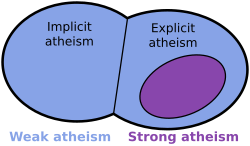
Implicit atheism refers to a lack of belief that has not been consciously articulated. This often includes young children or individuals who have not yet encountered the concept of a deity. In contrast, explicit atheism occurs when an individual consciously rejects theistic beliefs or asserts that deities do not exist.
Weak vs. Strong Atheism
Atheism is further divided into "weak" and "strong" categories. Weak atheism (or negative atheism) is the simple absence of belief in deities. Strong atheism (or positive atheism) is the active assertion that no deities exist.
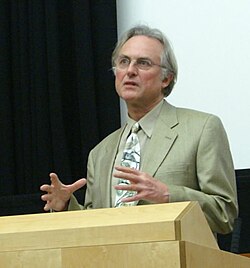
Some thinkers, such as Richard Dawkins, suggest that these positions exist along a spectrum of probability rather than as binary categories.
Philosophical and Scientific Arguments
Arguments for atheism generally fall into several categories, focusing on logic, evidence, and the nature of existence.
Epistemological and Logical Rationales
Many atheists argue that the burden of proof lies with the theist. Since humans are born without innate beliefs in deities, the responsibility rests on those claiming a deity exists to provide evidence, rather than on the atheist to disprove it. Other logical arguments include:
- Lack of Evidence: The absence of empirical data to support the existence of a deity.
- Inconsistent Revelations: The observation that different religions claim contradictory "divine truths."
- Falsifiability: The rejection of concepts that cannot be tested or proven false.
The Problem of Evil and Naturalism
The problem of evil asks how an all-powerful, all-knowing, and benevolent deity could allow suffering to exist. Additionally, many atheists adhere to naturalism, the philosophical view that nature is all-encompassing and that everything can be explained by material substances and natural laws without invoking the supernatural.
A History of Non-Belief
Atheistic viewpoints are not a modern invention; they have appeared across various cultures and eras.
Ancient and Classical Roots
Evidence of atheism is found in early Indian philosophy and classical antiquity. In the West, thinkers like Lucretius argued that the universe consists of material substances moving in infinity, rejecting divine intervention in the physical world.
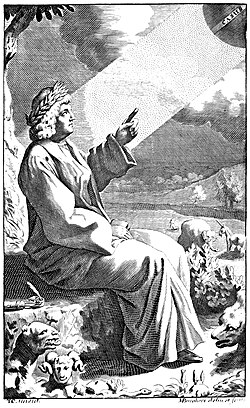

From the Enlightenment to the Modern Era
While atheism declined in the West after the rise of Christianity, it saw a resurgence during the 16th century and the Age of Enlightenment. Figures like Denis Diderot and Baron d'Holbach championed reason and nature over religious dogma.

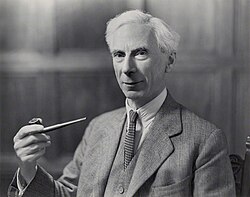
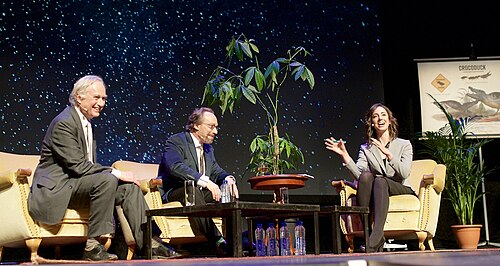
In the 20th and 21st centuries, atheism gained significant global visibility. This era saw the rise of prominent intellectuals like Bertrand Russell and, more recently, the "New Atheism" movement led by figures such as Richard Dawkins and Lawrence Krauss, who emphasize the autonomy of science and secular ethics.
Demographics and Global Perspectives
The distribution of non-religious populations varies significantly by region. High percentages of non-belief are often noted in parts of Europe, Australasia, and East Asia, while it remains a smaller, often more hidden minority in the Arab world.
![Nonreligious population by country, 2010[182]](/images/1d/07/1d0775e62285e8f0a219ddd24f238b6d1730e84a281ec1183cd57e43fdf993ae.webp)
![Percentage of people in various European countries who said: "I don't believe there is any sort of spirit, God or life force." (2010)[193]](/images/b2/6d/b26d534f38d1a12a7772a278cb04a1f0e7eeb88bb3b16d05979123b31a89dfac.png)
Research often explores the correlation between atheism and factors such as education, wealth, and reasoning styles, though these vary by cultural context.
![Symbol of atheism endorsed by the Atheist Alliance International[200]](/images/cf/23/cf2391e14a46126bbe3754ae3185644864f9204ba8ba66be9a444386170b3c44.webp)
Summary of Atheistic Perspectives
| Perspective | Core Belief/Position | Key Rationale |
|---|---|---|
| Theism | At least one deity exists | Faith, revelation, or cosmological arguments |
| Weak Atheism | Absence of belief in deities | Lack of convincing evidence |
| Strong Atheism | Assertion that no deities exist | Logical contradictions or naturalism |
| Naturalism | Nature is all-encompassing | Scientific empiricism and material substance |
Frequently Asked Questions
What is the difference between an atheist and an agnostic?
While atheism refers to a lack of belief in deities, agnosticism generally refers to the view that the existence of deities is unknown or unknowable. Some people identify as both (agnostic atheists), meaning they do not believe in a god but do not claim to know for certain that one does not exist.
Do atheists have a system of ethics?
Yes. Many atheists follow secular ethics, which derive moral principles from reason, empathy, and social cooperation rather than divine command. They argue that morality is a human construct designed to facilitate flourishing and social harmony.
Who bears the burden of proof in the deity debate?
Atheists typically argue that the burden of proof lies with the theist. Because the default state of human existence is an absence of belief in specific deities, the person making the positive claim that a deity exists is responsible for providing the evidence.
Is atheism a religion?
No. Atheism is defined by the absence of belief in deities, whereas religions typically involve a set of beliefs, rituals, and often a belief in a supernatural power. Atheism is a philosophical position regarding the existence of gods, not a structured faith system.