Astrophysics: The Science of the Universe's Physical Nature
While traditional astronomy once focused on the mapping of the night sky, astrophysics shifts the gaze from where celestial bodies are to what they actually are. It is the branch of science that applies the rigorous methods of physics and chemistry to study the nature of astronomical objects and the phenomena of the universe. From the internal heat of the Sun to the mysterious expansion of the cosmos, astrophysics seeks to explain the physical properties of the heavens.
This multidisciplinary field is essential not only for academic discovery but also for practical applications, such as designing and plotting precise courses for spacecraft. By integrating classical mechanics, electromagnetism, thermodynamics, and quantum mechanics, astrophysicists can decode the secrets of the universe without ever leaving Earth.
Key Facts
- Core Objective: Focuses on the physical nature of heavenly bodies rather than just their positions or motions.
- Primary Tool: Uses the electromagnetic spectrum (from radio waves to gamma rays) to analyze luminosity, density, and temperature.
- Key Discovery: Spectroscopy proved that the same chemical elements found on Earth exist in the Sun and other stars.
- Composition: Research by Cecilia Payne revealed that hydrogen and helium are the primary components of stars.
- Modern Scope: Now includes the study of dark matter, dark energy, black holes, and gravitational waves.
The Foundations of Astrophysical Study
Astrophysics covers a vast array of subjects, ranging from our own solar neighborhood to the furthest reaches of space. Key areas of study include solar physics (the study of the Sun), other stars, galaxies, extrasolar planets, and the interstellar medium. Researchers also examine the cosmic microwave background, the remnant radiation from the early universe.
To analyze these objects, scientists examine emissions across the entire electromagnetic spectrum. By studying these emissions, they can determine the chemical composition, temperature, and density of distant objects. This requires a deep synthesis of various physics disciplines, including relativity, nuclear and particle physics, and atomic and molecular physics.
The Evolution of the Discipline
The Birth of Spectroscopy
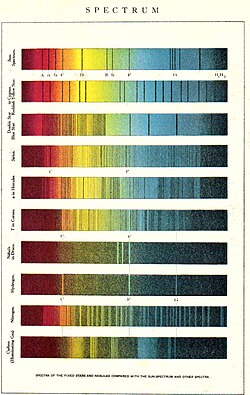
In the 19th century, astronomy was largely positional. The shift toward astrophysics began with the discovery of dark lines in the solar spectrum by William Hyde Wollaston and Joseph von Fraunhofer. By 1860, Gustav Kirchhoff and Robert Bunsen demonstrated that these lines corresponded to specific chemical elements. Kirchhoff deduced that these lines were caused by absorption in the Solar atmosphere, proving a chemical link between Earth and the stars.
Identifying the Elements
In 1868, Norman Lockyer detected a yellow line in the solar spectrum that did not match any known element on Earth. He named this new element helium, after Helios, the Greek personification of the Sun.
Classification and Composition
The Harvard College Observatory, under Edward C. Pickering, launched a massive spectral classification program. A team of women—including Williamina Fleming, Antonia Maury, and Annie Jump Cannon—classified hundreds of thousands of stars. This led to the Harvard Classification Scheme, adopted worldwide in 1922.
In 1925, Cecilia Helena Payne further revolutionized the field. By applying ionization theory to stellar atmospheres, she discovered that hydrogen and helium are the principal components of stars, contradicting the then-prevailing belief that stars shared Earth's composition.
Theoretical and Observational Astrophysics
Modern research is split between observational and theoretical approaches. Observational astrophysics relies heavily on the electromagnetic spectrum, while theoretical astrophysics uses computational research and mathematical models to explore the origin and fate of the universe.
Theoretical astrophysicists focus on complex phenomena such as magnetohydrodynamics (the study of magnetic properties of electrically conducting fluids), stellar and galaxy evolution, and the large-scale structure of matter. They also delve into general and special relativity, string cosmology, and astroparticle physics.
Summary of Astrophysical Research Areas
| Branch | Primary Focus | Key Concepts/Objects |
|---|---|---|
| Solar Physics | The Sun | Solar atmosphere, helium discovery |
| Theoretical Astrophysics | Mathematical Modeling | Dark matter, dark energy, black holes |
| Cosmology | Large-scale Universe | Origin and fate of the universe, string cosmology |
| Observational Astrophysics | Data Collection | Electromagnetic spectrum, gravitational waves |
Frequently Asked Questions
What is the difference between astronomy and astrophysics?
While astronomy historically focused on the positions and motions of celestial bodies (celestial mechanics), astrophysics seeks to understand the physical and chemical nature of those bodies—what they are made of and how they function.
How do astrophysicists know what stars are made of?
They use spectroscopy to analyze the light emitted by stars. By identifying specific dark or bright lines in the spectrum, they can match them to known chemical elements, such as hydrogen and helium.
What is the Harvard Classification Scheme?
Developed largely by Annie Jump Cannon and her colleagues at the Harvard College Observatory, it is a system used to group stars into spectral types based on their characteristics.
What are gravitational waves?
Gravitational waves are ripples in spacetime. In the 21st century, observations based on these waves have expanded the capabilities of astrophysics beyond the electromagnetic spectrum.
Who discovered the primary composition of stars?
Cecilia Helena Payne discovered in 1925 that hydrogen and helium are the main components of stars, a finding that was later confirmed by subsequent research.