Asteraceae: The Biology and Diversity of the Sunflower Family
The Asteraceae, commonly known as the aster, daisy, composite, or sunflower family, represents one of the most successful and diverse groups of flowering plants on Earth. With over 32,000 known species distributed across more than 1,900 genera, this family is rivaled in size only by the Orchidaceae. First described in 1740 under the name Compositae, these plants are found in nearly every corner of the globe, adapting to a vast array of ecological niches.
From the familiar garden daisy to the towering sunflower and the ubiquitous dandelion, the Asteraceae are defined by their unique floral architecture. This complex structure allows them to maximize pollination efficiency and reproductive success, contributing to their massive evolutionary expansion.

Key Facts
- Species Count: Over 32,000 accepted species.
- Genera: More than 1,900 genera.
- Temporal Range: Fossil records date back to 76–66 million years ago (mya).
- Primary Subfamilies: Asteroideae, Cichorioideae, Carduoideae, and Mutisioideae account for 99% of species diversity.
- Defining Feature: The composite flower head, which is actually an inflorescence of many smaller florets.
Evolutionary History and Paleontology
The evolutionary journey of the Asteraceae began during the Late Cretaceous period. The oldest known fossils are pollen grains discovered in Antarctica, dating to approximately 76–66 mya (Campanian to Maastrichtian), assigned to the extant genus Dasyphyllum.
Scientific estimates suggest that the crown group of the family evolved at least 85.9 mya during the Santonian stage, with a stem node age estimated between 88–89 mya (Coniacian). This ancient origin allowed the family to diversify rapidly across various continents as the Earth's climate and geography shifted.
Botanical Structure and Floral Architecture
The most striking characteristic of the Asteraceae is the floral head (capitulum). What appears to be a single flower is actually a dense cluster of many individual flowers, called florets, arranged on a common receptacle.
Types of Florets
There are two primary types of florets found within a typical head:
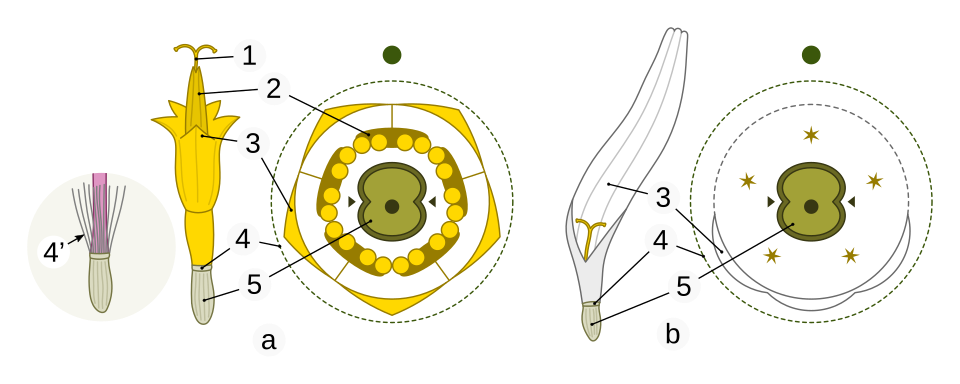
- Disk Florets: Small, tubular flowers usually located in the center of the head.
- Ray Florets: Flowers with a strap-like extension (ligule) that resembles a petal, typically located around the perimeter to attract pollinators.
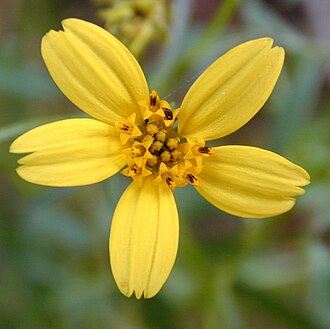
Floral Variations
Not all species follow this dual-floret pattern. Some exhibit specific variations:
- Ligulate heads: These contain only ligulate (strap-shaped) florets.
- Discoid heads: These consist entirely of disk florets, as seen in species like Delairea odorata.
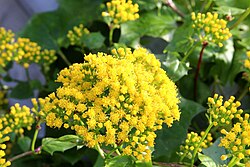
Detailed Floral Anatomy
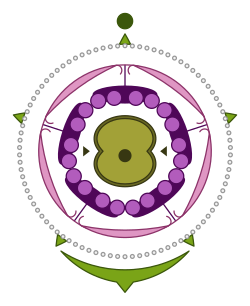
The internal structure of these florets is highly specialized. The calyx (the outermost whorl of a flower) is often reduced or modified into a pappus—a ring of bristles or hairs that aids in seed dispersal by wind. The ovary is inferior, meaning it is located below the other floral parts, and consists of two fused carpels containing a single ovule.
Taxonomy and Classification
The family is organized into 13 subfamilies. While the diversity is spread across many groups, the vast majority of species fall into four primary subfamilies:
| Subfamily | Approximate Percentage of Species |
|---|---|
| Asteroideae | 70% |
| Cichorioideae | 14% |
| Carduoideae | 11% |
| Mutisioideae | 3% |
| Other 9 Subfamilies | 2% |
Ecological Impact and Human Use
Asteraceae species serve critical roles in ecosystems, particularly as late-season food sources for pollinators. However, some species are viewed as invasive weeds in certain regions. For example, the succulent Senecio angulatus is prized for its cut flowers but is considered an invasive weed in New Zealand and Victoria, Australia.
![The twining succulent Senecio angulatus is used for its cut flowers,[46] despite being an invasive weed in some places, such as Victoria, Australia and New Zealand.[47]](/images/0e/38/0e382dcb10a794fad5c52b08c7d402602e2d3236a8c25c11b32242cd122198cf.jpg)
Beyond ecology, the family is widely used by humans for ornamental purposes, such as the bright orange flowers of Pseudogynoxys chenopodioides, and for medicinal applications, including antiparasitic and cardiovascular treatments.
![Pseudogynoxys chenopodioides is used as an ornamental plant for its bright orange flowers.[52]](/images/81/ef/81efc0f19cb8b66e8333fbf038eaac88e53c5a82dcccf504ab992c5adf27bf54.jpg)
Frequently Asked Questions
What is the difference between Asteraceae and Compositae?
There is no biological difference; they are synonyms. Compositae was the original name given to the family in 1740, while Asteraceae is the currently accepted scientific name.
Why is the sunflower family called "composite"?
It is called composite because the "flower" is actually a composite structure made up of many tiny individual flowers (florets) grouped together in a single head.
How old is the Asteraceae family?
The oldest known fossils are pollen grains from Antarctica dating back 76–66 million years, though the family's stem node is estimated to be 88–89 million years old.
Which subfamilies are the most common?
The Asteroideae is by far the largest, containing approximately 70% of all species, followed by Cichorioideae (14%) and Carduoideae (11%).
What is a pappus in Asteraceae?
A pappus is a modified calyx that often takes the form of bristles or hairs, functioning as a parachute to help seeds travel via wind dispersal.