Association Football Tactics: Strategic Principles of Offence and Defence
In theory, association football is a simple game. As former player Kevin Keegan once famously asserted, the goal is simply to "score more goals than the opposition." However, beneath this simplicity lies a complex layer of tactical prowess. For a manager, the ability to organize a team is a primary responsibility; a well-structured strategy can often lead a team of less skillful players to victory over a more talented but disorganized opponent.
Because a team consists of ten outfield players and one goalkeeper, passing is the heartbeat of the game. While youth, amateur, and semi-professional levels focus on the fundamentals, professional football introduces high levels of detail and complexity to gain a competitive edge.
Tactically, the pitch is often viewed in thirds of 35 metres each to help players and coaches reference the different stages of play.
![An association football pitch is in tactical terms often divided into thirds of 35 metres each, given standard size of pitch, so as to reference the three different stages of play.[1]](/images/9c/3d/9c3d2d1c99429439ca418859623c3c15b007d5014286ed4c3039aa1884733cac.png)
Key Facts
- Pitch Division: Tactical analysis often divides the pitch into three 35-metre sections.
- Substitutions: FIFA 11-a-side competitive matches allow up to five substitutions.
- Defensive Depth: A general rule of thumb for the distance between defensive and midfield lines is approximately 16 metres (17-18 yards).
- Core Principles: Width and depth are the fundamental pillars of both attacking and defending.
Player Management and Substitutions
In competitive FIFA 11-a-side fixtures, teams are permitted to substitute up to five players. All players and substitutes must be named before kick-off; any player entering the field who was not in the starting lineup is officially recorded as a substitution.
Rules for non-competitive matches are determined before the game begins. In international friendlies, the number of substitutes is limited only by the available substitution windows and the number of players on the bench, moving away from previous rules that limited these matches to six substitutes.
Attacking Tactics
Offensive strategies focus on manipulating the opponent's shape to create scoring opportunities. Two primary methods include:
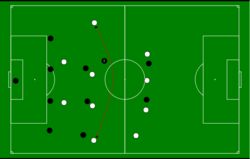
Switching Sides
This involves using a square or cross pass across the width of the pitch to a teammate on the far side. This tactic relieves pressure and forces the defending team to adjust their positions, which often opens up exploitable spaces.
The Through Ball
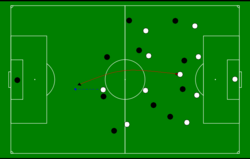
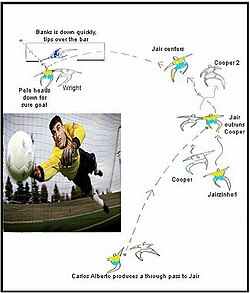
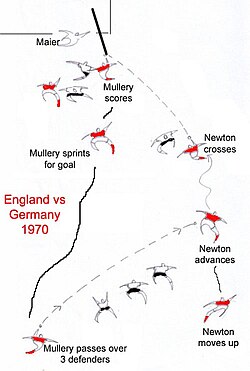
Also known as a slide-rule pass, this tactic targets space identified behind the opponent's defensive line. If the attacker remains onside, it can create a 1-on-1 opportunity with the goalkeeper. Even if intercepted, the attacking team remains in a dangerous position near the goal line, potentially earning a corner or throw-in. Teams with fast attackers frequently use this to exploit slower defensive lines.
A variation is the long through ball—a deep, often aerial pass from the team's own half intended to fly over the defence for a fast forward to chase.
Set Pieces and Special Situations
Set pieces are restarts that allow teams to execute rehearsed plays.
Free Kicks
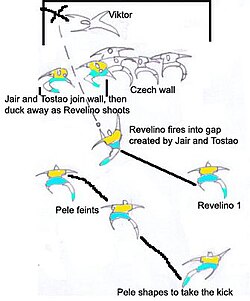
Free kicks occur after a foul. Indirect free kicks require a second player to touch the ball before a goal is scored, while direct free kicks can result in a goal immediately. When a kick is within 35-40 yards of the goal, the defence typically forms a "wall." Attackers may try to blast the ball through, curl it over, or kick it along the ground—though the latter is less effective now that many teams place a defender on the ground behind the wall.
Penalty Kicks
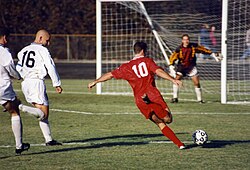
During a penalty, only the taker and goalkeeper are allowed in the penalty area. Defenders often cluster just outside the area to clear deflections or block attacking runs. Goalkeepers frequently employ gamesmanship—such as verbal distractions or extravagant body movements—to unsettle the taker. Notable examples of this include the tactics used by Bruce Grobbelaar (1984), Jerzy Dudek (2005), and Emi Martinez (2022).
Defensive Tactics
Defence is about managing space and neutralizing threats. A critical element is line depth, the distance between the defensive and midfield lines. Defensively minded teams typically maintain shorter line depths, especially when the ball is in their final third.
Defensive Systems
- Zone Defence: Players guard specific areas of the pitch.
- Man-to-Man Defence: A defender follows a specific opponent wherever they move. This allows for tighter marking and is often used to neutralize star players, though it can leave gaps that lead to counter-attacks. This was a hallmark of Italian teams in the 1970s and 1980s.
Historical Tactical Examples
| Tactic | Example Match | Key Outcome/Detail |
|---|---|---|
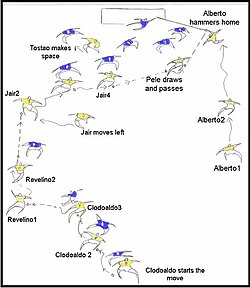
| Combined Width & Depth | Brazil vs Italy (1970 Final) | Penetrated the Italian catenaccio defence. |
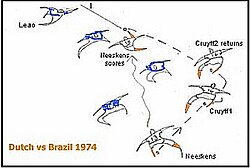
| Wall Pass (One-Two) | Netherlands vs Brazil (1974) | Effective penetration of the opposition. |
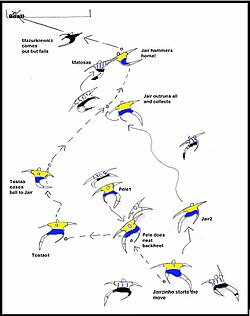
| Three-Man Move | Brazil vs Uruguay (1970) | Coordinated move by Pelé, Tostão, and Jairzinho. |
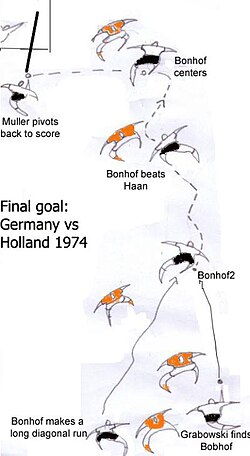
| Diagonal Run | West Germany vs Netherlands (1974) | Rainer Bonhof's run led to the winning goal. |
The 1970 World Cup provided several masterclasses in tactics. Brazil's final goal against Italy is cited as one of the best combined efforts in history, utilizing nearly every player to break the Italian catenaccio (a highly organized defensive system). Other examples include the use of trickery during free kicks against Czechoslovakia, where players joined the defensive wall to create a gap for the shot.
Frequently Asked Questions
What is the difference between a direct and indirect free kick?
A direct free kick can be scored immediately without touching another player. An indirect free kick must be touched by a second player (from either team) before a goal can be legally scored.
How does man-to-man defence differ from zone defence?
In man-to-man defence, a defender is assigned to a specific opponent and follows them across the pitch. In zone defence, defenders are responsible for guarding a specific area of the field regardless of which opponent enters it.
What is a "wall pass" in football?
A wall pass, also known as a "one-two" or "give and go," is a two-man combination where a player passes the ball to a teammate and immediately runs into space to receive it back, bypassing a defender.
What is the purpose of "switching sides" during an attack?
Switching sides uses a long pass to move the ball to the opposite flank. This forces the defending team to shift their entire structure, which often creates gaps and open space for the attacking team to exploit.
How many substitutions are allowed in a standard FIFA competitive match?
Teams are allowed to substitute up to five players during competitive 11-a-side fixtures, provided those players were named before the match began.