Football Defenders: Roles, Formations, and Tactical Evolution
In association football, the defender is an outfield player tasked with the critical responsibility of stopping opposition attacks and preventing the opposing team from scoring. While the primary objective is defensive, the role has evolved from simple goal-protection into a complex tactical asset that can influence the game from the back.
Modern defenders are generally categorized into four main roles: centre-backs, full-backs, sweepers, and wing-backs. While centre-backs and full-backs are staples of almost every modern formation, the sweeper and wing-back roles are more specialized, utilized based on a manager's specific tactical philosophy.
Key Facts
- Centre-backs are the primary line of defense directly in front of the goal.
- Full-backs operate on the flanks, balancing defensive duties with offensive support.
- Sweepers (Liberos) act as a "last man" behind the main defensive line.
- Wing-backs are a hybrid of full-backs and wingers, emphasizing high-intensity attacking.
- Inverted full-backs move into central midfield during possession to create numerical advantages.
The Centre-Back: The Defensive Anchor
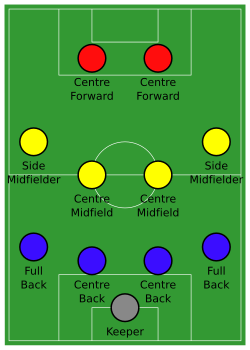
The centre-back, also referred to as a central defender or centre-half, operates in the heart of the defense. Their primary goal is to neutralize the opposing centre-forwards. They achieve this through a combination of blocking shots, tackling, intercepting passes, and contesting headers. Because they frequently engage in aerial duels, centre-backs are often chosen for their height and strength.
In contemporary football, most teams deploy two or three centre-backs. Common formations such as the 4–4–2, 4–3–3, and 4–2–3–1 typically rely on a pair of centre-backs to secure the area in front of the goalkeeper.
The Sweeper: The Tactical "Libero"
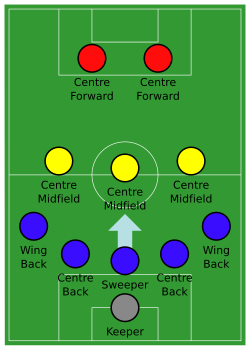
The sweeper, or libero, is a specialized role designed to act as a safety net. This position was pioneered by Austrian manager Karl Rappan in the 1930s as part of his catenaccio (or verrou, meaning "doorbolt") system. Rappan moved a player from the midfield to a position behind the defensive line to protect the back-line and initiate counter-attacks.
Other historical variations include Aleksandr Abramov's "Volga clip" (Volzhskaya Zashchepka) in the 1940s and Giuseppe Viani's "vianema" system at Salernitana. Viani's approach modified the English WM system, allowing a defender to act as a sweeper to help smaller teams compete against wealthier clubs with stronger individual players.
While some sweepers were purely defensive—such as Ivano Blason and Armando Picchi in the 1960s—others were expected to possess superior ball control and passing ability to launch attacks from deep.
Full-Backs and the Evolution of Width
The full-back role evolved as formations shifted. The 3–2–5 (WM formation) pushed full-backs wider, and the subsequent 4–2–4 formation pushed them even further to the flanks to counter opposing wingers and support their own attacking wingers. Brazil's 1950s team, featuring Djalma Santos and Nílton Santos, is credited with pioneering this modern, dynamic style.
Unlike the more static centre-backs, modern full-backs are characterized by their pace, crossing ability, and high work rate. They are also frequently assigned the responsibility of taking throw-ins.
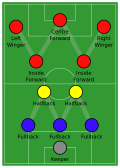
Inverted Full-Backs
A modern tactical variation is the inverted full-back. Instead of staying wide, these players tuck inside during possession to function as additional midfielders. This creates passing triangles with centre-backs and midfielders, helping the team progress the ball through congested central areas. This movement can effectively transform a 4–3–3 formation into a 3–2–2–3 shape, creating a numerical advantage in midfield and pulling opposing defenders out of position.

The Wing-Back: The Hybrid Role
The wing-back is a variation of the full-back with a significantly heavier emphasis on attacking. Combining the duties of a winger and a full-back, this is one of the most physically demanding positions in the sport. Wing-backs are typically among the fastest players on the squad.
They are most commonly used in formations with three centre-backs, such as the 3–5–2 or 5–3–2. However, they can appear in other systems; for example, Jürgen Klopp utilized them in a 4–3–3 at Liverpool to provide width in attack.
Defender Role Summary
| Role | Primary Focus | Key Attributes | Typical Formations |
|---|---|---|---|
| Centre-Back | Goal protection & marking | Height, strength, aerial ability | 4-4-2, 4-3-3, 4-2-3-1 |
| Full-Back | Flank defense & support | Pace, crossing, work rate | Most 4-man backlines |
| Sweeper | Last line of defense | Positioning, reading the game | Catenaccio, 1-3-3-3 |
| Wing-Back | Attacking width & recovery | Extreme pace, stamina | 3-5-2, 5-3-2 |
| Inverted Full-Back | Midfield control | Technical skill, vision | Possession-based 4-3-3 |
Frequently Asked Questions
What is the difference between a full-back and a wing-back?
A full-back primarily focuses on defending the flanks with occasional offensive support, whereas a wing-back is a hybrid role with a much stronger emphasis on attacking and providing width, often playing in a system with three central defenders.
What does a "libero" do?
A libero, or sweeper, plays as the "last man" behind the rest of the defensive line. Their job is to clear balls away from the penalty area and, in some tactical systems, to start counter-attacks using their passing ability.
How does an inverted full-back change a team's shape?
By moving from the flank into the center during possession, an inverted full-back creates a numerical advantage in midfield. This can shift a formation (like a 4-3-3) into a different shape (like a 3-2-2-3) to better control the game.
Which formations typically use two centre-backs?
The 4–4–2, 4–3–3, and 4–2–3–1 formations are common examples that employ two centre-backs to defend the area directly in front of the goalkeeper.
Who pioneered the sweeper role?
Austrian manager Karl Rappan is considered a pioneer of the role, incorporating it into his catenaccio system with the Swiss club Servette during the 1930s.